The 3 Percent Deficit Rule: Theocracy as Logic

By

Satish Chandra Mishra.

Dr. Satish Chandra Mishra, an economist educated at Oxford and Cambridge with senior past experience at the United Nations (UNDP), OECD, and USAID, is the Founder and Executive Director of Arthashastra Institute, Bali, Indonesia.
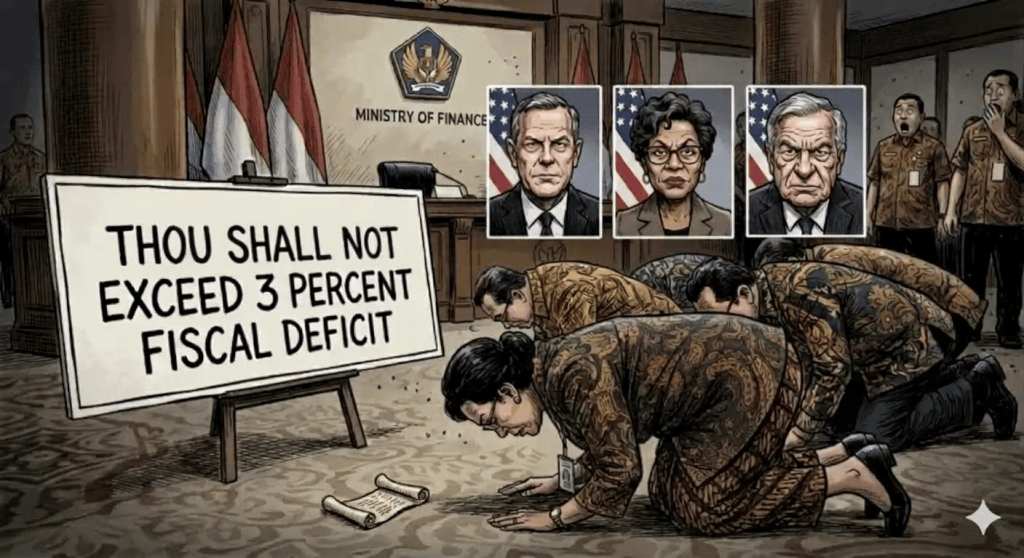


In 1981, Guy Abeille, a French budget official, invented a number. President Francois Mitterrand needed something simple to say to ministers demanding money. Abeille opted for three percent of GDP budget deficit as a working hypothesis and an expedient rule of thumb. No model produced it. No theory backs it. It was all the result of an evening’s improvisation.

No one could have predicted the future of such a hurried conjecture. The IMF and World Bank put it on the global map. They stamped that figure into loan conditions and credibility assessments. Soon a rule of thumb hardened into doctrine. Rating agencies and index makers watched it. Investors took their cue from it. A rule invented in a single fireside evening soon took on all the attributes of a new theocracy.

Ironically, it was the very countries, Germany and France, that within six years of putting it into the Maastricht treaty, waived their own penalties in 2003. Brussels suspended the whole framework again for four straight years through the pandemic and the war in Ukraine.

At the same time, economies that actually closed the gap with the rich world never let this ceiling slow them down in the first place. China ran deficits and directed state investment at whatever scale the moment required, for four decades, and grew from poverty to the world’s second-largest economy without pausing to check a number invented in Paris. South Korea’s own developmental state did not industrialize inside that constraint either. India, its own fiscal responsibility law notwithstanding, has repeatedly missed and revised its deficit targets in the pursuit of growth it judged more urgent than the arithmetic.

In the age of discontinuity unfolding before our very eyes today, it is time to understand that slow to moderate growth, and low fiscal deficit, go beyond a prudent policy choice in the world today. On the contrary, giving up on accelerated growth is the hidden danger of our own imagining and lack of national confidence.

The reasons are very familiar. We live in an age of AI, trillion dollar oligarchies and the end of a unipolar world: something humankind has never witnessed before.

In this fast evolving world, India and Indonesia together have an undeniable claim to form Asia’s second pole to China’s own rise. That claim rests on history, strategic location and economic weight: not on how faithfully either has adhered to a 3 percent budget deficit ceiling.

The 3 percent ceiling also ignores strategic emergencies. Consider defense. Indonesia has spent roughly 0.8 percent of GDP on its military for a decade, the lowest ratio in Southeast Asia, well behind Malaysia and Thailand, a fraction of Singapore’s. A nation with the largest archipelago on earth, contested waters on more than one border, and ambitions to sit at the top table of a multipolar Asia cannot get there on a budget this thin. In similar circumstances most governments would simply choose to ignore the 3 percent rule.

Nor is Indonesia in a weak position to do so. Against the world’s fifty largest economies, its deficit sits somewhere in the middle, not the end. Its public debt, near 41 percent of GDP, is much lower than the average 69 percent for the group.

Indonesia has a population still young while much of the world ages, a democracy that has produced five peaceful transfers of power since 1999, and an excellent fiscal position despite its low tax to GDP ratio. It has earned the right to be more ambitious; to stand up and be counted on the global stage.

But the growth that history demands today cannot only be high. It has also to be inclusive, or it will not hold the country together long enough to matter. A nation spread across thousands of islands and hundreds of ethnic communities does not stay unified on GDP growth alone; it stays unified when growth reaches Ambon as well as Jakarta.

Nation-building and high growth are not two separate projects competing for the same rupiah. They are the same project.

This is generational work, sustained across a change of government and a change of decade the way China’s and Korea’s own commitments were, not one finance minister’s project.

A rule invented in one evening in Paris, enforced ever since by institutions that have never themselves obeyed it, ignored outright by every economy that actually grew enough to matter, was not founded on the dry logic of economic reasoning. It was based on an inherited faith that defies both logic and the needs of the day.

In fact, Abeille’s 3 percent rule was never meant to answer any serious question at all. It was a guess, a hunch, a convenience of the moment that founded an economic theocracy.

Faith and investor confidence worked when the world stood still long enough to turn hunch into prejudice. That is not the case now.

Indonesia does not merely need a different figure to replace 3 percent. It needs to face the emerging global future with logic and reason rather than inherited faith. It is time for an open, rational debate about what kind of fiscal rule actually serves a country ready to stand inside Asia’s second pole, and to breach the technological frontier.

In 1981, Guy Abeille, a French budget official, invented a number. President Francois Mitterrand needed something simple to say to ministers demanding money. Abeille opted for three percent of GDP budget deficit as a working hypothesis and an expedient rule of thumb. No model produced it. No theory backs it. It was all the result of an evening’s improvisation.

No one could have predicted the future of such a hurried conjecture. The IMF and World Bank put it on the global map. They stamped that figure into loan conditions and credibility assessments. Soon a rule of thumb hardened into doctrine. Rating agencies and index makers watched it. Investors took their cue from it. A rule invented in a single fireside evening soon took on all the attributes of a new theocracy.

Ironically, it was the very countries, Germany and France, that within six years of putting it into the Maastricht treaty, waived their own penalties in 2003. Brussels suspended the whole framework again for four straight years through the pandemic and the war in Ukraine.

At the same time, economies that actually closed the gap with the rich world never let this ceiling slow them down in the first place. China ran deficits and directed state investment at whatever scale the moment required, for four decades, and grew from poverty to the world’s second-largest economy without pausing to check a number invented in Paris. South Korea’s own developmental state did not industrialize inside that constraint either. India, its own fiscal responsibility law notwithstanding, has repeatedly missed and revised its deficit targets in the pursuit of growth it judged more urgent than the arithmetic.

In the age of discontinuity unfolding before our very eyes today, it is time to understand that slow to moderate growth, and low fiscal deficit, go beyond a prudent policy choice in the world today. On the contrary, giving up on accelerated growth is the hidden danger of our own imagining and lack of national confidence.

The reasons are very familiar. We live in an age of AI, trillion-dollar oligarchies and the end of a unipolar world: something humankind has never witnessed before.

In this fast evolving world, India and Indonesia together have an undeniable claim to form Asia’s second pole to China’s own rise. That claim rests on history, strategic location and economic weight: not on how faithfully either has adhered to a 3 percent budget deficit ceiling.

The 3 percent ceiling also ignores strategic emergencies. Consider defense. Indonesia has spent roughly 0.8 percent of GDP on its military for a decade, the lowest ratio in Southeast Asia, well behind Malaysia and Thailand, a fraction of Singapore’s. A nation with the largest archipelago on earth, contested waters on more than one border, and ambitions to sit at the top table of a multipolar Asia cannot get there on a budget this thin. In similar circumstances most governments would simply choose to ignore the 3 percent rule.

Nor is Indonesia in a weak position to do so. Against the world’s fifty largest economies, its deficit sits somewhere in the middle, not the end. Its public debt, near 41 percent of GDP, is much lower than the average 69 percent for the group.

Indonesia has a population still young while much of the world ages, a democracy that has produced five peaceful transfers of power since 1999, and an excellent fiscal position despite its low tax to GDP ratio. It has earned the right to be more ambitious; to stand up and be counted on the global stage.

But the growth that history demands today cannot only be high. It has also to be inclusive, or it will not hold the country together long enough to matter. A nation spread across thousands of islands and hundreds of ethnic communities does not stay unified on GDP growth alone; it stays unified when growth reaches Ambon as well as Jakarta.

Nation-building and high growth are not two separate projects competing for the same rupiah. They are the same project.

This is generational work, sustained across a change of government and a change of decade the way China’s and Korea’s own commitments were, not one finance minister’s project.

A rule invented in one evening in Paris, enforced ever since by institutions that have never themselves obeyed it, ignored outright by every economy that actually grew enough to matter, was not founded on the dry logic of economic reasoning. It was based on an inherited faith that defies both logic and the needs of the day.

In fact, Abeille’s 3 percent rule was never meant to answer any serious question at all. It was a guess, a hunch, a convenience of the moment that founded an economic theocracy.

Faith and investor confidence worked when the world stood still long enough to turn hunch into prejudice. That is not the case now.

Indonesia does not merely need a different figure to replace 3 percent. It needs to face the emerging global future with logic and reason rather than inherited faith. It is time for an open, rational debate about what kind of fiscal rule serves a country ready to stand inside Asia’s second pole and to breach the technological frontier.
Indonesia’s Financial Shock of 2026: What the Rating Agencies Got Wrong

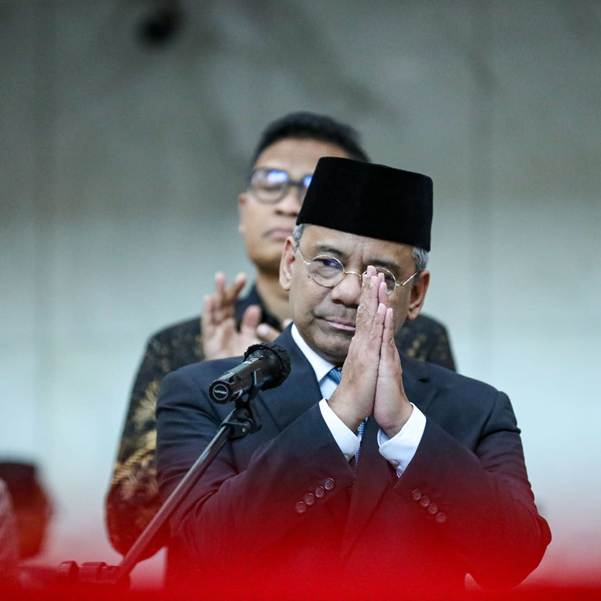
Indonesia’s Finance Minister Suahasil Nazara greeting the audience

Source: https://www.cnbc.com/2026/09/16/indonesia-finance-minister-msci-prabowo-.html


By

Satish Chandra Mishra

Dr. Satish Chandra Mishra, an economist educated at Oxford and Cambridge with senior past experience at the United Nations (UNDP), OECD, and USAID, is the Founder and Executive Director of Arthashastra Institute, Bali, Indonesia.


A Glass More Than Half Full

Indonesia’s story is one of the more remarkable transitions of our era. Within a single generation, the country has built the world’s third-largest democracy, reduced poverty from roughly a quarter of the population during the 1997–1999 Krismon crisis to 8.25 percent by September 2025, and decentralised political power to more than 500 popularly elected regional governments. Unemployment ended 2025 below 4.8 percent. Government debt stands at approximately 40 percent of GDP. Inflation ended 2025 below 3 percent. GDP growth has averaged close to 5 percent per annum for two decades, the 2020 pandemic contraction aside, and reached 5.11 percent in 2025. By any serious comparative standard, these are impressive fundamentals. But such credentials were not enough to save Indonesia from a concerted attack from the heavy hitters of the investment rating agencies and global index providers. II.  The Engineered Shock In a six-week window between late January and early March 2026, Indonesia experienced one of its most severe episodes of capital market instability in recent memory. The sequence merits scrutiny. On 22 January, President Prabowo delivered a well-received address at Davos, outlining Indonesia’s investment ambitions and the Danantara architecture. Five days later, MSCI froze index changes for Indonesian stocks and warned that it could reclassify Indonesia from Emerging Market to Frontier Market status, a demotion that would oblige emerging-market index funds to sell Indonesian equities. The next day the Jakarta Composite Index (JCI) fell more than 8 percent intraday, triggering a mandatory trading halt; a second halt followed the day after, and approximately USD 80 billion in market capitalisation was erased over the two sessions. On 5 February, Moody’s revised Indonesia’s sovereign outlook to negative. Fitch followed in early March with a negative outlook. The reasons offered ranged across market shallowness, governance anxieties over the dismissal of Finance Minister Sri Mulyani, concerns about Danantara’s management, and ancillary grievances including cabinet size and the school meals programme. The timing invites scrutiny. Whether by design or by the constrained logic of global financial markets reacting simultaneously to the same inputs, the effect was a sharp public rebuke at the precise moment Indonesia was projecting confidence and soliciting capital. III. 

The Credibility Problem

Any serious assessment of January 2026 must be set against the agencies’ wider record. That record is, to put it plainly, poor. The 1997–1998 Asian financial crisis is the most conspicuous example. Having failed entirely to anticipate the crisis, the major agencies then downgraded the affected economies more aggressively than the deterioration of their fundamentals warranted, amplifying panic rather than providing analytical ballast. Enron and Parmalat both carried investment-grade ratings until days before their collapses. The 2008 global financial crisis confirmed what the Asian crisis had suggested: the agencies systematically misrated vast quantities of subprime mortgage-backed securities, a finding the US Financial Crisis Inquiry Commission described as central to the financial meltdown. The conflict of interest embedded in the ‘issuer pays’ model had not been reformed — merely obscured. The structural bias toward procyclicality and herd behaviour visible in those failures is present in the January 2026 Indonesian episode. The question is not whether Indonesia has genuine structural challenges. It does. The question is whether the agencies’ interventions reflected a rigorous assessment calibrated to Indonesia’s specific historical and institutional context. The evidence suggests they did not.

The MSCI Question

A central irony of the MSCI intervention is that the structural characteristics it cited — market shallowness, concentrated ownership, limited free float — have been comprehensively documented for decades. A landmark 1999 World Bank study established that fifteen Indonesian family groups controlled 61.7 percent of total stock market capitalisation, and the single largest family group alone accounted for 16.6 percent. This architecture has been known to any serious analyst for more than twenty-five years. If the concerns were genuine and longstanding, why were they escalated into a market-destabilising public threat within days of the President’s Davos appearance, rather than addressed through the constructive regulatory engagement MSCI ordinarily employs? Indonesia’s Financial Services Authority (OJK) is aware of the free-float and transparency deficits and has set out reform targets in its Capital Market Development Roadmap. Meaningful reform of entrenched corporate ownership structures takes years, not months. A credible analytical institution would acknowledge this reality. Threatening destabilising reclassification on a politically compressed timetable serves no remedial purpose.

  Indonesia Is Not Greece, and It Is Not Argentina

The spectre implicit in the agencies’ interventions is sovereign default or fiscal crisis. This possibility deserves to be examined honestly, and honestly it deserves to be rejected. Indonesia has serviced its debts in full since the rescheduling that followed the 1997–1998 crisis. Its debt-to-GDP ratio of approximately 40 percent is well within any sustainable analytical range and is far lower than that of many developed economies carrying AA or AAA ratings. Its banking sector, reformed after the catastrophic failures of 1997–1998, holds capital well above regulatory minimums. Greece’s crisis arose from fiscal excess within a monetary union that removed the exchange rate mechanism, compounded by deliberate financial engineering to obscure public finances. Argentina’s recurrent crises reflect a specific history of monetary instability and creditor disputes that bears no structural resemblance to Indonesia’s situation. Drawing implicit analogies between Indonesia and these cases through rating outlooks and index signals is not responsible analysis. Rating agencies are well-suited to assess debt default probabilities in economies with stable institutional trajectories. They are structurally ill-equipped to evaluate the political economy of systemic transformation — which is precisely what Indonesia is navigating.

Toward an Honest Dialogue Among Equals

The January 2026 shock bears the hallmarks of an intervention whose timing and framing served purposes beyond objective credit analysis. What is clear is that the effect was a significant economic penalty administered at a moment of political transition — and that the analytical justifications do not withstand serious scrutiny. Indonesia, for its part, has genuine reform obligations. Greater stock market transparency, improved free-float ratios, a clearer governance and enterprise plan for Danantara, and a persuasive medium-term fiscal framework are all within reach. These reforms should be pursued not to placate foreign rating agencies, but because well governed institutions serve Indonesia’s own citizens first. The rating agencies retain a legitimate function. Reliable, impartial sovereign assessment channels capital toward creditworthy borrowers and signals genuine fiscal mismanagement. These functions matter. But they depend on credibility the agencies have repeatedly squandered — through the Asian crisis, the corporate rating scandals of the early 2000s, and the catastrophic misratings of 2008. What credibility remains rests on market convention, not demonstrated accuracy. What is required is an honest dialogue between Indonesia and the institutions that judge it — conducted between equals rather than between examiner and examinee, and one that takes a quarter-century of demonstrated institutional resilience seriously rather than treating each governance challenge as though it occurred in an institutional vacuum. The agencies aspire to teach. Perhaps, in the process, they will learn. That would be the first step toward the trust that both sides currently lack — and that both sides genuinely need.

The governance of central banks and monetary policy committees: are they too narrowly constructed?

A modern central bank usually relies on ‘monetary policy committees’ or MPCs (albeit with different names, such as boards and councils) that play a pivotal role in the conduct of monetary policy. The collective deliberations of the MPCs are held regularly throughout the year and are geared towards recommendations (either by vote or consensus) on the setting of the policy rate.

The core principle is that the practice of monetary policy – and hence the role of the MPCs – should be free of political pressure. Central banks should be accountable but have operational independence in pursuit of their primary goal of maintaining price stability.

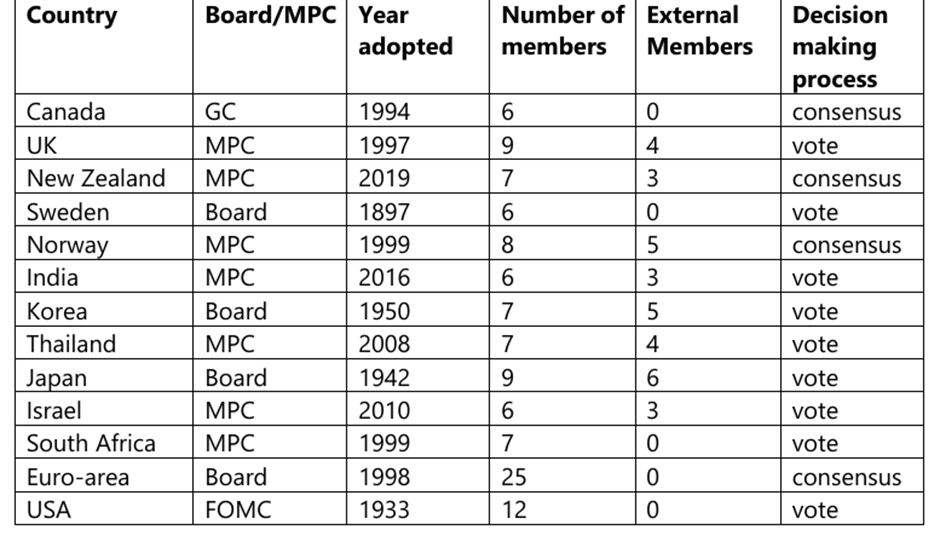
The size of the MPCs and the decision-making structure varies across countries and regions as shown below (Table 1). The MPCs are dominated by internal bank staff and economists, and, in some cases, with representatives from the corporate world. There are also cases in which there are no external members. There is no scope for representatives of workers and employers and representatives from civil society to be part of the membership of MPCs.  

Table 1: Composition of MPCs, selected central banks

Source: https://rbareview.gov.au/sites/rbareview.gov.au/files/2023-04/rbareview-paper-gai.pdf

The degree of gender parity is low in a typical MPC. India is a conspicuous example – see Exhibit 1. Would improving gender parity improve the quality of monetary policy as measured in terms of maintaining price stability? Research findings on this are ambivalent, but the aim is to use an august institution to promote gender equality which is a core element of the global development agenda.

Exhibit 1: Where have all the women gone? The Governor of the Reserve Bank of India meets with members of the MPC

Despite the restrictions placed on central banks that restrain them from broad-based community-level engagement, these entities have tried to overcome such restraints by a transparent communications strategy in which deliberations of MPCs are made public. Furthermore, in recent years central banks have moved away from a preoccupation with price and financial stability. One important example of this trend is a new form of engagement via international cooperation among central banks, most notably supporting climate action as a key aspect of monetary policy. This is best illustrated by the ‘Network for Greening the Financial System’ (NGFS) which now has 134 members.

Financial inclusion is another way in which central banks are changing their engagement with workers and employers and the broader community. As is well known, the aim of financial inclusion is to incorporate the unbanked segment of the population – which can be quite large in developing countries – into the formal financial system. A 2024 meta-analytical assessment shows that ‘…financial inclusion outcomes reflect small, positive and statistically significant average effects on consumption, income, asset and other poverty-related indicators. Given this finding, it is noteworthy to point out that the ‘Alliance for Financial Inclusion’ reports that there are now 84 central banks across the world that have formally integrated financial inclusion in their mandates.

Financial inclusion creates synergies between monetary policy and poverty reduction strategies as well as the agenda of transition to formality. Central banks have discovered that financial inclusion, by encouraging formalization, improves the monetary transmission mechanism and thus strengthens the effectiveness of monetary policy. This in turn creates the space for workers and employers as well as civil society at the domestic level to engage with monetary authorities in areas that go beyond price stability.

Counting the missing billions: taking care when reporting on money laundering

In reporting on financial and economic statistics, it is important to distinguish between stocks and flows as well relative and absolute numbers. Stocks (accumulated value of a variable over a given period) typically catches public attention in a way that annualised data usually do not. Similarly, relative figures usually turn out to be a lot more modest than absolute numbers.  I will illustrate these points by drawing on the Bangladesh experience.

In Bangladesh, media reports conflate typically stocks and flows. The currently popular citation is that US$ 150 billion has been siphoned off to various overseas havens by politically connected individuals over the last 15 years. Some media reports proceed to express stock estimates of money laundering as a proportion of flow data (annual GDP).  This can befuddle the lay reader.

The task of tracking money laundering falls on the Bangladesh Financial Intelligence Unit (BFIU).  I suspect, it is a small, under-resourced unit within the Bangladesh Bank (the best talent and resources probably go to units dealing with monetary policy). This does not make BFIU estimates less reliable than other estimates, but alternative estimates of annual rates of money laundering do exist and they ought to be acknowledged in public discourse. Transparency International Bangladesh (TIB) in the recent past has come up with an annualised figure of USD 3 billion, while the Washington-based Global Financial Integrity Institute (GFI) reported annualised figures of USD 8.7 billion. They note that most money laundering activities occur through trade mis-invoicing. One should not also overlook the use of the humble, but time-honoured, Hundi, as a source of money laundering. The bank heist by one of Bangladesh’s richest men is sensational but not a very common source of money laundering.

I personally prefer the use of annualised figure because they are easy to compare over time and across countries. Also, stock estimates can be made to assume astronomical magnitudes. For example, I understand that some Bangladeshi economists have come up with a stock estimate of money laundering for the 1972-2022 period. This understandably dwarfs the size of money laundering that are being reported now.

There is the issue of relative vs absolute numbers. Annualised data on money laundering can be expressed as a proportion of a country’s GDP. This is what the UN does. Another advantage is that this relative number offers an indication of the potential output loss from money laundering. In the case Bangladesh, a back-of-the envelope estimate (which is based on the annualised estimate of USD150 billion) suggests that it is 3.2% of GDP. The global norm ranges between 2-5% of GDP.

Has the incidence of money laundering has gotten worse over time? Here, the changes in country-specific ranking anchored in an ‘anti-money laundering index’ for 152 countries by a Swiss organisation, can be useful (1= worst, 152= best). BD ranked 82 in 2017, but then fell below 40 in later years before recovering to 46 in 2023. Why this has happened merits further investigation.

Finally, it is worth noting that, however measured, money laundering represents massive waste of resources enriching some at the expense of poorer nations. To be resolved, it needs global cooperation. Why is it that Singapore and London, for example, allow themselves to become havens for laundered funds? Indeed, London has been described as …’the main nerve centre of the darker global offshore system that hides and guards the world’s stolen wealth’. If the authorities there camp down on such havens (which they can), the incentive to park illicit funds abroad by crooks and criminals from developing countries will be significantly diminished.

.’