Offers succinct commentary on topical issues that cut across both rich and poor countries. Entails critical insights on poverty, inequality, health, macro-policies and many more
Today (11 September 2026) marks the 25th anniversary of 9/11. The worst terrorist attack on American soil on September 11, 2001 brought trauma and tragedy to a nation that simply could not believe that there are people in the Muslim world who ‘hate us’ to the point where a determined and deadly group was prepared to engage in ‘suicide terrorism’. Nearly, 3000 innocent lives were lost when the Twin Towers in Manhattan, NY, collapsed as two aircraft slammed into the famous buildings. In response, a vengeful superpower engaged in a global war on terror that persisted for two decades, cost trillions of dollars, and brought untold misery to millions. An American tragedy became a global tragedy.
An estimated 3.6-3.8 million people have died indirectly in post-9/11 war zones, bringing the total death toll to at least 4.5-4.7 million and counting.
At least 940,000 people have died due to direct war violence, including civilians, armed forces on all sides, contractors, journalists, and humanitarian workers.
The cost of the post-9/11 wars in Iraq, Afghanistan, Pakistan, Syria, and elsewhere totals about $8 trillion (approximately 25 per cent of the current size of the US economy). This does not include future interest costs on borrowing for the wars.
Who will hold a superpower accountable for the colossal crimes that have been committed against humanity – and crimes that continue to be committed? Only its elected officials and citizens, as voters and conscientious members of society, can fulfill such much-needed responsibilities. One wonders whether the requisite political transformation will ever take place in the USA.
There are theories that Baa, Baa, Black Sheep reflects historical wool taxes in medieval England, particularly taxes associated with the wool trade. In that reading:
“One for the master” refers to the Crown or ruling authority.
“One for the dame” refers to a local landowner or manor.
“And one for the little boy who lives down the lane” is seen as the small share left for ordinary people.
However, historians don’t agree that this was the rhyme’s original meaning. The earliest printed versions do not explicitly mention taxation, and there is limited evidence directly linking the rhyme to a specific tax policy. Many nursery rhymes attract political interpretations after the fact because their simple language lends itself to symbolism.
So it’s fair to say the rhyme has been interpreted as a commentary on heavy taxation and unequal distribution of wealth. Still, it would be overstating the evidence to say it was definitely written for that purpose.
If former UK Prime Minister Keir Starmer read the rhyme as a warning about taking too much from producers while leaving them with too little, then it becomes a political lesson about the consequences of overburdening farmers or other productive sectors.
Yes, taxes and policy reversals (“U-turns”) are often politically damaging because they can create a sense that a government is either:
Taking more from people than expected, or
Lacking a clear, consistent plan.
That’s one reason nursery-rhyme metaphors can resonate in political debate. If someone interprets Baa, Baa, Black Sheep as being about producers handing over much of what they earn, it becomes an easy shorthand for arguments about taxation, especially among farmers or other groups who feel overburdened.
Of course, supporters of higher taxes may argue they’re necessary to fund public services, while critics argue they can discourage investment and productivity. Similarly, what opponents call a “U-turn” might be described by supporters as a pragmatic response to changing circumstances.
So the point here is less about the literal meaning of the rhyme and more about its symbolic relevance: a warning that policies affecting those who create wealth or produce goods can have significant political consequences if they’re perceived as unfair.
Public reaction to government U-turns is often mixed, but in the case of controversial tax policies affecting farmers, there was significant public and sector-specific backlash before some reversals occurred.
Farmers organized protests, including tractor demonstrations in Westminster, arguing that proposed inheritance tax changes would threaten family farms and make passing farms to the next generation more difficult.
Rural communities and farming organizations campaigned heavily against the policy, and ministers later said they had “listened closely” to those concerns when modifying the proposals.
The National Farmers’ Union welcomed the later changes as a relief for many farming families, suggesting the revised policy reduced some of the anxiety created by the original proposal.
Critics of the government argued that repeated policy reversals created an image of indecision and poor planning. Opposition parties portrayed the U-turns as evidence that ministers had misjudged public opinion.
Some Labour MPs reportedly became frustrated as well, with reports of concern inside the governing party about having to retreat from policies after defending them publicly.
More broadly, U-turns tend to produce two competing reactions: supporters see them as a government listening and adapting to concerns, while critics see them as a sign that the policy was flawed from the start. The balance between those views often depends on people’s existing political outlook and the specific issue involved.
However, Starmers downfall was not only these U-turns but his undignified stance as a so called human rights lawyer towards the Gaza genocide. When he was asked about the shutting of water and electricity in Gaza, his stance was pathetic as his reply was “Israel has the right to defend itself “
The U-turn here would have earned him a lot of respect! If not protecting his position as a Prime Minister.
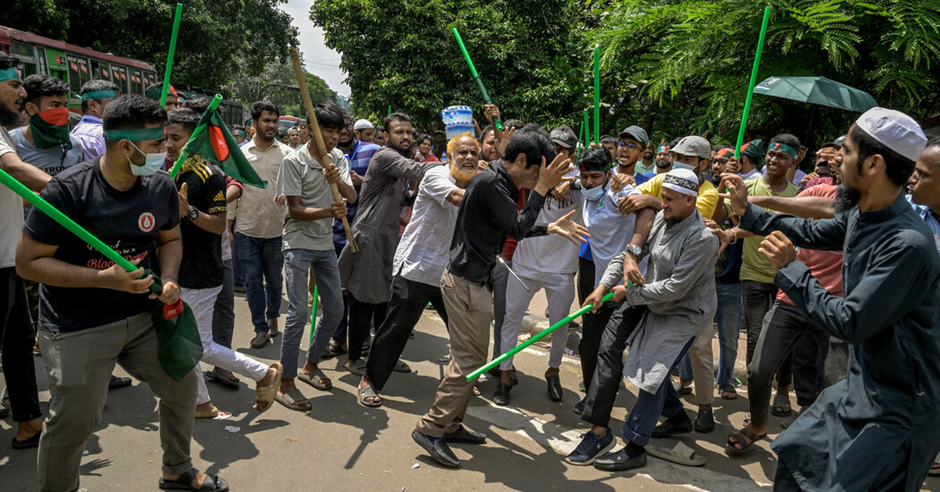
Bangladesh has endured political upheaval before. What made the recent interim period stand out was not protest or dissent, but the scale and normalisation of mob violence—vigilante attacks, public beatings, and political reprisals carried out openly. According to the European Agency for Asylum, Bangladeshi human rights organisations “…documented the highest rates of deaths due to mob beatings in a decade”. This did not happen because Bangladesh suddenly became more violent. It happened because, at a critical moment, authority hesitated. That authority was led by Professor Yunus, a Nobel laureate.
Interim governments exist for one primary reason: to stabilise the state during transition. They are not ceremonial caretakers. They govern during the most fragile phase of political life, when early decisions shape long‑term outcomes. In Bangladesh, that responsibility was not met.
Authority existed — and that is the point
The most important fact in this debate is often overlooked: the Bangladeshi state did not collapse during the interim period. Police forces remained in place. Courts functioned. The administration operated. International recognition was strong. Authority existed.
Political philosopher Hannah Arendt makes a distinction that is crucial here. Power, Arendt argues, rests on legitimacy and collective acceptance. Violence appears when that power is weakened or abdicated. When violence spreads, it is usually not a sign of popular empowerment, but of authority failing to act.
Seen this way, Bangladesh’s experience points to omission rather than inevitability. Leaders do not need to encourage violence to be responsible for its spread. Hesitation, delayed enforcement, and mixed signals are enough. In fragile institutional settings, restraint is rarely read as wisdom. It is read as permission.
How perpetrators of mob violence learned they enjoyed impunity
Sociologist Charles Tilly helps explain how this dynamic unfolds. He shows that mob violence is shaped by signals and incentives, not chaos. People watch what happens after the first incident. If early violence is punished quickly and consistently, it often subsides. If it is not, others follow.
Bangladesh fits this pattern. Analysts inside the country have pointed out that mob violence did not previously occur at this scale. Its expansion followed a familiar sequence: early incidents went insufficiently addressed, expectations of impunity formed, imitation followed, and violence became normalised. Each unpunished act lowered the threshold for the next.
Once this process begins, restoring order becomes far more difficult. By the time condemnations are issued, the street has already learned that enforcement is uncertain.
This was not inevitable
Defenders of the interim period often argue that the violence was unavoidable given the intensity of political change. That argument is weak. Transitions are volatile everywhere, but they also offer a narrow window where clear boundaries can be set. Early arrests, visible prosecutions, and unambiguous messaging can quickly shape behaviour. Bangladesh missed that window.
This is not a cultural story, and it is not about importing ideas from abroad. Modern democracies do not practise vigilantism. The issue is contextual misjudgement—applying restraint suited to strong institutional environments in a weak one.
The lesson and an anti-thesis of Arendt and Tilly
Bangladesh’s experience offers a stark lesson. Interim governments wield real power, even if temporarily. When that power is not exercised clearly and early, violence fills the gap. Arendt explains why violence signals failed authority. Tilly explains how inaction turns disorder into routine. Together, they show why mob violence in Bangladesh was not fate, but the result of a missed moment—and why accountability for that failure matters.
The above would partially explain according to Arendt and Tilly. The real reason is the disposition of the central character of the mob violence, Professor Yunus. It may sound preposterous but reflecting on his rule, or rather misrule, one can easily argue, that he came with a personal vendetta against the previous Government. He seized the opportunity to expand his own agenda of the Grameen group taking over many sectors. The mob violence was a “false flag” for him!
The American author William Irving created a famous fictional character called Rip Van Winkle who drinks a magic potion and wakes up decades later to find that his personal world and the world around him have changed greatly. Winkle observes both positive and negative changes.
Imagine that the magical properties of Rip Van Winkle are embodied in an 18-year-old Rahim. He is a staunch Bengali nationalist. Rahim is a witness to epochal events: the Bangladesh War of Liberation that started on 26 March 1971 and ended on 16 December 1971; the emergence of Bangladesh as a new nation; the devastating famine in 1974 in which more than a million people perished; a highly contentious political experiment of a one party state that lasted between January and August 1975; the gruesome assassination of Sheikh Mujib and most members of his family in mid-August 1975, the founding father of the nation and its first elected Prime Minister; the trauma and turmoil that followed.
In a state of despair and desperation that his expectations of a peaceful and prosperous Sonar Bangla (Golden Bengal) were dashed, Rahim drinks a magic potion and falls into a long and deep slumber. He wakes up in contemporary Bangladesh. He is now an old man well past 70. What does he see? What will he say?
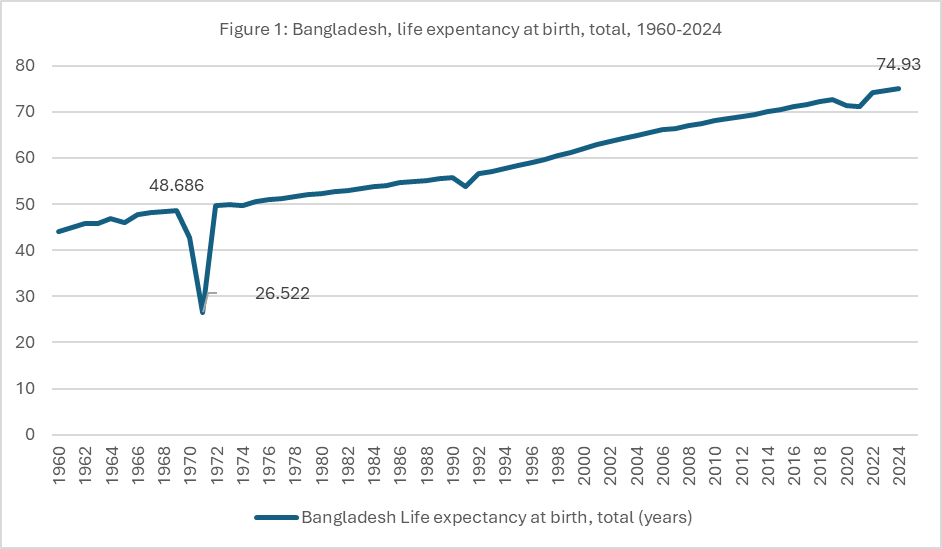
As a staunch Bengali nationalist, he would certainly be elated at the economic progress that has taken place. The average Bangladeshi today can expect to live around 75 years. It is difficult to imagine that life expectancy in Bangladesh in 1971 plummeted to 27 years (!) during the War of Liberation before recovering to 49 years in 1972 – see Figure 1.
Rahim would also note that such statistics is a powerful vindication of the view that huge losses of life and displacement of people took place during the War of Liberation and one that was primarily caused by genocidal acts of the Pakistan army and its local collaborators. He would lament the fact that those who committed such war crimes were not held accountable for such gruesome acts. The Pakistani soldiers and army officers who occupied Bangladesh as perpetrators of violence against innocent civilians between March and December 1971 were given a safe return to Pakistan (thanks to the magnanimous gesture of the Indian government of the time). Some local collaborators were tried, found guilty and given the death penalty, but most escaped any form of accountability. Rahim must wonder: when will this culture of immunity end?
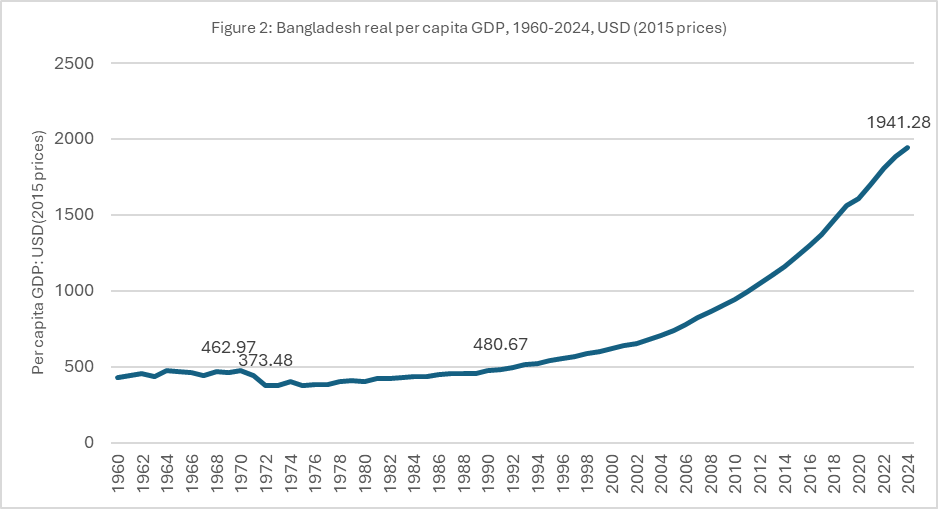
If one uses another basic metric of living standards, per capita real GDP, Rahim would simply be stunned at the scale of the progress that has taken place. Between 1969 and 1972 per capita real GDP contracted by 19 per cent. Today, per capita GDP is 5.2 times the level that prevailed in 1972 – see Figure 2. Furthermore, as a recent World Bank assessment (October 2025) notes:[2]
Between 2010 and 2022, real GDP grew by 6.6 percent annually, nearly doubling GDP per capita and reducing poverty at the extreme national poverty line (lower) from 12.2 to 5.6 percent and at the absolute national poverty line (upper) from 37.1 to 18.7 percent. Multidimensional poverty also declined from 46.8 to 21.3 percent, alongside improvements in health, education, sanitation, and electricity access.
Rahim can barely reconcile these numbers with the Bangladesh that he witnessed in 1971-72 and during the famine of 1974. Poverty was endemic. He would heartily endorse the view that “Bangladesh has lot to be proud of”.[3] He can say that he comes from an era in which Bangladesh was denigrated as a “basket case” and there was extraordinarily little to be proud of. This, he would proclaim with a deep sense of satisfaction, is a vindication of all the optimists – most notably Mujib and his generation of nationalist politicians and fellow travellers – who fervently believed in the idea of Bangladesh long before it became a reality. Indeed, he would go even further and say that Bangladesh would, today, be worse off had it remained as a province of Pakistan. In core areas of well-being, Bangladesh as an independent nation has outperformed Pakistan. For example, life expectancy in Bangladesh is about ten years more than Pakistan, while its literacy rate is twenty percentage points higher than Pakistan’s.[4]
Yet, like Rip Van Winkle, Rahim must highlight adverse changes. To start with, he would find the capital city Dhaka clogged with traffic and bursting at the seams with high rise apartments and buildings. The air quality in Dhaka is among the worst in the world.[5] He is alarmed at a report that about 30 percent of the population face heightened climate risk. The Dhaka that he left in the 1970s was much poorer but quieter and cleaner. Global warming and its deleterious consequences were not part of the policy agenda.
Rahim would be aghast at the grotesque levels of inequality and the endemic corruption that pervades everyday life. One study, based on a ‘corruption perception index’ (CPI), finds that “the global average score out of 100 (which is best) is 42, while Bangladesh’s score is 24—which is 18 points lower than the global average score and 21 points lower than the Asia Pacific region’s average score of 45”.[6] Furthermore, the same study finds that Bangladesh’s ranking since 2023 has not changed, despite major political transitions.
Despite notable socio-economic progress, Rahim would note that new challenges have emerged. The latest reports suggest that in the post-2022 period, both overall and extreme poverty have increased in Bangladesh.[7] Growth has slowed down, while the global political and economic climate, following the war on Iran, has worsened. Bangladesh, like many countries in the world, faces a fuel crisis which is being driven by external factors.
It is on the political front that Rahim has the most concerns. He was shocked to realize that Sheikh Hasina, who was reportedly a timorous, soft-spoken housewife, turned out to be a ruthless politician who became the longest serving female Prime Minister in the country’s history. At the same time, her attempt to hold on to political power by force made her vulnerable. She was ousted in a violent uprising in August 2024 and was forced into exile. There is a judicial ruling against her that entails the death sentence for committing crimes against humanity. Rahim would be deeply saddened to note how Hasina, in a bid to deify her father’s memory, ended up destroying his legacy. The Awami league that Rahim knew is now in the political wilderness from which it might never return.
Rahim is left wondering how the new Bangladesh will evolve. The key power brokers, now led by the Bangladesh Nationalist Party (BNP), as well as the official Opposition, led by Jamaat, represent a constellation of forces that are keen to construct a durable historical narrative that will be inhospitable to the values and principles that animated a generation who fought selflessly for the idea of Bangladeshi nationhood. In that fundamental sense, Rahim wonders whether Bangladesh has really progressed beyond the 1970s. A political culture of immunity, violence and vendetta that were so evident in the mid-seventies remain ever-present dangers.
Viral Empire: How Microbes Reflect Human Power Structures
By Aunul Islam, PhD (Imperial College, UK)
Modern power no longer operates primarily through borders or armies but through networks—supply chains, information flows, technology, and interdependence. In this sense, contemporary geopolitics resembles microbial systems more than traditional empires.
Microbes exert influence through connectivity, adaptation, and asymmetry. Small organisms can destabilise large systems by exploiting vulnerabilities, just as minor interventions can trigger outsized effects in a networked world. Power depends less on scale than on speed, positioning, and resilience.
Like microbes, political systems evolve under pressure. Expansion produces resistance, cooperation strengthens survival, and rigid structures fail in volatile environments. The greatest risk is not defeat by rivals but internal systemic collapse.
Seen this way, global power functions as a living ecosystem—adaptive, fragile, and continuously contested rather than permanently controlled.
In the above narration, the scientific expressions like mutation, virulence in the microbes behaviour have been translated in the business and strategic literature to relate them to humans. But this literature lacks sufficient emphasis on the destruction through wars and conflicts by humans on core aspects of their own life. This entails destruction of properties and other supporting elements such as hospitals, energy production etc.
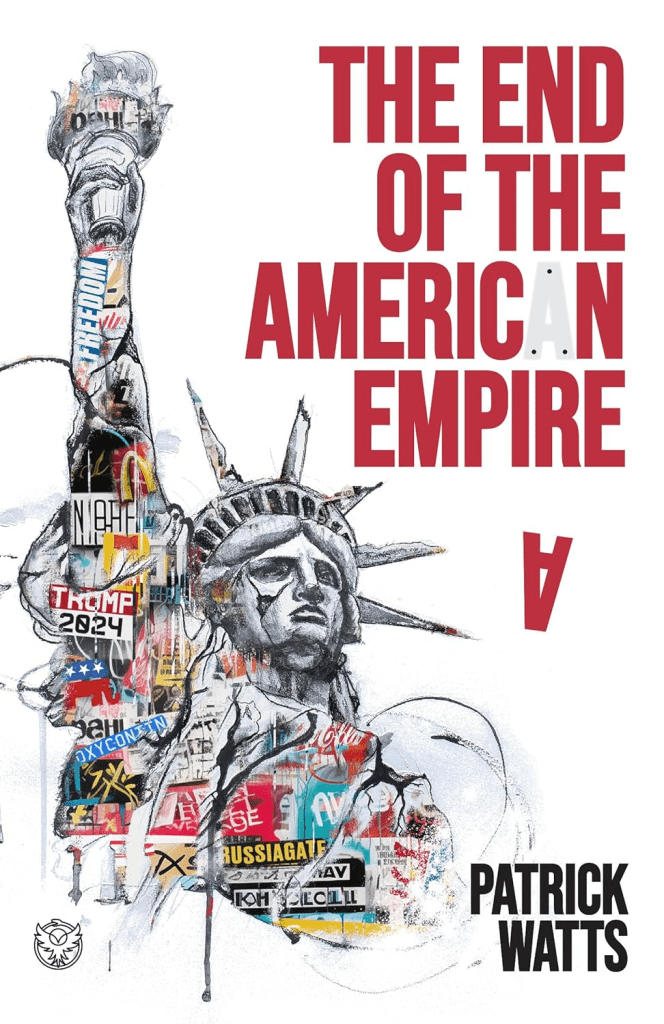
At this juncture, the anti-thesis to above narratives is that human empire or a Supreme Empire do not adhere to the simple modalities in present day geopolitics. The present empire dictated by a lone country (USA) along with its lackeys is no longer a traditional empire as depicted previously. The viral empire like that of the bubonic plague or even the Covid-19 virus are now long forgotten past. The present Super Empire is best described as the worst of its kind, genocidal in nature and any other terms that can be used to describe it, where new words have to be added to the dictionary.
The last hope of the present world order is that the super empire does behave like a viral empire and succumbs to its own systemic collapse. Maybe this will happen in the next few decades!


 Reflections on development and governance
