The American author William Irving created a famous fictional character called Rip Van Winkle who drinks a magic potion and wakes up decades later to find that his personal world and the world around him have changed greatly. Winkle observes both positive and negative changes.
Imagine that the magical properties of Rip Van Winkle are embodied in an 18-year-old Rahim. He is a staunch Bengali nationalist. Rahim is a witness to epochal events: the Bangladesh War of Liberation that started on 26 March 1971 and ended on 16 December 1971; the emergence of Bangladesh as a new nation; the devastating famine in 1974 in which more than a million people perished; a highly contentious political experiment of a one party state that lasted between January and August 1975; the gruesome assassination of Sheikh Mujib and most members of his family in mid-August 1975, the founding father of the nation and its first elected Prime Minister; the trauma and turmoil that followed.
In a state of despair and desperation that his expectations of a peaceful and prosperous Sonar Bangla (Golden Bengal) were dashed, Rahim drinks a magic potion and falls into a long and deep slumber. He wakes up in contemporary Bangladesh. He is now an old man well past 70. What does he see? What will he say?
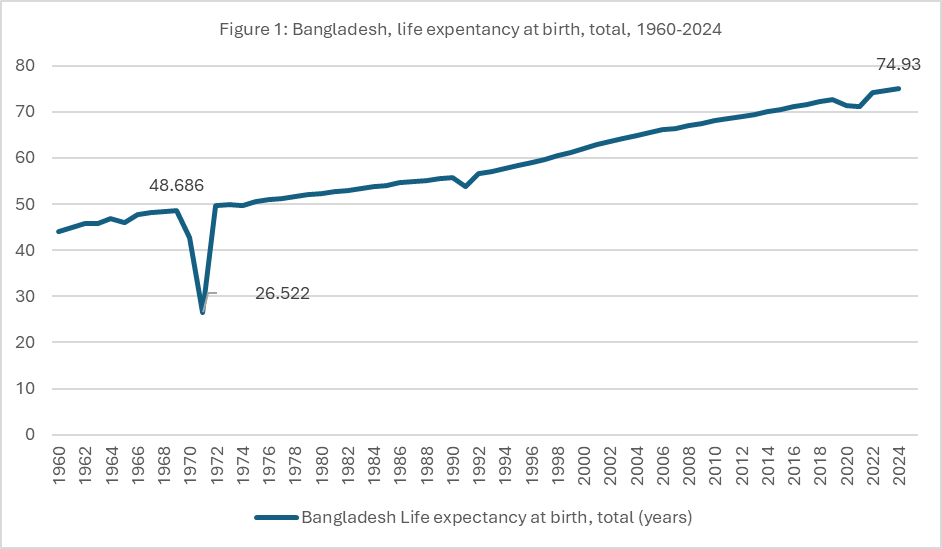
As a staunch Bengali nationalist, he would certainly be elated at the economic progress that has taken place. The average Bangladeshi today can expect to live around 75 years. It is difficult to imagine that life expectancy in Bangladesh in 1971 plummeted to 27 years (!) during the War of Liberation before recovering to 49 years in 1972 – see Figure 1.
Source: Derived by author from World Bank, https://data.worldbank.org/indicator/SP.DYN.LE00.IN?locations=BD
Rahim would also note that such statistics is a powerful vindication of the view that huge losses of life and displacement of people took place during the War of Liberation and one that was primarily caused by genocidal acts of the Pakistan army and its local collaborators. He would lament the fact that those who committed such war crimes were not held accountable for such gruesome acts. The Pakistani soldiers and army officers who occupied Bangladesh as perpetrators of violence against innocent civilians between March and December 1971 were given a safe return to Pakistan (thanks to the magnanimous gesture of the Indian government of the time). Some local collaborators were tried, found guilty and given the death penalty, but most escaped any form of accountability. Rahim must wonder: when will this culture of immunity end?
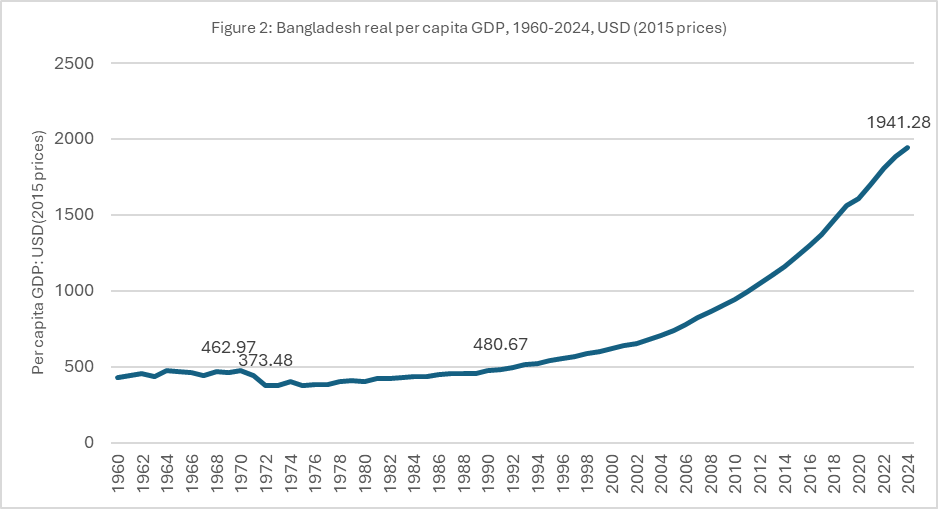
If one uses another basic metric of living standards, per capita real GDP, Rahim would simply be stunned at the scale of the progress that has taken place. Between 1969 and 1972 per capita real GDP contracted by 19 per cent. Today, per capita GDP is 5.2 times the level that prevailed in 1972 – see Figure 2. Furthermore, as a recent World Bank assessment (October 2025) notes:[2]
Source: Derived by authors from World Bank, https://data.worldbank.org/indicator/NY.GDP.PCAP.KD?locations=BD
Between 2010 and 2022, real GDP grew by 6.6 percent annually, nearly doubling GDP per capita and reducing poverty at the extreme national poverty line (lower) from 12.2 to 5.6 percent and at the absolute national poverty line (upper) from 37.1 to 18.7 percent. Multidimensional poverty also declined from 46.8 to 21.3 percent, alongside improvements in health, education, sanitation, and electricity access.
Rahim can barely reconcile these numbers with the Bangladesh that he witnessed in 1971-72 and during the famine of 1974. Poverty was endemic. He would heartily endorse the view that “Bangladesh has lot to be proud of”.[3] He can say that he comes from an era in which Bangladesh was denigrated as a “basket case” and there was extraordinarily little to be proud of. This, he would proclaim with a deep sense of satisfaction, is a vindication of all the optimists – most notably Mujib and his generation of nationalist politicians and fellow travellers – who fervently believed in the idea of Bangladesh long before it became a reality. Indeed, he would go even further and say that Bangladesh would, today, be worse off had it remained as a province of Pakistan. In core areas of well-being, Bangladesh as an independent nation has outperformed Pakistan. For example, life expectancy in Bangladesh is about ten years more than Pakistan, while its literacy rate is twenty percentage points higher than Pakistan’s.[4]
Yet, like Rip Van Winkle, Rahim must highlight adverse changes. To start with, he would find the capital city Dhaka clogged with traffic and bursting at the seams with high rise apartments and buildings. The air quality in Dhaka is among the worst in the world.[5] He is alarmed at a report that about 30 percent of the population face heightened climate risk. The Dhaka that he left in the 1970s was much poorer but quieter and cleaner. Global warming and its deleterious consequences were not part of the policy agenda.
Rahim would be aghast at the grotesque levels of inequality and the endemic corruption that pervades everyday life. One study, based on a ‘corruption perception index’ (CPI), finds that “the global average score out of 100 (which is best) is 42, while Bangladesh’s score is 24—which is 18 points lower than the global average score and 21 points lower than the Asia Pacific region’s average score of 45”.[6] Furthermore, the same study finds that Bangladesh’s ranking since 2023 has not changed, despite major political transitions.
Despite notable socio-economic progress, Rahim would note that new challenges have emerged. The latest reports suggest that in the post-2022 period, both overall and extreme poverty have increased in Bangladesh.[7] Growth has slowed down, while the global political and economic climate, following the war on Iran, has worsened. Bangladesh, like many countries in the world, faces a fuel crisis which is being driven by external factors.
It is on the political front that Rahim has the most concerns. He was shocked to realize that Sheikh Hasina, who was reportedly a timorous, soft-spoken housewife, turned out to be a ruthless politician who became the longest serving female Prime Minister in the country’s history. At the same time, her attempt to hold on to political power by force made her vulnerable. She was ousted in a violent uprising in August 2024 and was forced into exile. There is a judicial ruling against her that entails the death sentence for committing crimes against humanity. Rahim would be deeply saddened to note how Hasina, in a bid to deify her father’s memory, ended up destroying his legacy. The Awami league that Rahim knew is now in the political wilderness from which it might never return.
Rahim is left wondering how the new Bangladesh will evolve. The key power brokers, now led by the Bangladesh Nationalist Party (BNP), as well as the official Opposition, led by Jamaat, represent a constellation of forces that are keen to construct a durable historical narrative that will be inhospitable to the values and principles that animated a generation who fought selflessly for the idea of Bangladeshi nationhood. In that fundamental sense, Rahim wonders whether Bangladesh has really progressed beyond the 1970s. A political culture of immunity, violence and vendetta that were so evident in the mid-seventies remain ever-present dangers.
[1] https://www.britannica.com/topic/Rip-Van-Winkle-short-story-by-Irving
[2] https://documents1.worldbank.org/curated/en/099408104212512419/pdf/IDU-c56b9657-74d2-45ab-ba59-3dd8d12ff803.pdf
[3] https://www.worldbank.org/en/news/opinion/2023/03/01/defying-the-odds-bangladesh-s-journey-of-transformation-and-resilience
[4] https://www.worlddata.info/country-comparison.php?country1=BGD&country2=PAK
[5] https://www.dhakatribune.com/bangladesh/dhaka/409294/dhaka-air-quality-slips-to-4th-worst-globally
[6] https://www.ti-bangladesh.org/en/cpi
[7] https://www.thedailystar.net/business/news/poverty-rate-jumps-279-extreme-poverty-nearly-doubles-93-3970246

