Bangladesh today: The return of Rip Van Winkle

The American author William Irving created a famous fictional character called Rip Van Winkle who drinks a magic potion and wakes up decades later to find that his personal world and the world around him have changed greatly. Winkle observes both positive and negative changes.

Imagine that the magical properties of Rip Van Winkle are embodied in an 18-year-old Rahim. He is a staunch Bengali nationalist. Rahim is a witness to epochal events: the Bangladesh War of Liberation that started on 26 March 1971 and ended on 16 December 1971; the emergence of Bangladesh as a new nation; the devastating famine in 1974 in which more than a million people perished; a highly contentious political experiment of a one party state that lasted between January and August 1975; the gruesome assassination of Sheikh Mujib and most members of his family in mid-August 1975, the founding father of the nation and its first elected Prime Minister; the trauma and turmoil that followed.

In a state of despair and desperation that his expectations of a peaceful and prosperous Sonar Bangla (Golden Bengal) were dashed, Rahim drinks a magic potion and falls into a long and deep slumber. He wakes up in contemporary Bangladesh. He is now an old man well past 70. What does he see? What will he say?

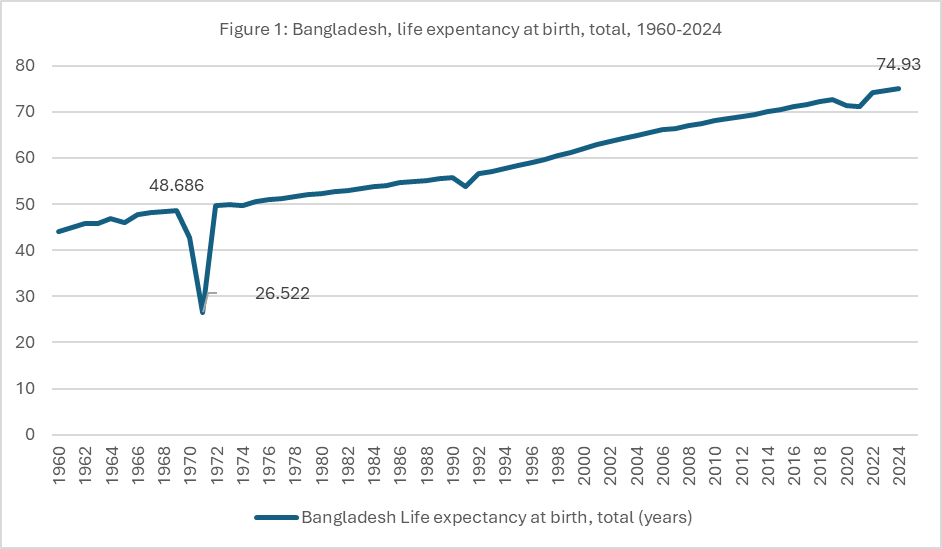
As a staunch Bengali nationalist, he would certainly be elated at the economic progress that has taken place. The average Bangladeshi today can expect to live around 75 years. It is difficult to imagine that life expectancy in Bangladesh in 1971 plummeted to 27 years (!) during the War of Liberation before recovering to 49 years in 1972 – see Figure 1.

Source: Derived by author from World Bank, https://data.worldbank.org/indicator/SP.DYN.LE00.IN?locations=BD

Rahim would also note that such statistics is a powerful vindication of the view that huge losses of life and displacement of people took place during the War of Liberation and one that was primarily caused by genocidal acts of the Pakistan army and its local collaborators. He would lament the fact that those who committed such war crimes were not held accountable for such gruesome acts. The Pakistani soldiers and army officers who occupied Bangladesh as perpetrators of violence against innocent civilians between March and December 1971 were given a safe return to Pakistan (thanks to the magnanimous gesture of the Indian government of the time). Some local collaborators were tried, found guilty and given the death penalty, but most escaped any form of accountability. Rahim must wonder: when will this culture of immunity end?

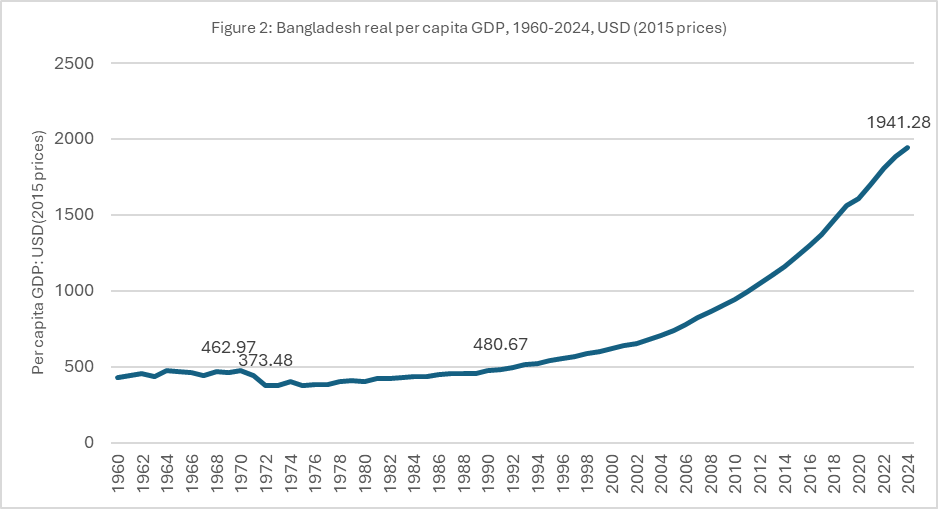
If one uses another basic metric of living standards, per capita real GDP, Rahim would simply be stunned at the scale of the progress that has taken place. Between 1969 and 1972 per capita real GDP contracted by 19 per cent. Today, per capita GDP is 5.2 times the level that prevailed in 1972 – see Figure 2. Furthermore, as a recent World Bank assessment (October 2025) notes:[2]

Source: Derived by authors from World Bank, https://data.worldbank.org/indicator/NY.GDP.PCAP.KD?locations=BD

Between 2010 and 2022, real GDP grew by 6.6 percent annually, nearly doubling GDP per capita and reducing poverty at the extreme national poverty line (lower) from 12.2 to 5.6 percent and at the absolute national poverty line (upper) from 37.1 to 18.7 percent. Multidimensional poverty also declined from 46.8 to 21.3 percent, alongside improvements in health, education, sanitation, and electricity access.

Rahim can barely reconcile these numbers with the Bangladesh that he witnessed in 1971-72 and during the famine of 1974. Poverty was endemic. He would heartily endorse the view that “Bangladesh has lot to be proud of”.[3] He can say that he comes from an era in which Bangladesh was denigrated as a “basket case” and there was extraordinarily little to be proud of. This, he would proclaim with a deep sense of satisfaction, is a vindication of all the optimists – most notably Mujib and his generation of nationalist politicians and fellow travellers – who fervently believed in the idea of Bangladesh long before it became a reality. Indeed, he would go even further and say that Bangladesh would, today, be worse off had it remained as a province of Pakistan. In core areas of well-being, Bangladesh as an independent nation has outperformed Pakistan. For example, life expectancy in Bangladesh is about ten years more than Pakistan, while its literacy rate is twenty percentage points higher than Pakistan’s.[4]

Yet, like Rip Van Winkle, Rahim must highlight adverse changes. To start with, he would find the capital city Dhaka clogged with traffic and bursting at the seams with high rise apartments and buildings. The air quality in Dhaka is among the worst in the world.[5] He is alarmed at a report that about 30 percent of the population face heightened climate risk. The Dhaka that he left in the 1970s was much poorer but quieter and cleaner. Global warming and its deleterious consequences were not part of the policy agenda.

Rahim would be aghast at the grotesque levels of inequality and the endemic corruption that pervades everyday life. One study, based on a ‘corruption perception index’ (CPI), finds that “the global average score out of 100 (which is best) is 42, while Bangladesh’s score is 24—which is 18 points lower than the global average score and 21 points lower than the Asia Pacific region’s average score of 45”.[6] Furthermore, the same study finds that Bangladesh’s ranking since 2023 has not changed, despite major political transitions.

Despite notable socio-economic progress, Rahim would note that new challenges have emerged. The latest reports suggest that in the post-2022 period, both overall and extreme poverty have increased in Bangladesh.[7] Growth has slowed down, while the global political and economic climate, following the war on Iran, has worsened. Bangladesh, like many countries in the world, faces a fuel crisis which is being driven by external factors.

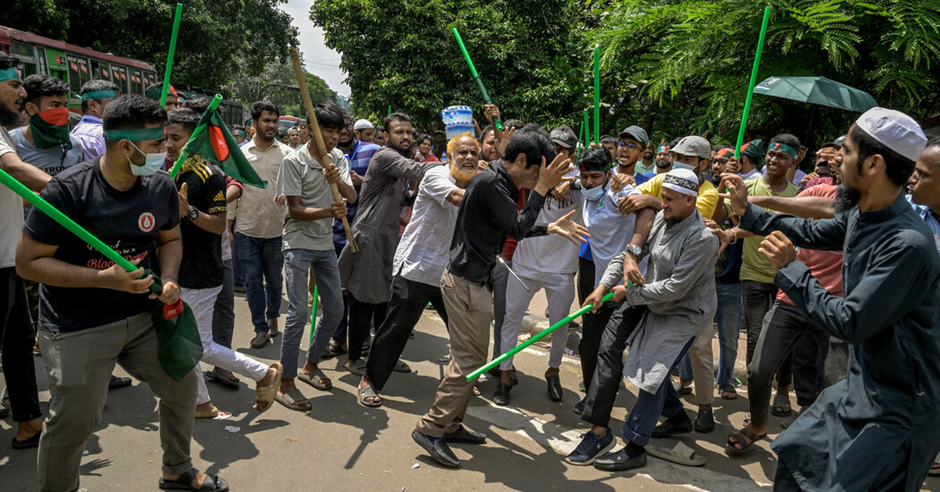
It is on the political front that Rahim has the most concerns. He was shocked to realize that Sheikh Hasina, who was reportedly a timorous, soft-spoken housewife, turned out to be a ruthless politician who became the longest serving female Prime Minister in the country’s history. At the same time, her attempt to hold on to political power by force made her vulnerable. She was ousted in a violent uprising in August 2024 and was forced into exile.  There is a judicial ruling against her that entails the death sentence for committing crimes against humanity. Rahim would be deeply saddened to note how Hasina, in a bid to deify her father’s memory, ended up destroying his legacy. The Awami league that Rahim knew is now in the political wilderness from which it might never return.

Rahim is left wondering how the new Bangladesh will evolve. The key power brokers, now led by the Bangladesh Nationalist Party (BNP), as well as the official Opposition, led by Jamaat, represent a constellation of forces that are keen to construct a durable historical narrative that will be inhospitable to the values and principles that animated a generation who fought selflessly for the idea of Bangladeshi nationhood. In that fundamental sense, Rahim wonders whether Bangladesh has really progressed beyond the 1970s. A political culture of immunity, violence and vendetta that were so evident in the mid-seventies remain ever-present dangers.


[1] https://www.britannica.com/topic/Rip-Van-Winkle-short-story-by-Irving

[2] https://documents1.worldbank.org/curated/en/099408104212512419/pdf/IDU-c56b9657-74d2-45ab-ba59-3dd8d12ff803.pdf

[3] https://www.worldbank.org/en/news/opinion/2023/03/01/defying-the-odds-bangladesh-s-journey-of-transformation-and-resilience

[4] https://www.worlddata.info/country-comparison.php?country1=BGD&country2=PAK

[5] https://www.dhakatribune.com/bangladesh/dhaka/409294/dhaka-air-quality-slips-to-4th-worst-globally

[6] https://www.ti-bangladesh.org/en/cpi

[7] https://www.thedailystar.net/business/news/poverty-rate-jumps-279-extreme-poverty-nearly-doubles-93-3970246

Viral Empire: How Microbes Reflect Human Power Structures

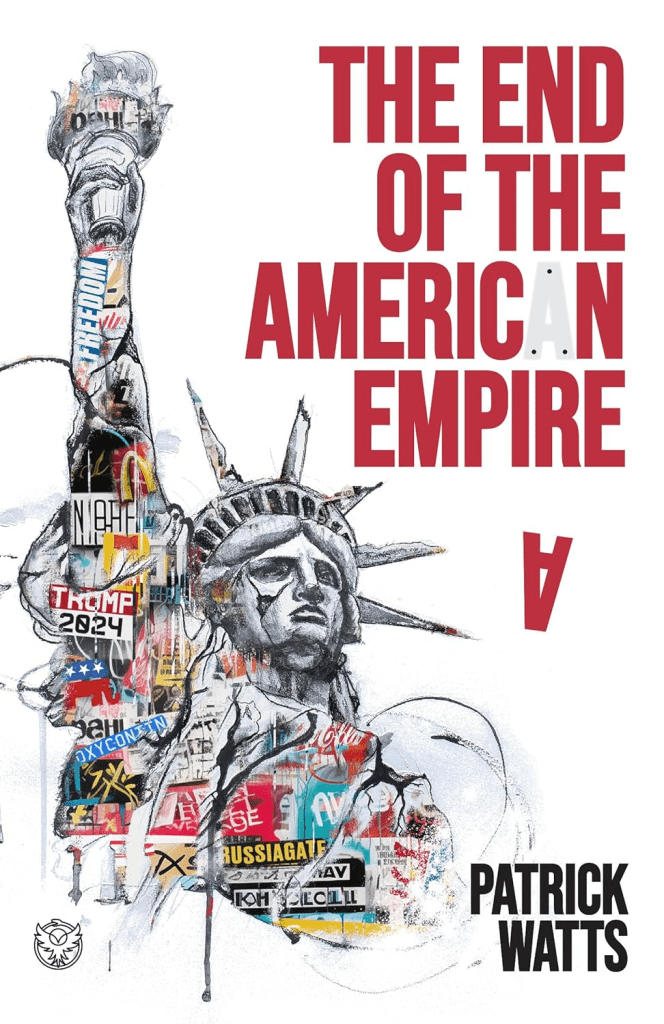
Source: https://grahamhancock.com/wattsp1/

Viral Empire: How Microbes Reflect Human Power Structures

By Aunul Islam, PhD (Imperial College, UK)

Modern power no longer operates primarily through borders or armies but through networks—supply chains, information flows, technology, and interdependence. In this sense, contemporary geopolitics resembles microbial systems more than traditional empires.

Microbes exert influence through connectivity, adaptation, and asymmetry. Small organisms can destabilise large systems by exploiting vulnerabilities, just as minor interventions can trigger outsized effects in a networked world. Power depends less on scale than on speed, positioning, and resilience.

Like microbes, political systems evolve under pressure. Expansion produces resistance, cooperation strengthens survival, and rigid structures fail in volatile environments. The greatest risk is not defeat by rivals but internal systemic collapse.

Seen this way, global power functions as a living ecosystem—adaptive, fragile, and continuously contested rather than permanently controlled.

In the above narration, the scientific expressions like mutation, virulence in the microbes behaviour have been translated in the business and strategic literature to relate them to humans. But this literature lacks sufficient emphasis on the destruction through wars and conflicts by humans on core aspects of their own life. This entails destruction of properties and other supporting elements such as hospitals, energy production etc.

At this juncture, the anti-thesis to above narratives is that human empire or a Supreme Empire do not adhere to the simple modalities in present day geopolitics. The present empire dictated by a lone country (USA) along with its lackeys is no longer a traditional empire as depicted previously. The viral empire like that of the bubonic plague or even the Covid-19 virus are now long forgotten past. The present Super Empire is best described as the worst of its kind, genocidal in nature and any other terms that can be used to describe it, where new words have to be added to the dictionary.

The last hope of the present world order is that the super empire does behave like a viral empire and succumbs to its own systemic collapse. Maybe this will happen in the next few decades!

Sent from my iPhone

Notes on Iran: regime collapse or survival?

Source: https://www.afr.com/world/middle-east/in-pictures-iran-war-s-global-impact-20260302-p5o6ol

There are several reasons why one can be optimistic about the survival of the current regime in Iran following the illegal and unprovoked war on the nation waged by the USA and Israel. First, the regime managed to overcome its most dangerous and fragile moment, that is, immediately after the assassination by Israeli bombs of Khamenei, his family members and his entourage of senior leaders. At 86, and after having ruled Iran for 40 years with an iron fist, Khamenei decided to become a martyr. Hence, he was at his office – a publicly disclosed location – when he was killed. This was both a spiritual and strategic move. Martyrdom plays a vital role among the Shia faithful. The decision to die in this manner was strategic because it signalled to the Iranian population that a succession plan was in place in line with constitutional provisions. Iran is a constitutional republic that has endured for 50 years. It is not a lawless theocracy dependent on the whims of an aging Ayatollah.

Second, and this follows from the first, Trump and Netanyahu failed to understand the multi-layered structure of the Iranian regime. They thought with Khamenei and his senior entourage gone, the regime would collapse and the thankful Iranians would dance with joy in the streets and enthusiastically engage with a new pro-American and pro-Israeli political settlement. Both Trump and Netanyahu would declare victory and go home. This did not happen. Instead, the regime maintained its constitutional continuity. The bombing continues, hundreds have been killed so far (550 at last count). It is difficult at this stage for the average Iranian to treat the Americans and Israelis as liberators when they are being killed and maimed by made in USA bombs and missiles.

Third, Iran has shown that it can retaliate against the combined military might of USA and Israel by using a most potent weapon of modern warfare – long-range (but not intercontinental) ballistic missiles that draw on North Korean, Russian and Chinese expertise. According to some estimates, Iran possesses more than 3,000 of them. Admittedly, both USA and Israel have so-called interceptors, that is, defensive technology that can intercept incoming missiles. But, as Israel is finding to its cost, such a technology is not fool-proof. Most importantly, the very sophistication of this technology is also its Achilles Heel. It is extremely expensive to operate, stocks are limited and has high turnaround times to replenish. It has been suggested that neither the USA nor Israel has the capacity to sustain full-scale use of the interceptors beyond a few weeks before critical shortages emerge.

Fourth, Iran has fully adopted the tools of asymmetric warfare which weaker parties deploy against formidable adversaries. Unlike the last war (June 2025), when it was attacked by Israel, Iran decided from the very beginning that there are no ‘red lines.’ Hence, it is hitting the Arab allies of USA in the Gulf monarchies and causing them considerable grief and consternation. This is being done by inflicting damage on US bases hosted by the Gulf states, targeting sensitive civilian assets entailing airports, ports, luxury hotels and energy infrastructure. The result is mayhem. The famous airlines of the Middle East – Emirates, Etihad and Qatar – are all grounded. ‘Hundreds of thousands of travellers’ are caught in limbo. The carefully curated images of Bahrain, Dubai, Abu Dhabi and Doha as safe playgrounds for affluent, hedonistic hustlers have been severely damaged. Most importantly, energy prices are projected to rise sharply, partly because countries such as Qatar have temporarily stopped LNG production. Iran has also choked off traffic in the Straits of Hormuz to a trickle. This is highly significant because Hormuz hosts oil tankers that supply 20-30% of the world’s oil.

The attack on the Arab allies of USA might appear that an Iranian regime is lashing out against its neighbours in desperation, but the strategic rationale is different. By attacking the Gulf states in such a brazen way, Iran is sending a clear message: US protection of its Arab allies means extraordinarily little when push comes to shove. This is a move by the Iranians that was not part of the strategic calculus of USA and its allies.

Fourth, it is by no means clear that Trump has the appetite for a long war which is deeply unpopular among Americans (75% oppose the war on Iran, according to some polls). He has brazenly broken his election pledge that there will be no more ‘wars of choice.’ Trump’s approval rating is low. His MAGA base is becoming restless, caught in the grip of a cost-of-living crisis that is likely to worsen with the projected increase in energy prices. Mid-term elections are approaching and Trump has little to show as accomplishments other than vacuous showmanship. American military personnel are paying for Trump’s war of choice with their lives – six dead so far with many more injuries. The pain threshold for the average American is low when such needless deaths occur.

In sum, ‘victory’ for Iran means regime survival even when facing formidable foes. If Iran can pull it off, it will be seen as the mythical David prevailing over Goliath. Of course, the costs will be extremely high in terms of death and destruction and adverse economic consequences that will linger for years, but the Iranian leadership could say that it did not choose this suicidal path. It was forced to defend the nation against implacable and powerful enemies.

Stranger in My Own Paradise

By

Aunul Islam, PhD (Imperial College, UK)

Synopsis:

This is a deeply personal narrative yet layered with history. What stands out is how the narrative intertwines individual memory with collective national trauma. The author moves between moments of hope (1971, independence) and disillusionment (1975, the assassination of Bangabandhu, and later political upheavals), showing how “paradise” shifts from a homeland to a fragile state of mind.

In Bangladesh, memory serves both as a unifying force and a source of division

Paradise. For me, it was never a distant dream—it was home. The land where rivers meandered through green fields, where the air carried the scent of liberation and hope. In 1972, at sixteen, I left that paradise behind, boarding a plane to the United Kingdom with a heart full of ambition and a mind still echoing the cries of victory from a bloody war of independence. Bangladesh was free, and I believed its future would be bright.

Image 1: A huge crowd celebrates the Bangladesh Liberation War

Three years later, I returned. The contrast with Britain was stark, yet I felt no dissonance. My country was poor, scarred by war, but it was mine until 15 August 1975, when paradise bled again. The Father of the Nation—our beacon of freedom—was brutally murdered along with his family in a military coup. What shattered me was not only the violence but the silence that followed. A nation that had fought so fiercely for liberty now stood mute, whether paralysed by shock or poisoned by betrayal. My dream of returning home after my education crumbled that day.

Image 2: The dark night of Bangabandhu’s assassination: how it unfolded…bdnews24.com, 15 August 2021

I tried again in 1979, hoping time would heal. But the spirit of the liberation war was fading, replaced by whispers of corruption and compromise. In 1985, I returned to settle, married, clinging to the hope that roots could still grow. Yet the soil felt strange beneath my feet. By 1988, I went back to my newly adopted paradise—the UK—carrying the ache of a homeland slipping away.

From 1995 to 2006, I made another attempt. I walked the streets of my childhood, searching for the rhythm I once knew. But the society had changed beyond recognition. The ideals we fought for were eroding; the language of freedom was drowned in the noise of greed and power. I was a stranger among my own people.

And then came the final blow. From 2006 to 2025, I watched from afar as history was rewritten. In 2024, another political upheaval erased the very memory of our liberation struggle—the foundation of our identity. The dream that had carried me across oceans was gone. My paradise was not just lost; it was betrayed.

Image 3: Celebrating the July uprising…but where is the nation heading?

Image 4: Bangabandhu Sheik Mujib’s home is destroyed as a crowd watches with a combination of fear and fascination

What does it mean to lose paradise? For me, it is not the loss of land or flag, but the slow death of ideals—the erosion of truth, justice, and memory. I fought for a country that promised freedom, dignity, and hope. Today, that promise lies buried beneath the weight of power and silence. Paradise, I have learned, is not a place. It is a state of mind—a fragile vision we carry within us. And when that vision dies, even home becomes foreign.

I am a migrant twice over—once by choice, and now by necessity. My adopted land gave me shelter, but my heart still wanders the streets of a homeland that exists only in memory. I am, and will remain, a stranger in my own paradise.

Democracy promotion, regime change and US foreign policy: The case of Bangladesh

On August 5, 2024, a student-led movement toppled Sheikh Hasina’s deeply entrenched authoritarian regime. The redoubtable Economist magazine voted Bangladesh ‘the country of the year’ (2024) because students led a movement that ‘toppled a tyrant’ and paved the way for a brighter future.

Do the student leaders really deserve such praise, or was there the not-so-hidden hand of external forces?

It is reasonable to argue that the legitimacy of a home-grown pro-democracy movement is impaired when it is co-opted by powerful external actors whose geopolitical considerations might not be aligned with a country’s national interest.

The Economist is silent on this issue, and there is hardly any national debate on this vexed question, perhaps because the media is still not free in the post-Hasina era.

The prime suspect that aided and abetted the expulsion of the Hasina regime is the USA.  This proposition is supported by a combination of historical records and circumstantial evidence.

To find out more, follow this link: