By
Aunul Islam, PhD (Imperial College, London, UK)
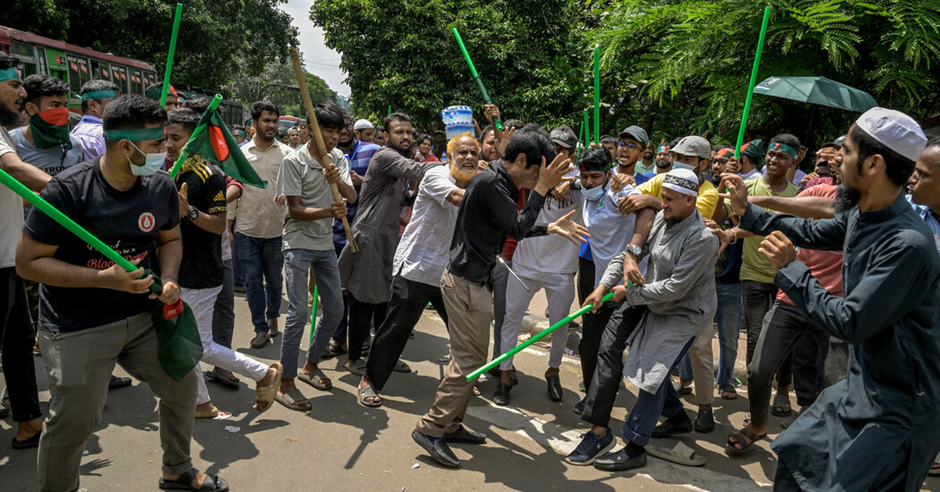
Source: New York Times, 15/08/2025
Bangladesh has endured political upheaval before. What made the recent interim period stand out was not protest or dissent, but the scale and normalisation of mob violence—vigilante attacks, public beatings, and political reprisals carried out openly. According to the European Agency for Asylum, Bangladeshi human rights organisations “…documented the highest rates of deaths due to mob beatings in a decade”. This did not happen because Bangladesh suddenly became more violent. It happened because, at a critical moment, authority hesitated. That authority was led by Professor Yunus, a Nobel laureate.
Interim governments exist for one primary reason: to stabilise the state during transition. They are not ceremonial caretakers. They govern during the most fragile phase of political life, when early decisions shape long‑term outcomes. In Bangladesh, that responsibility was not met.
Authority existed — and that is the point
The most important fact in this debate is often overlooked: the Bangladeshi state did not collapse during the interim period. Police forces remained in place. Courts functioned. The administration operated. International recognition was strong. Authority existed.
Political philosopher Hannah Arendt makes a distinction that is crucial here. Power, Arendt argues, rests on legitimacy and collective acceptance. Violence appears when that power is weakened or abdicated. When violence spreads, it is usually not a sign of popular empowerment, but of authority failing to act.
Seen this way, Bangladesh’s experience points to omission rather than inevitability. Leaders do not need to encourage violence to be responsible for its spread. Hesitation, delayed enforcement, and mixed signals are enough. In fragile institutional settings, restraint is rarely read as wisdom. It is read as permission.
How perpetrators of mob violence learned they enjoyed impunity
Sociologist Charles Tilly helps explain how this dynamic unfolds. He shows that mob violence is shaped by signals and incentives, not chaos. People watch what happens after the first incident. If early violence is punished quickly and consistently, it often subsides. If it is not, others follow.
Bangladesh fits this pattern. Analysts inside the country have pointed out that mob violence did not previously occur at this scale. Its expansion followed a familiar sequence: early incidents went insufficiently addressed, expectations of impunity formed, imitation followed, and violence became normalised. Each unpunished act lowered the threshold for the next.
Once this process begins, restoring order becomes far more difficult. By the time condemnations are issued, the street has already learned that enforcement is uncertain.
This was not inevitable
Defenders of the interim period often argue that the violence was unavoidable given the intensity of political change. That argument is weak. Transitions are volatile everywhere, but they also offer a narrow window where clear boundaries can be set. Early arrests, visible prosecutions, and unambiguous messaging can quickly shape behaviour. Bangladesh missed that window.
This is not a cultural story, and it is not about importing ideas from abroad. Modern democracies do not practise vigilantism. The issue is contextual misjudgement—applying restraint suited to strong institutional environments in a weak one.
The lesson and an anti-thesis of Arendt and Tilly
Bangladesh’s experience offers a stark lesson. Interim governments wield real power, even if temporarily. When that power is not exercised clearly and early, violence fills the gap. Arendt explains why violence signals failed authority. Tilly explains how inaction turns disorder into routine. Together, they show why mob violence in Bangladesh was not fate, but the result of a missed moment—and why accountability for that failure matters.
The above would partially explain according to Arendt and Tilly. The real reason is the disposition of the central character of the mob violence, Professor Yunus. It may sound preposterous but reflecting on his rule, or rather misrule, one can easily argue, that he came with a personal vendetta against the previous Government. He seized the opportunity to expand his own agenda of the Grameen group taking over many sectors. The mob violence was a “false flag” for him!


