Offers succinct commentary on topical issues that cut across both rich and poor countries. Entails critical insights on poverty, inequality, health, macro-policies and many more
The so-called ‘growth convergence’ literature posits that poorer economies will grow faster than richer ones and eventually catch up with them, but this is conditional on the presence of ‘fundamentals’ – good policies and inclusive institutions.
It will take Bangladesh more than 45 years to reach the current per capita real GDP of the USA, but in terms of life expectancy, a remarkable degree of convergence seems to have taken place.
There are several states in the USA in which life expectancy is lower than in Bangladesh. See the table below.
Arkansas
South
73.9
45
Oklahoma
South
73.8
46
Tennessee
South
73.8
47
Alabama
South
73.8
48
Louisiana
South
73.8
49
Kentucky
South
73.6
50
Mississippi
South
72.6
51
West Virginia
South
72.2
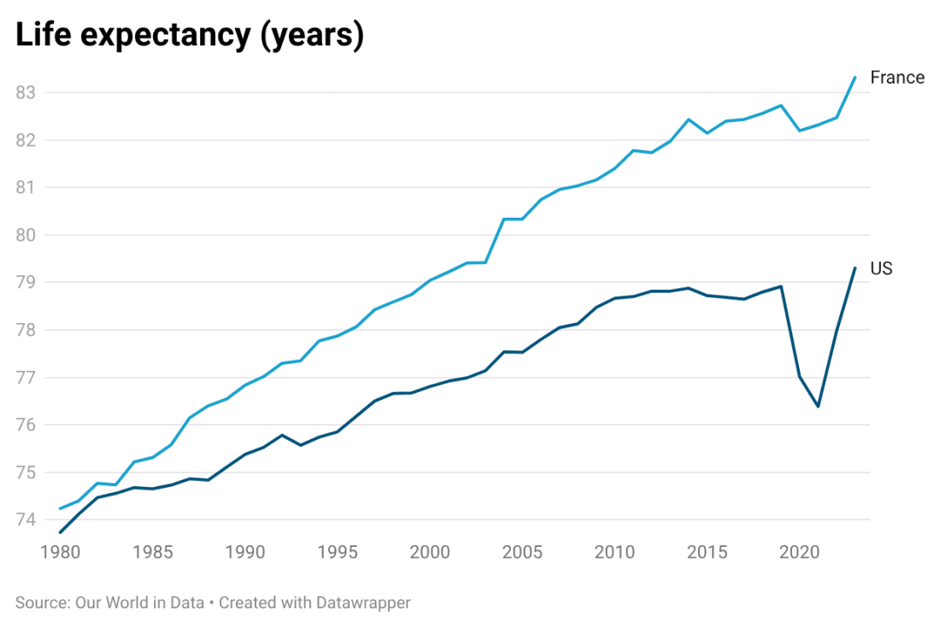
Life expectancy in the USA has diverged from trends in other rich nations. The figure below provides an example.
When one examines ‘healthy life expectancy’ (HALE), that is, the average number of years that a person can expect to be healthy, Bangladesh has apparently almost caught up with USA! See the table below.
Indicator
Bangladesh
United States
Healthy Life Expectancy (HALE) at birth
62.4 years (2023)
64.6 years (2023)
Overall Life Expectancy at birth
72.7 years (2023)
78.5 years (2023)
Years spent living in poor health/disability
~10.3 years
~13.9 years
How did this ‘longevity revolution’ in Bangladesh happen? A complex confluence of factors has led to this outcome. They are explored in a complementary commentary on my Substack platform.
Dr. Satish Chandra Mishra, an economist educated at Oxford and Cambridge with senior past experience at the United Nations (UNDP), OECD, and USAID, is the Founder and Executive Director of Arthashastra Institute, Bali,Indonesia.
Draw a line on a map from the Bay of Bengal through the Malacca and Sunda Straits to the Coral Sea. Three capitals sit on it: New Delhi, Jakarta, Canberra. Nobody planned it that way. Geography did.
For most of the last eighty years, these three countries barely spoke to each other. India looked inward, then toward its own neighbourhood. Australia looked toward London, then Washington. Indonesia looked toward nobody in particular. By design.
That design has a name: bebas aktif, free and active. It is not indecision dressed up as principle. Indonesia won its independence in 1945. A decade later, in 1955, it hosted the Bandung Conference, where newly independent nations from Asia and Africa agreed to refuse conscription into either Cold War camp, the meeting that gave the Non-Aligned Movement its name. Bebas aktif was Indonesia’s own translation of that idea into policy, and seventy years on, it still shapes every conversation Jakarta has with Canberra, or with Delhi.
If Indonesia has spent seven decades declining to pick sides, why would three years of paperwork change that? Isn’t this just two bilateral relationships wearing a trilateral costume, with Indonesia as the reluctant middle party in both?
On the evidence, it is the wrong one.
First, the pace. Between August 2024 and August 2026, Australia and Indonesia signed a treaty-level Defence Cooperation Agreement, ran their largest-ever combined military exercise, and then signed a second, broader security treaty on top of the first. India and Indonesia, in the same window, transferred BrahMos missiles, a deal that had sat in negotiation since 2023, held up because it was never a simple purchase. India and Australia finished a trade agreement, then a fuller one behind it. None of this was inevitable. Agreements this dense do not happen between countries hedging for form’s sake.
Second, the money has started following the paperwork rather than preceding it, which is the harder direction. Indonesia’s non-oil trade surplus with India passed the Philippines and closed in on the United States in 2025. Indian investment in Indonesian nickel and pharmaceuticals has moved from announcements to plants. Australia’s goods trade with Indonesia under their partnership has nearly doubled
since 2020. Trade agreements are cheap to sign and easy to ignore. These have not been ignored.
Third, Indonesia has not stopped being non-aligned. It has started treating non-alignment as something to be defended actively rather than simply declared. When Indonesia’s own defence and foreign ministers sat down with their Australian counterparts in Melbourne this August, the first thing out of Jakarta’s mouth was reassurance: the new treaty, they said, changes nothing about bebas aktif. Canberra’s own language, meanwhile, calls the same treaty a “deeper strategic alignment.” Two governments, one signature, two readings. That gap is not a flaw in the relationship. It is the relationship, working as designed.
Fourth, the institutions are starting to outlast the summits that produced them. A defence dialogue does not need Modi or Albanese or Prabowo in the room to keep meeting. A tariff schedule does not need a joint statement to keep applying. Somewhere between 2024 and now, the India-Indonesia-Australia relationship stopped being a sequence of leader-level photographs and became something closer to furniture. Nobody notices furniture. That is rather the point of it.
If the trend is already running in the right direction, why does it need any help at all?
Because trends that run on their own eventually stop running on their own. Every one of the agreements listed above still needs a domestic parliament, a domestic ratification process, or a domestic budget line to survive contact with its own government. Australia has already ratified its side of the 2024 defence agreement; Indonesia has not finished ratifying its side, eighteen months on. That is not obstruction. It is simply how democracies work, and all three of these countries are, unfashionably, democracies, which move at the speed of their own institutions rather than the speed of their prime ministers’ enthusiasm.
There is also an election calendar to reckon with, in all three capitals, on staggered but overlapping schedules through the rest of this decade. Agreements signed by one government can be quietly starved of budget by the next, not through hostility, but through neglect, which is the more common way policy dies. The next two to three years are the period in which these frameworks either get locked into institutions that survive a change of government, or they do not, and the region reverts to what it has mostly been for the last eighty years: three countries that trade politely and cooperate occasionally, without ever quite becoming partners.
Is that outcome likely? No. Is it impossible? Also no. Nothing about middle-power cooperation is self-executing. It requires someone, in each capital, to keep doing the unglamorous work of ratification hearings and budget lines long after the joint statement has stopped making news.
None of this requires India, Indonesia, and Australia to become allies in the way that word is used in Washington or Beijing. Indonesia will not sign a mutual-defence pact, and nobody serious is asking it to. What it requires is smaller and more achievable: that three governments finish what they have already started, rather than letting good agreements expire quietly in a filing cabinet marked pending.
The three capitals on that line through the Bay of Bengal did not choose their geography. They are choosing, right now, whether to do anything with it. History does not offer many second invitations of this kind. It offers this one, for perhaps three more years, and then it moves on to ask someone else.
A Medical Crisis, Four Fathers, and an Uncomfortable Question
By Aunul Islam
Aunul Islam, read for hisPhD at Imperial College, London.He graduated from the University of Manchester. He is a Quality Assurance Specialist in Higher Education and a Technology Consultant. He is an ex-civil servant of the UK government. A keen gardener, he finds solace through nature in this dysfunctional world order.
Imagine four fathers faced with the same tragedy.
Three belong to different faiths. Their beliefs differ, their prayers are directed in different ways, and their understanding of God is not the same. What they have in common is limited financial means.
The fourth father is an atheist. He is immensely wealthy.
When their children are diagnosed with a life-threatening illness, the three men of faith rely on ordinary hospitals and the treatment available to them. They pray, hope, and trust that their children will recover.
The atheist places his trust in medicine and uses his wealth to secure treatment at one of the world’s leading medical centres.
Months later, the results are stark. The atheist’s child survives. The other three children do not.
The outcome raises a question many would hesitate to ask:
Is money more powerful than God?
The scenario is striking because the three fathers come from different religious traditions. Whatever their theological differences, they face the same practical limitation: they cannot afford the level of care available to the wealthier father. In the end, it is not their faith that distinguishes them from the atheist, but their financial circumstances.
From a purely material perspective, the conclusion appears obvious. Money provided access to better facilities, specialists, technology, and treatment. Wealth translated directly into opportunity. In this instance, money seems to have achieved what faith did not.
The question recalls a theme explored in F. Scott Fitzgerald’s The Great Gatsby. Gatsby believed wealth could overcome every obstacle and secure the future he desired. Fitzgerald never denied the power of money. On the contrary, he showed how dramatically it shapes lives and opens doors. Yet he also questioned whether money alone could provide everything people seek.
The medical scenario presents a more sobering version of that dilemma. Here, wealth does not buy luxury or status; it buys possibility. It increases the odds of survival itself.
For many observers, this is precisely why money can appear almost godlike in modern society. It influences where people live, how they are educated, how they are represented, and, increasingly, the quality of healthcare they receive. While faith may offer comfort and meaning, money often determines access.
None of this proves or disproves the existence of God. It simply highlights a reality that many find uncomfortable: in the world as it exists, financial resources can have a decisive impact on human outcomes.
Perhaps, then, the real question is not whether money is more powerful than God. It is whether modern society has created conditions in which money often exercises a form of power that many once associated with the divine.
As The Great Gatsby suggests, wealth may not answer life’s deepest questions, but for those standing outside the doors it can open, its power can seem almost limitless.
Dr. Satish Chandra Mishra, an economist educated at Oxford and Cambridge with senior past experience at the United Nations (UNDP), OECD, and USAID, is the Founder and Executive Director of Arthashastra Institute, Bali,Indonesia.
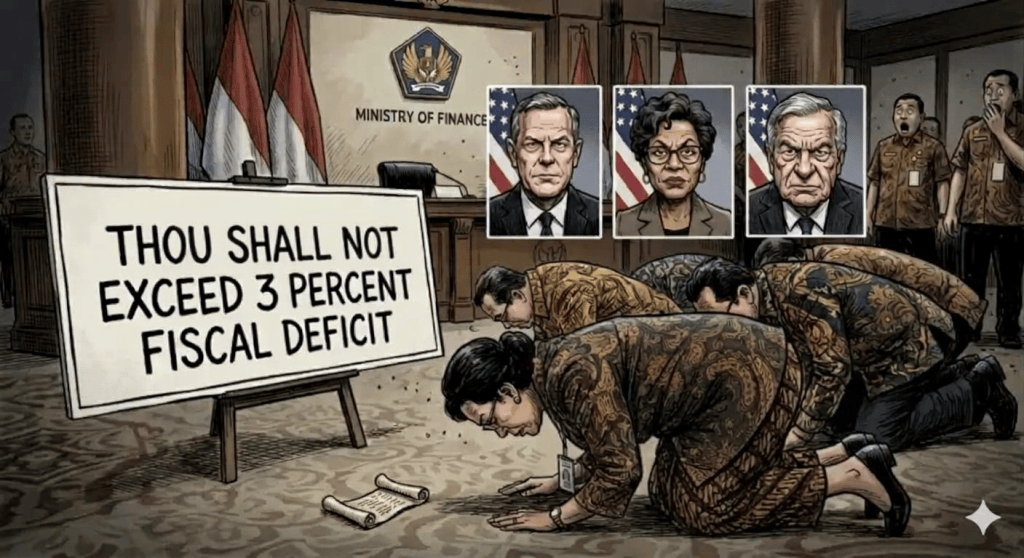
In 1981, Guy Abeille, a French budget official, invented a number. President Francois Mitterrand needed something simple to say to ministers demanding money. Abeille opted for three percent of GDP budget deficit as a working hypothesis and an expedient rule of thumb. No model produced it. No theory backs it. It was all the result of an evening’s improvisation.
No one could have predicted the future of such a hurried conjecture. The IMF and World Bank put it on the global map. They stamped that figure into loan conditions and credibility assessments. Soon a rule of thumb hardened into doctrine. Rating agencies and index makers watched it. Investors took their cue from it. A rule invented in a single fireside evening soon took on all the attributes of a new theocracy.
Ironically, it was the very countries, Germany and France, that within six years of putting it into the Maastricht treaty, waived their own penalties in 2003. Brussels suspended the whole framework again for four straight years through the pandemic and the war in Ukraine.
At the same time, economies that actually closed the gap with the rich world never let this ceiling slow them down in the first place. China ran deficits and directed state investment at whatever scale the moment required, for four decades, and grew from poverty to the world’s second-largest economy without pausing to check a number invented in Paris. South Korea’s own developmental state did not industrialize inside that constraint either. India, its own fiscal responsibility law notwithstanding, has repeatedly missed and revised its deficit targets in the pursuit of growth it judged more urgent than the arithmetic.
In the age of discontinuity unfolding before our very eyes today, it is time to understand that slow to moderate growth, and low fiscal deficit, go beyond a prudent policy choice in the world today. On the contrary, giving up on accelerated growth is the hidden danger of our own imagining and lack of national confidence.
The reasons are very familiar. We live in an age of AI, trillion dollar oligarchies and the end of a unipolar world: something humankind has never witnessed before.
In this fast evolving world, India and Indonesia together have an undeniable claim to form Asia’s second pole to China’s own rise. That claim rests on history, strategic location and economic weight: not on how faithfully either has adhered to a 3 percent budget deficit ceiling.
The 3 percent ceiling also ignores strategic emergencies. Consider defense. Indonesia has spent roughly 0.8 percent of GDP on its military for a decade, the lowest ratio in Southeast Asia, well behind Malaysia and Thailand, a fraction of Singapore’s. A nation with the largest archipelago on earth, contested waters on more than one border, and ambitions to sit at the top table of a multipolar Asia cannot get there on a budget this thin. In similar circumstances most governments would simply choose to ignore the 3 percent rule.
Nor is Indonesia in a weak position to do so. Against the world’s fifty largest economies, its deficit sits somewhere in the middle, not the end. Its public debt, near 41 percent of GDP, is much lower than the average 69 percent for the group.
Indonesia has a population still young while much of the world ages, a democracy that has produced five peaceful transfers of power since 1999, and an excellent fiscal position despite its low tax to GDP ratio. It has earned the right to be more ambitious; to stand up and be counted on the global stage.
But the growth that history demands today cannot only be high. It has also to be inclusive, or it will not hold the country together long enough to matter. A nation spread across thousands of islands and hundreds of ethnic communities does not stay unified on GDP growth alone; it stays unified when growth reaches Ambon as well as Jakarta.
Nation-building and high growth are not two separate projects competing for the same rupiah. They are the same project.
This is generational work, sustained across a change of government and a change of decade the way China’s and Korea’s own commitments were, not one finance minister’s project.
A rule invented in one evening in Paris, enforced ever since by institutions that have never themselves obeyed it, ignored outright by every economy that actually grew enough to matter, was not founded on the dry logic of economic reasoning. It was based on an inherited faith that defies both logic and the needs of the day.
In fact, Abeille’s 3 percent rule was never meant to answer any serious question at all. It was a guess, a hunch, a convenience of the moment that founded an economic theocracy.
Faith and investor confidence worked when the world stood still long enough to turn hunch into prejudice. That is not the case now.
Indonesia does not merely need a different figure to replace 3 percent. It needs to face the emerging global future with logic and reason rather than inherited faith. It is time for an open, rational debate about what kind of fiscal rule actually serves a country ready to stand inside Asia’s second pole, and to breach the technological frontier.
In 1981, Guy Abeille, a French budget official, invented a number. President Francois Mitterrand needed something simple to say to ministers demanding money. Abeille opted for three percent of GDP budget deficit as a working hypothesis and an expedient rule of thumb. No model produced it. No theory backs it. It was all the result of an evening’s improvisation.
No one could have predicted the future of such a hurried conjecture. The IMF and World Bank put it on the global map. They stamped that figure into loan conditions and credibility assessments. Soon a rule of thumb hardened into doctrine. Rating agencies and index makers watched it. Investors took their cue from it. A rule invented in a single fireside evening soon took on all the attributes of a new theocracy.
Ironically, it was the very countries, Germany and France, that within six years of putting it into the Maastricht treaty, waived their own penalties in 2003. Brussels suspended the whole framework again for four straight years through the pandemic and the war in Ukraine.
At the same time, economies that actually closed the gap with the rich world never let this ceiling slow them down in the first place. China ran deficits and directed state investment at whatever scale the moment required, for four decades, and grew from poverty to the world’s second-largest economy without pausing to check a number invented in Paris. South Korea’s own developmental state did not industrialize inside that constraint either. India, its own fiscal responsibility law notwithstanding, has repeatedly missed and revised its deficit targets in the pursuit of growth it judged more urgent than the arithmetic.
In the age of discontinuity unfolding before our very eyes today, it is time to understand that slow to moderate growth, and low fiscal deficit, go beyond a prudent policy choice in the world today. On the contrary, giving up on accelerated growth is the hidden danger of our own imagining and lack of national confidence.
The reasons are very familiar. We live in an age of AI, trillion-dollar oligarchies and the end of a unipolar world: something humankind has never witnessed before.
In this fast evolving world, India and Indonesia together have an undeniable claim to form Asia’s second pole to China’s own rise. That claim rests on history, strategic location and economic weight: not on how faithfully either has adhered to a 3 percent budget deficit ceiling.
The 3 percent ceiling also ignores strategic emergencies. Consider defense. Indonesia has spent roughly 0.8 percent of GDP on its military for a decade, the lowest ratio in Southeast Asia, well behind Malaysia and Thailand, a fraction of Singapore’s. A nation with the largest archipelago on earth, contested waters on more than one border, and ambitions to sit at the top table of a multipolar Asia cannot get there on a budget this thin. In similar circumstances most governments would simply choose to ignore the 3 percent rule.
Nor is Indonesia in a weak position to do so. Against the world’s fifty largest economies, its deficit sits somewhere in the middle, not the end. Its public debt, near 41 percent of GDP, is much lower than the average 69 percent for the group.
Indonesia has a population still young while much of the world ages, a democracy that has produced five peaceful transfers of power since 1999, and an excellent fiscal position despite its low tax to GDP ratio. It has earned the right to be more ambitious; to stand up and be counted on the global stage.
But the growth that history demands today cannot only be high. It has also to be inclusive, or it will not hold the country together long enough to matter. A nation spread across thousands of islands and hundreds of ethnic communities does not stay unified on GDP growth alone; it stays unified when growth reaches Ambon as well as Jakarta.
Nation-building and high growth are not two separate projects competing for the same rupiah. They are the same project.
This is generational work, sustained across a change of government and a change of decade the way China’s and Korea’s own commitments were, not one finance minister’s project.
A rule invented in one evening in Paris, enforced ever since by institutions that have never themselves obeyed it, ignored outright by every economy that actually grew enough to matter, was not founded on the dry logic of economic reasoning. It was based on an inherited faith that defies both logic and the needs of the day.
In fact, Abeille’s 3 percent rule was never meant to answer any serious question at all. It was a guess, a hunch, a convenience of the moment that founded an economic theocracy.
Faith and investor confidence worked when the world stood still long enough to turn hunch into prejudice. That is not the case now.
Indonesia does not merely need a different figure to replace 3 percent. It needs to face the emerging global future with logic and reason rather than inherited faith. It is time for an open, rational debate about what kind of fiscal rule serves a country ready to stand inside Asia’s second pole and to breach the technological frontier.