By
Satish Chandra Mishra.
Dr. Satish Chandra Mishra, an economist educated at Oxford and Cambridge with senior past experience at the United Nations (UNDP), OECD, and USAID, is the Founder and Executive Director of Arthashastra Institute, Bali, Indonesia.
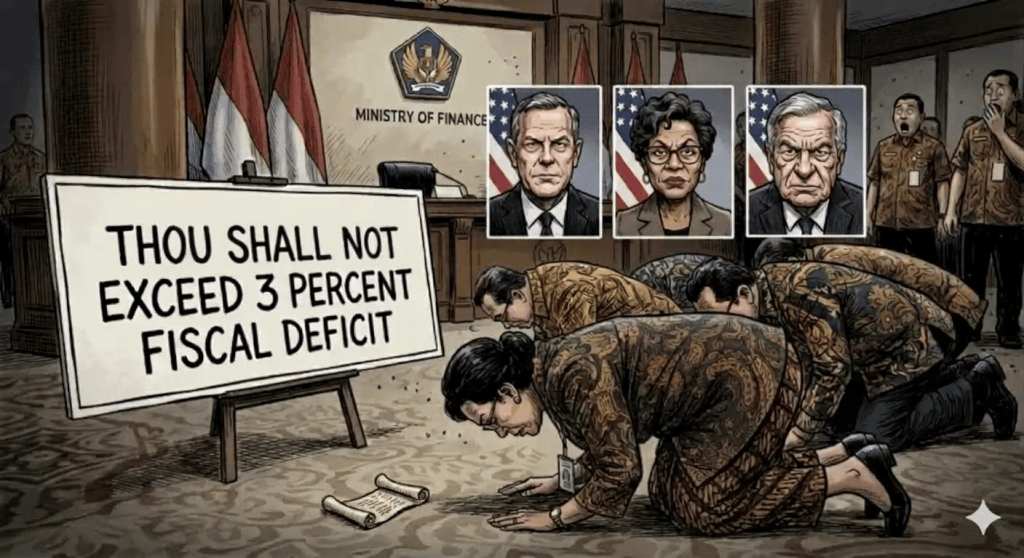
In 1981, Guy Abeille, a French budget official, invented a number. President Francois Mitterrand needed something simple to say to ministers demanding money. Abeille opted for three percent of GDP budget deficit as a working hypothesis and an expedient rule of thumb. No model produced it. No theory backs it. It was all the result of an evening’s improvisation.
No one could have predicted the future of such a hurried conjecture. The IMF and World Bank put it on the global map. They stamped that figure into loan conditions and credibility assessments. Soon a rule of thumb hardened into doctrine. Rating agencies and index makers watched it. Investors took their cue from it. A rule invented in a single fireside evening soon took on all the attributes of a new theocracy.
Ironically, it was the very countries, Germany and France, that within six years of putting it into the Maastricht treaty, waived their own penalties in 2003. Brussels suspended the whole framework again for four straight years through the pandemic and the war in Ukraine.
At the same time, economies that actually closed the gap with the rich world never let this ceiling slow them down in the first place. China ran deficits and directed state investment at whatever scale the moment required, for four decades, and grew from poverty to the world’s second-largest economy without pausing to check a number invented in Paris. South Korea’s own developmental state did not industrialize inside that constraint either. India, its own fiscal responsibility law notwithstanding, has repeatedly missed and revised its deficit targets in the pursuit of growth it judged more urgent than the arithmetic.
In the age of discontinuity unfolding before our very eyes today, it is time to understand that slow to moderate growth, and low fiscal deficit, go beyond a prudent policy choice in the world today. On the contrary, giving up on accelerated growth is the hidden danger of our own imagining and lack of national confidence.
The reasons are very familiar. We live in an age of AI, trillion dollar oligarchies and the end of a unipolar world: something humankind has never witnessed before.
In this fast evolving world, India and Indonesia together have an undeniable claim to form Asia’s second pole to China’s own rise. That claim rests on history, strategic location and economic weight: not on how faithfully either has adhered to a 3 percent budget deficit ceiling.
The 3 percent ceiling also ignores strategic emergencies. Consider defense. Indonesia has spent roughly 0.8 percent of GDP on its military for a decade, the lowest ratio in Southeast Asia, well behind Malaysia and Thailand, a fraction of Singapore’s. A nation with the largest archipelago on earth, contested waters on more than one border, and ambitions to sit at the top table of a multipolar Asia cannot get there on a budget this thin. In similar circumstances most governments would simply choose to ignore the 3 percent rule.
Nor is Indonesia in a weak position to do so. Against the world’s fifty largest economies, its deficit sits somewhere in the middle, not the end. Its public debt, near 41 percent of GDP, is much lower than the average 69 percent for the group.
Indonesia has a population still young while much of the world ages, a democracy that has produced five peaceful transfers of power since 1999, and an excellent fiscal position despite its low tax to GDP ratio. It has earned the right to be more ambitious; to stand up and be counted on the global stage.
But the growth that history demands today cannot only be high. It has also to be inclusive, or it will not hold the country together long enough to matter. A nation spread across thousands of islands and hundreds of ethnic communities does not stay unified on GDP growth alone; it stays unified when growth reaches Ambon as well as Jakarta.
Nation-building and high growth are not two separate projects competing for the same rupiah. They are the same project.
This is generational work, sustained across a change of government and a change of decade the way China’s and Korea’s own commitments were, not one finance minister’s project.
A rule invented in one evening in Paris, enforced ever since by institutions that have never themselves obeyed it, ignored outright by every economy that actually grew enough to matter, was not founded on the dry logic of economic reasoning. It was based on an inherited faith that defies both logic and the needs of the day.
In fact, Abeille’s 3 percent rule was never meant to answer any serious question at all. It was a guess, a hunch, a convenience of the moment that founded an economic theocracy.
Faith and investor confidence worked when the world stood still long enough to turn hunch into prejudice. That is not the case now.
Indonesia does not merely need a different figure to replace 3 percent. It needs to face the emerging global future with logic and reason rather than inherited faith. It is time for an open, rational debate about what kind of fiscal rule actually serves a country ready to stand inside Asia’s second pole, and to breach the technological frontier.
In 1981, Guy Abeille, a French budget official, invented a number. President Francois Mitterrand needed something simple to say to ministers demanding money. Abeille opted for three percent of GDP budget deficit as a working hypothesis and an expedient rule of thumb. No model produced it. No theory backs it. It was all the result of an evening’s improvisation.
No one could have predicted the future of such a hurried conjecture. The IMF and World Bank put it on the global map. They stamped that figure into loan conditions and credibility assessments. Soon a rule of thumb hardened into doctrine. Rating agencies and index makers watched it. Investors took their cue from it. A rule invented in a single fireside evening soon took on all the attributes of a new theocracy.
Ironically, it was the very countries, Germany and France, that within six years of putting it into the Maastricht treaty, waived their own penalties in 2003. Brussels suspended the whole framework again for four straight years through the pandemic and the war in Ukraine.
At the same time, economies that actually closed the gap with the rich world never let this ceiling slow them down in the first place. China ran deficits and directed state investment at whatever scale the moment required, for four decades, and grew from poverty to the world’s second-largest economy without pausing to check a number invented in Paris. South Korea’s own developmental state did not industrialize inside that constraint either. India, its own fiscal responsibility law notwithstanding, has repeatedly missed and revised its deficit targets in the pursuit of growth it judged more urgent than the arithmetic.
In the age of discontinuity unfolding before our very eyes today, it is time to understand that slow to moderate growth, and low fiscal deficit, go beyond a prudent policy choice in the world today. On the contrary, giving up on accelerated growth is the hidden danger of our own imagining and lack of national confidence.
The reasons are very familiar. We live in an age of AI, trillion-dollar oligarchies and the end of a unipolar world: something humankind has never witnessed before.
In this fast evolving world, India and Indonesia together have an undeniable claim to form Asia’s second pole to China’s own rise. That claim rests on history, strategic location and economic weight: not on how faithfully either has adhered to a 3 percent budget deficit ceiling.
The 3 percent ceiling also ignores strategic emergencies. Consider defense. Indonesia has spent roughly 0.8 percent of GDP on its military for a decade, the lowest ratio in Southeast Asia, well behind Malaysia and Thailand, a fraction of Singapore’s. A nation with the largest archipelago on earth, contested waters on more than one border, and ambitions to sit at the top table of a multipolar Asia cannot get there on a budget this thin. In similar circumstances most governments would simply choose to ignore the 3 percent rule.
Nor is Indonesia in a weak position to do so. Against the world’s fifty largest economies, its deficit sits somewhere in the middle, not the end. Its public debt, near 41 percent of GDP, is much lower than the average 69 percent for the group.
Indonesia has a population still young while much of the world ages, a democracy that has produced five peaceful transfers of power since 1999, and an excellent fiscal position despite its low tax to GDP ratio. It has earned the right to be more ambitious; to stand up and be counted on the global stage.
But the growth that history demands today cannot only be high. It has also to be inclusive, or it will not hold the country together long enough to matter. A nation spread across thousands of islands and hundreds of ethnic communities does not stay unified on GDP growth alone; it stays unified when growth reaches Ambon as well as Jakarta.
Nation-building and high growth are not two separate projects competing for the same rupiah. They are the same project.
This is generational work, sustained across a change of government and a change of decade the way China’s and Korea’s own commitments were, not one finance minister’s project.
A rule invented in one evening in Paris, enforced ever since by institutions that have never themselves obeyed it, ignored outright by every economy that actually grew enough to matter, was not founded on the dry logic of economic reasoning. It was based on an inherited faith that defies both logic and the needs of the day.
In fact, Abeille’s 3 percent rule was never meant to answer any serious question at all. It was a guess, a hunch, a convenience of the moment that founded an economic theocracy.
Faith and investor confidence worked when the world stood still long enough to turn hunch into prejudice. That is not the case now.
Indonesia does not merely need a different figure to replace 3 percent. It needs to face the emerging global future with logic and reason rather than inherited faith. It is time for an open, rational debate about what kind of fiscal rule serves a country ready to stand inside Asia’s second pole and to breach the technological frontier.

