Offers succinct commentary on topical issues that cut across both rich and poor countries. Entails critical insights on poverty, inequality, health, macro-policies and many more
It is February 2007. Only a few months ago, in December 2006, Muhammad Yunus earned the unique distinction of being the first ever Bangladeshi to win the Nobel Peace Prize for his pioneering work on micro-credit to the poor as a primary vehicle for lifting millions out of poverty. The institution that he led – Grameen Bank – shared the Nobel Prize.
Fresh from his global triumph, Yunus set his sights on the Bangladesh political landscape. Much to the surprise of mainstream politicians and the general populace at large, Yunus publicly launched a new political party Nagorik Shakti (Citizen’s Force) on 18 February 2007, which, he proclaimed, would contest in 300 constituencies whenever an election was announced. Thus, Yunus, ‘the banker to the poor’ emerged as a politician who embraced secularism and progressive, pro-poor politics and sought to lead the country into a new direction. Bangladesh, he felt, was in the grip of capricious, highly partisan, and short-sighted career politicians who were represented by the two biggest parties in the country: Bangladesh National Party (BNP) and Awami League (AL). Yunus declared:
“There is no way I can stay away from politics any longer. I am determined…and it does not matter who says what about me,”
Unfortunately, the determination and enthusiasm associated with a new political party did not last long. Yunus withdrew from this new venture because it did not garner enough support. Nagorik Shakti was abruptly disbanded on 3 March 2007, that is, roughly two weeks after it was created. He ruefully acknowledged:
“I have decided to back out from my efforts for forming a political party, bowing to the practical aspects of the situation.”
Yunus, the failed politician of 2007, did not anticipate that further trouble was brewing that would affect his global image. Unknown to him, Tom Heinemann, an award-winning Danish investigative journalist, started his intrepid field work on microcredit schemes in 2007 across three countries, Bangladesh, India and Mexico. This laid the foundation for an explosive 2010 documentary in which Heinemann argued that micro-credit, far from being an instrument for lifting people out of poverty, mired the poor and vulnerable in unsustainable ‘micro debt’. A new documentary by DW (2025) substantiates the findings of Heinemann. Subsequent professional evaluations have found that the impact of micro-credit schemes on poverty ranged from ‘zero’ (Roodman, 2012) to ‘weak’ (Churchill, 2020).
Tom Heinemann
Heinmann also made the sensational claim that Yunus engaged in financial malfeasance. This allegation was not proven in an investigation by the Norwegian government which exonerated him from any financial and unethical wrongdoing.
Unfortunately, the Heinemann documentary added grist to the mill of then Hasina regime that was bent on a sustained campaign of persecution against Yunus. He lost his custodianship of Grameen Bank and became embroiled in all kinds of legal cases. Was Yunus being punished by a ruthless government for daring to challenge the political status quo as he briefly did in 2007? Probably.
Yunus managed to activate his formidable PR and political skills to portray himself as a noble victim of an authoritarian government and elicit both global and national sympathy for his predicament. At that point, one doubts whether he even imagined that he would be able to re-emerge as a politician and be at the helm of national affairs. This is what happened in August 2024. The long reign of the AL led by Hasina came to an abrupt and ignoble end as self-appointed student leaders, supported by the masses, unleashed a bloody and violent uprising and forced Hasina to seek refuge in neighbouring India.
After the failure of 2007, Yunus made a triumphant return to national politics, while his arch-nemesis Hasina languished in India. Under the recommendation of the student leaders, Yunus was appointed Chief Adviser to an Interim Government supported by an Advisory Council.
Has Yunus learnt the lessons of his 2007 short-lived experiment to engage in politics? In some respects, yes. There is indeed a new political party called Jatiya Nagorik Party (National Citizens Party -NCP). The similarity of this label to Nagorik Shakti can be readily detected. The key difference is that it is being run by student leaders of the anti-Hasina movement. So, in formal terms, there is a discreet distance between NCP and Yunus, but there is a widely understood notion that the NCP has the blessings of the interim government. Yunus appears to have the best of both worlds. He will not be held responsible if NCP fails to sustain itself electorally. If NCP emerges as a major electoral force, then Yunus has a lot to gain. He will indeed reign supreme and succeed in his long-standing quest to break the political status quo in Bangladesh.
Yet, the future for Yunus is not so clear. In seeking political redemption and retribution, the noble laureate has experienced several setbacks – such as the rise of Islamic radicalism, diluting the integrity of the judicial process, failure to improve the law and order situation, being evasive about holding elections, unable to engage in policies that can revive economic growth, reduce poverty and create jobs. While Yunus has actively courted one influential constituency —the self-appointed student leaders and Islamist parties —he has found himself at odds with the BNP. Bangladesh’s largest political party has insisted that an unelected, interim government must be quickly replaced by an elected parliamentary government by December of this year. The powerful Bangladesh Army has lent support to the BNP’s stand.
How does Yunus, the politician, respond under such challenging circumstances? Even a global icon like Yunus has limits to his authority and influence if he lacks electoral legitimacy. A sustainable pathway to power does not lie in prolonging the life of an unelected interim government or in offering preferential treatment to an upstart political party like NCP. Perhaps he should pay heed to the sagacious advice of one of his well-wishers:
” Yunus is 84 years old. His best bet to protect his legacy is to avail a safe exit by holding a free and fair election and facilitating a peaceful transition to a democratically elected political government, which would have more legitimacy than his interim administration and be in a better position to move the country forward.”
On August 5, 2024, a student-led movement toppled Sheikh Hasina’s deeply entrenched authoritarian regime. The redoubtable Economist magazine voted Bangladesh ‘the country of the year’ (2024) because students led a movement that ‘toppled a tyrant’ and paved the way for a brighter future.
Do the student leaders really deserve such praise, or was there the not-so-hidden hand of external forces?
It is reasonable to argue that the legitimacy of a home-grown pro-democracy movement is impaired when it is co-opted by powerful external actors whose geopolitical considerations might not be aligned with a country’s national interest.
The Economist is silent on this issue, and there is hardly any national debate on this vexed question, perhaps because the media is still not free in the post-Hasina era.
The prime suspect that aided and abetted the expulsion of the Hasina regime is the USA. This proposition is supported by a combination of historical records and circumstantial evidence.
Khondker, a Bangladeshi Australian based in Brisbane, possesses 38 years of extensive experience in sustainable urban planning and development. His career includes significant involvement in complex projects across multiple countries, highlighted by his pivotal role in leading the development of the Qatar National Master Plan (QNMP). Upon the plan’s completion, he supervised the implementation of over 60 planning policies and 200 actionable items, many of which were critical to the substantial infrastructure projects associated with the FIFA World Cup 2022 in Qatar. In addition to his professional accomplishments, Khondker has imparted knowledge in water engineering and environmental subjects at esteemed universities in Bangladesh, Melbourne, Brisbane, Bangkok, and Qatar.
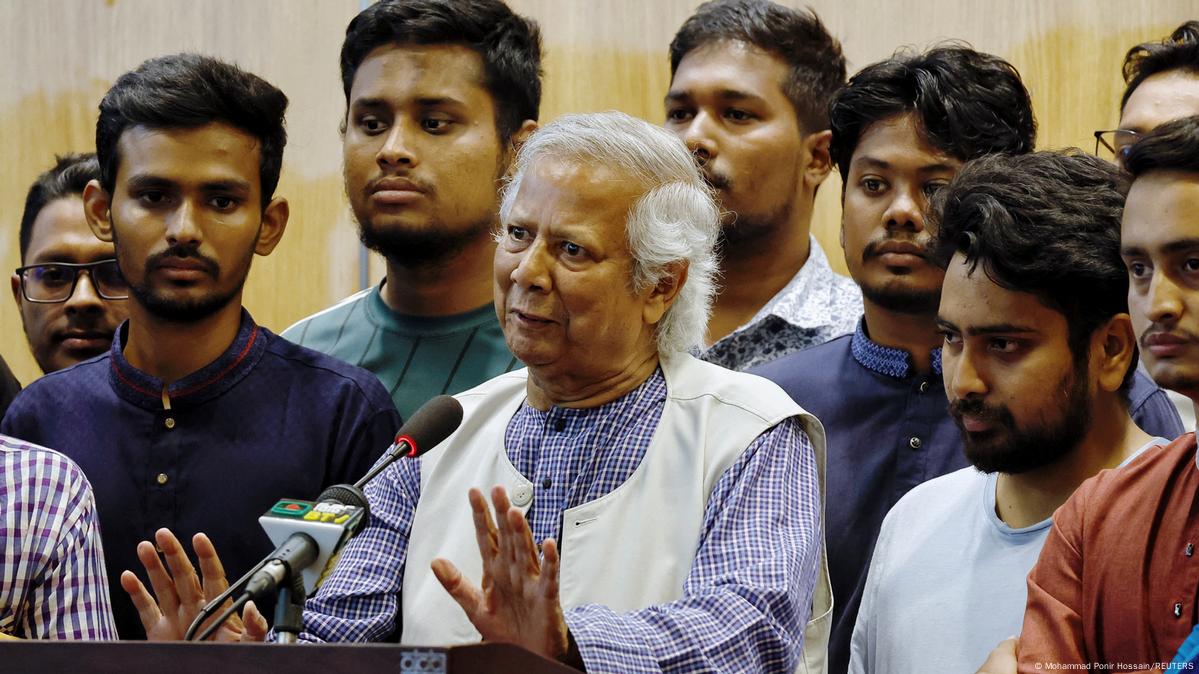
The Bangladesh interim government led by Nobel Laureate Yunusand flanked by student leaders
I arrived in Dhaka on Thursday, November 21st from Brisbane which is my usual place of residence. Before coming to Dhaka, over the last three months or so, after the fall of the Hasina regime on August 5th, which ended 16 years of fascist rule, most of our friends and a number of others were living in hope that this time Bangladesh was truly heading in a positive direction. Despite the cruel August floods and a series of crises/movements led by the remaining thugs and criminals of the ousted Awami League (AL) and Chatra League, many of us in Brisbane thought and hoped that the situation on the ground was not as bad as reported by several media outlets. The media had been feeding conflicting, if not incorrect, information. I have been actively objecting to and arguing against any negative comments and references, trying to uphold the spirit of the July 24 uprising/movement. After all, it is now well-documented through several sources that more than 1,500 lives—students, members of the general public, youngsters, and even children—were lost during the uprising. More than 500 people lost their eyesight permanently. Nearly 50,000 were injured, some of whom are still fighting for their lives. So, talking about the spirit, I was simply absorbed with tremendous hope, and perhaps for the first time in the last 53 years since we earned our independence in 1971, I felt that the generation who led this movement was very different from those I had known, and they were simply too strong to let the great July revolution’s outcome slip away.
However, I have been proven wrong. On the ground, the situation is quite different. If I can summarize in one sentence: “If this is not anarchy, what is?”
I deliberately tried to talk to several people from different levels of society, spending hours reading the print media and watching many TV shows and daily live news. I would love to share my conclusions here (they are, of course, subjective and may not align with many others).
1. An Inconvenient Truth:
As our beloved Prophet once said, “If you tell me that the great Uhud Mountain has shifted overnight, I will believe it, but it would be hard for me to believe if you tell me the character of our people has changed!” – what a cruel truth that accurately portrays us, the people of Bangladesh, and perhaps many around the world. So, before getting too excited, we must remember this inconvenient truth.
2. India’s Involvement:
India is not just active but super active in destabilizing the current interim government. They are pouring a lot of money and deploying agents alongside the AL and other criminals across various sectors to create disturbances and unrest. In all recent incidents, these thugs and criminals have infiltrated and taken the lead, creating unprecedented chaos, stalemate, and a sense of unbelievable insecurity. Even Uber drivers and private car owners are hesitant to take their vehicles onto the streets for fear that their vehicles will be damaged.
3. Political Parties:
Political parties, specifically the BNP, are systematically making the affairs of the current interim government incredibly difficult by making threats, imposing demands (e.g., a long list of constitutional changes, pushing the interim government to include their nominated individuals in committees and commissions, etc.), and offering unfair criticism. The most notable of all is their grassroots thugs, who are behaving as though they are currently in power. It is unbelievable that almost all Chatra League and Awami League offices throughout the entire country were looted and taken control of by BNP groups. Overnight, it is said that before Hasina landed in India on August 5th, BNP-affiliated groups such as Chatra Dal and Jubo Dal took control of these areas and markets. Overnight, they changed the sign plates to BNP and began operating from there. However, under directives from BNP high command, many of these offices have been shut down. It is just a matter of time before they will take these offices back. God knows how many so-called advisors to the BNP Chairperson there are, but they are out and about everywhere, shouting at the interim government through different talk shows, pressurizing them for elections. BNP knows very well that they are becoming incredibly unpopular, and with time, they will find it hard to maintain their position as the largest political entity. Jamaat, on the other hand, is staying quiet and visibly supporting the interim government. In all their gatherings, they are actively promoting the idea that they are an alternative to the three long-standing political entities—AL, BNP, and JP—and that these parties have miserably failed the people of Bangladesh in every sector of governance. In my quick chats with more than thirty people, including my own family, over the past week, no one—absolutely no one—would vote for BNP in the upcoming election. They will vote for either Jamaat or a newly formed student-led party.
4. Student Groups and the Anti-discrimination Student Movement:
Post-August 5th, student movements have become increasingly complex. Islami Chatra Shibir (the student wing of Jamaat-e-Islami) which had been operating undercover for a long time during the Hasina regime, has resurfaced as a political entity in different educational institutions, particularly in universities across the country. BNP-affiliated Chatra Dal and Jubo Dal are trying to establish dominance, not only in different areas and markets around the city but also in educational institutions. Often, Chatra Dal and Chatra Shibir clash with each other. A part of the Anti-discrimination Student Movement, which spearheaded the July-August uprising along with civic groups and a few other student platforms, has formed a new entity called the Jatiya Nagarik Committee (JNC). It is rather confusing to to identify the key actors in this zoo. The members of the JNC launched a roadshow a few weeks ago, traveling around the country to garner support for their platform to build a new Bangladesh. Sadly, their intention was not noticeably clear. They had to wrap up their show after receiving unpleasant responses from the general public. At present, we continue to see a few known faces, such as Sarjis and Hasnat, in different gatherings. However, it is not clear whether the very student platform that led the massive uprising during July-August still has wider control over the recent incidents. In fact, soon after August 5th, the Anti-discrimination Student Movement, led by Hasnat and Sarjis, crushed a large number of BAL-Chatra League-backed protests and attempts to destabilize law and order. Police and law enforcement agencies relied on their intelligence and support initially, but in recent times, that mode of operation has completely failed. Student groups everywhere are now openly criticizing the Anti-discrimination Student Movement or the JNC. Talking to people on the ground reveals that the students have sadly lost support. Some are even openly challenging whether they would get the large response they did during the July-August uprising if they called for any gathering or movement. Having said that, the Anti-discrimination Student Movement has, over the past few months, acted as a pressure group to influence the interim government in making decisions, such as banning Chatra League. However, in very recent times, the government is ignoring their calls and demands. This is a sensible move. That said, it is not clear at all to whom the interim government is listening. People say they are more confused than the public, and at times, they are seen as bowing to BNP’s intensive demands.
5. Army and Law Enforcement Agencies:
The army’s role is not clear to anyone. However, it is widely believed that higher-ranking officers are still loyal to the members of the ousted Hasina regime, and there have been many leaked phone conversations revealing talks between army officers/generals and BAL leaders who fled the country. The army chief, Gen. Waqar, knows this but won’t take any action. The advisor for home affairs, Lt. Gen. (ret.) Jahangir Alam Chowdhury, oversees the police, RAB, BGB, and Ansar. He is considered one of the weakest home ministers/advisors. His reluctance and inaction have led to several unpleasant events in recent times. The intelligence under his portfolio is pretty much non-functional. Police, in my own eyewitness account, are playing the role of bystanders. The army, in some places, acts, but in nine out of 10 situations, it is too little, too late. Students openly exchange inflammatory remarks at the armed forces without any fear whatsoever.
6. The Government of the Day (The Interim Government):
Professor Yunus is deliberately avoiding the media in recent times. He gets irritated quickly. It is not clear who he is listening to, but one thing everyone here says is that he is not going to support an election soon. He wants several reforms completed before the election. These reforms are primarily the election commission reform and the revised constitution. Both will take longer than another 12 months. The rumour is that the earliest date the government has in mind is June-July 2026 for the national election. I am not sure if the BNP will let the interim government (IG) delay it that far.
The biggest plus the IG has so far been the wholehearted support for Prof Yunus. However, people are extremely critical of the role of more than 70% of the advisors. Notably, the advisors for home affairs and education. Serious questions are being asked about the role of the advisor from the student group, Mr Mahfuz Alam. He is considered by many as a radical person, who is pushing a kind of agenda that is very similar to “-2” agenda of 1/11 caretaker government. A couple of days ago his Facebook status has ignited a fiery debate among many BNP leaders. He has openly criticised BNP being responsible for raging a campaign to vilify the July-Augst student movement and also doing all it can to destabilize the IG. This is a serious allegation and in his current position, he should have restrained himself from this unnecessary statement. The other two student advisors are pretty active in their roles, however, more and more they are facing obstacles to do their job.
7. The Role of Media:
Post 5th Aug, all the media channels are enjoying an unprecedented freedom that they never had over the past 53 years since independence in 1971. This certainly has created huge chaos and confusion, and many media outlets are appearing as sources of disinformation. General public do not necessarily have the time and capacity to check these and pick the correct ones, resulting into rumour mills running in full swing. One item the media are throwing every day in large numbers are the talk shows. The so-called recycled politicians they bring into these shows are so contentless and all out liars that it is so hard to swallow.
8. Some Recent Events – “Chaos is Probably an Understatement”
#1 Battery Operated Auto Rickshaw Fiasco A week ago, before I arrived, someone in the IG filed a writ with the High Court to ban all the battery-operated rickshaws in Bangladesh. The High Court made the ruling to ban these rickshaws within three days. This decision came as a result of a serious accident where a university student lost her life due to an uncontrollable brake system in one of these rickshaws. However, the government did not consider the impact of this decision on nearly one million rickshaw pullers in the country. Behind each rickshaw, on average, 6-8 people are impacted. They include the families of the rickshaw pullers, people involved in the repair shops, battery shops, and the rickshaw owners. This means that 6-8 million people are directly affected. This doesn’t include the passengers – it is estimated that more than 10 million passengers are impacted daily.
The rickshaw pullers then went on countrywide movements, blocking roads and key junctions, almost bringing the whole country to a halt. I was stuck for hours in one such blockade near Bijoy Shorony.
So, what did the government do? They themselves submitted another writ to the High Court to withdraw the ban. What a flip-flop! Not exactly the same, but this closely compares with the student quota movement debacle. The High Court ruled a stay order for one month before any decision could be made.
#2 Clashes Among Students from Different Colleges in Dhaka Students from Dhaka College and City College engaged in intermittent clashes on the afternoon of November 20th, Wednesday, at the Science Lab intersection area, leaving at least 32 people injured. The clash erupted when some Dhaka College students vandalized a bus in the Science Lab area. This led to intense arguments and escalated into a physical altercation with City College students.
On November 18th, Mollah College (located on the Dhaka Demra highway near Samadnagar, Kotwali Police Station) student Avijit died in Dhaka National Medical College Hospital due to alleged negligence. Following Avijit’s death, students demonstrated against the hospital authorities in the hospital premises. Eyewitness reports say that the hospital authorities at that time sought help from nearby Suhrawardy and Kabi Nazrul College Chatra Dal students. Students from Suhrawardy and Kabi Nazrul colleges then attacked the demonstrators from Mollah College on November 21st.
Following the attack, several thousand students, including those from Mollah College, Dhaka College, City College, and Notre Dame College, gathered in front of the hospital again on November 24th, protesting the death of Avijit and the subsequent attack on Mollah College students. It is believed that some students from St Gregory’s School and College also joined this protest.
At one stage, the protesters stretched their movement towards Suhrawardy and Kabi Nazrul College and engaged in clashes and counter-clashes. The violence continued the following day when students from Suhrawardy and Kabi Nazrul College, in large numbers, attacked Mollah College and ransacked the entire college building. More than 100 students were injured during the clashes. It is also reported that the student mob from Suhrawardy and Kabi Nazrul College attacked St Gregory’s School/College on Monday, November 25th, in retaliation for the altercation the day before, the St Gregory’s school administration shut down the school indefinitely to avoid any further escalation.
Unconfirmed sources also report that a large number of students in different universities, including BUET, and college hostels, are fleeing Dhaka temporarily to avoid any escalation of the above events. Unconfirmed sources reported that at least three students died during the attack and several others among the 100 injured are in critical condition.
#3 Thousands Gather in Shahbag, Dhaka from Several Districts to Receive Interest-Free Loans from Prof. Yunus More than 20,000 people from at least five districts were circulated with stamped notes and boarded on chartered buses to arrive in Dhaka and gather in Shahbag to get interest-free loans ranging from one lakh to one crore taka. This incident took place on November 25-26. Police investigations afterward revealed that almost all these buses were chartered by banned Chatra League and Jubo League thugs. It is interesting to note a serious intelligence failure from the law enforcement agencies.
#4 Arrest of ISKCON Leader Chinmoy Das Chinmoy Krishna Das, of Bangladesh Sommilito Sanatani Jagran Jote, was arrested on November 26th, Tuesday, on charges of disrespecting the national flag during a protest rally in Chittagong on October 25th. Chinmoy, a leading figure of ISKCON in Bangladesh, had led several rallies in Dhaka, Chittagong, and Rangpur in recent times, inciting communal tensions. Ekushey TV also reported child and underage sexual abuse accusations against him.
The port city of Chittagong went into turmoil as significant clashes broke out between the police, BGB, and Chinmoy supporters from ISKCON. These clashes turned violent when Chinmoy was being transferred from the courthouse to jail after his bail was denied. It is reported that a mob led by ISKCON supporters and some thugs from the banned Chatra League went inside the lower level of the Chittagong Courthouse and brutally hacked Government Attorney Mr. Saiful Islam Alif to death in broad daylight. The deceased left behind his pregnant wife and a 4-year-old daughter. This news spread like wildfire in the port city, and several others were seriously injured.
Several Western and Indian news outlets reported this incident incorrectly. One newspaper mentioned that Mr. Alif was working for Chinmoy Das, and that a student-led public mob killed him. Another outlet reported that he was killed during clashes with law enforcement agencies. Ousted ex-PM Hasina, now sheltering in India, opened her mouth for the first time in Hindu Times, demanding the immediate release of Chinmoy Das and condemning the death of Mr. Alif. Interesting, to say the least.
More than 200,000 people took part in the Janaza in Chittagong. Advisors from Prof. Yunus’s cabinet and leaders of the student movement, Mr. Sargis Alam and Hasant Abdullah, attended the Janaza. There were four Janaza prayers before Mr. Alif was buried in his hometown in Satkania, Chittagong.
When Sargis and Hasanat were returning from Satkania after the burial of Mr. Alif, their car was deliberately hit by a mini truck. Sargis and Hasanat, along with two others in the vehicle, narrowly escaped injury. Later, the driver of the mini truck was arrested and found to be disputing his own accounts.
The brutal murder of Mr. Alif brought a deep sense of sadness and shock among everyone in the country. People have demanded the banning of ISKCON and submitted a writ to the High Court. The High Court has denied the writ and mentioned that it is the decision of the government to ban any organization.
With repeated requests from different political leaders, political analysts, and most importantly, the Anti-discrimination Student movement, people in Chittagong showed their utmost restraint, preventing the murder of Mr. Alif from escalating into any communal violence. This would have given Hasina and her Indian protectors the ammunition to launch another Hindu minority attack issue. They certainly failed again.
#5 Strikes Continue in Several Garment Factories in Gazipur, Causing Road Blockages, etc., as Employees Are Unpaid for More Than a Couple of Months The strikes in Gazipur have continued, with workers demanding their unpaid wages. This has caused significant disruptions, including road blockages.
#6 Bangladesh Bank Prints 22,500 Crore New Money to Bail Out Six Dying Banks BB U-turn: Prints 22,500 Crore to bailout 6 banks. The banks include FSIBPLC, SIBL, Exim, National, Union, and Global Islami. The Bangladesh Bank will withdraw this money from the market by issuing new bonds. The money flow into the market will not increase, nor will inflation rise, says the BB Governor.
From the Dhaka Tribune: Ahsan H. Mansur also stated, “We backtracked from our previous decision of not printing money. We injected money into weak banks by printing money for the short term.”
“We will withdraw this money from the market by issuing bonds. We will proceed with our tight monetary policy, giving money in one hand and taking it in the other. The flow of money into the market will not increase, nor will inflation rise. This will not create unrest in the market either,” he added.
In this way, the net reserve money will not increase, he stated. “The banking regulator is now helping weak banks with liquidity support so that the depositors can get their money back,” the governor said.
Conclusion:
In conclusion, while my experience in Dhaka has been a rude awakening, I must admit that the situation on the ground is far more complex than I had initially believed. The optimism that many of us held before arriving here has been tempered by the harsh realities of life in a politically unstable nation. The road ahead for Bangladesh is filled with uncertainty, but the resolve of its people gives me hope that they will continue to strive for a better, more prosperous future.
For now, I remain cautious but hopeful. Change will not come easily, but with persistence and resilience, it is possible. The challenge will be whether the people of Bangladesh can unite and overcome the divisions that have held them back for so long. If they can, there may yet be a bright future ahead. But until then, the battle for a better Bangladesh continues.
Aunul Islam, read for his PhD at Imperial College, London. He graduated from The University of Manchester. He is a Quality Assurance Specialist in Higher Education and a Technology Consultant. He is an ex-civil servant of the UK government. A keen gardener, he finds solace through nature in this dysfunctional world order.
As I reflect on the July uprising that toppled the long reign of Sheikh Hasina in Bangladesh, I recall the film entitled “Ashani Sanket” (Distant Thunder). It is a 1973 Bengali film directed by the late and legendary director Satyajit Ray. A New York Times critic called it a fable. It is through the prism of this fable that I will revisit some recent historical episodes in Bangladesh and contemporary developments.
The film was based on the Bengal famine during World War II. The irony of this was that the famine was entirely a man-made one. Then-British Prime Minister Churchill’s war effort diverted most of the food crops away from the civilian population. Millions perished, with estimates ranging from 2.5 to more than 3 million.
Ironically 30 years later and a year after ‘Distant Thunder’ was released, famine returned to Bengal (March 1974-December 1974). Geopolitically, the world by then was a different place. It returned to erstwhile East Bengal which emerged as the newly formed nation of Bangladesh. This famine too was a man-made one leading, according to some estimates, to the death of 1.5 million people.
With the failure of American policy in the Indian sub-continent that failed to prevent the emergence of Bangladesh, the US government engaged in the cruel endeavour of making Bangladesh a ‘failed state.’ Hence, it withheld much-needed food aid to Bangladesh despite the prevalence of one of the worst famines in recent history.
Perhaps, now, Bangladesh’s young history (three years after independence) has changed the direction of the nation. The history of a nation was changed because Bangladesh was considered a homogeneous society and the nation speaking one language, Bengali, of course with the variation of dialects. In terms of religion too, it was homogenous, as it was a Muslim population but with a secular disposition. Unlike Pakistan and India that have different ethnicities or groups like the Punjabis, Balochis, Pathans, Gujaratis, as well as many indigenous populations where homogeneity does not exist as such. With diverse ethnicities, socio-political management becomes challenging for some nations in South Asia to have stability. Pakistan is suffering huge instability due to this, and India faces the strain of managing its fractious communities.
Bangladesh should have remained stable in terms of its homogeneity but, alas, USA created a new fault-line. It sought to divide the nation by seeking to create a failed founding leader and establishment of another group, the so- called “saviours” of the nation.
It reminds me something from history. When the British were strategically trying to enter India, one of the observations was the pride of the different languages the people of the subcontinent spoke! Destroy this, the nation will be divided, and the “will” to fight! Introduce English and this will create the fault-line to colonise them.
The 1974 famine was followed in 1975 by the brutal killing of Sheikh Mujibur Rahman (the country’s Prime Minister and founder of the nation) and most of his family members. The country was at that point in time the second poorest in the world (after Burkina Faso). The very fabric of the society was simple and therefore overcoming the shock of Mujib’s assassination was easier than it would have been presently.
In July-August 2024, a so-called “revolution” took place in ousting Sheikh Hasina as the Prime Minister after 16 years of rule, which is the culmination of the venting of pent-up frustration of the way that the country was run at the top. It reminds me also of a book entitled “Prisoners of Geography” and the many geopolitical pressure that impinge on a developing country but a country that was on the way to becoming a middle income economy and trying to free itself from being a prisoner of geography.
One could look at the film “Distant Thunder” either as a commentary on the past or the Thunder that is going to be in the future. Here, I will attempt and to try to understand and narrate what could be a bad omen for the Bangladesh as a nation.
To add to the fault-line, it is unique only to Bangladesh that the student community leads political agitations. This happened in the case of the 1952 language movement where students played a crucial role. In 1971, the student community played a significant role along with the mass of the population. However, one of the negative aspects of any student-led revolution is that it could lead to chronic instability and reduce a nation’s prospects to become a prosperous middle-income economy.
At this point, I tried to re-visit the French Revolution and its long-lived impact on the psyche of the French nation. Even today, the most violent riots that takes place is in the French capital Paris. Thousands of cars have been burnt in few days in 2019 and 2021. This is unlike other neighbouring European countries. A prosperous country like France can afford its ‘revolutionary moments,’ but can Bangladesh?
Now let me revisit the situation in Bangladesh. The revolutionary moment was random (or was it “meticulously planned and executed” as maintained by Yunus, the Head of the Interim Government?) Many people lost their lives and thousands were injured at the hands of security forces, but the police also bore the wrath of the protestors when Sheikh Hasina’s regime fell. Many police stations were burnt to ashes and many ancestral homes of Hasina’s political members, and the civil servants were destroyed. Many became victims of mob violence and even as this is being written, the scenario is in a state of flux.
The strange position that the army took as a silent bystander is not helpful to the nation. They have been very selfish because their position as peacekeepers in the United Nations would be jeopardised and lost. They became silent partners and in doing so have really destroyed the very political and social stability of a country and it does not bode very well for the nation and ironically, they have lost the control of the population. On top of that, it has created a deep division with the police.
So, what transpired after three months of the takeover by the interim government is that it did not take a strong decision on the student-led revolution and make the student leaders go back to basics, that is, study first and be nation builders later. One cannot have a situation where self-appointed student leaders are running a nation and seeking to control key policy decisions. This has never been seen anywhere in the world! Ironically too, they want to rewrite history.
Bangladesh can least afford to be running a new experiment in student-led national governance. It is an Ashani Sanket (Distant Thunder) for the future of Bangladesh!
In reporting on financial and economic statistics, it is important to distinguish between stocks and flows as well relative and absolute numbers. Stocks (accumulated value of a variable over a given period) typically catches public attention in a way that annualised data usually do not. Similarly, relative figures usually turn out to be a lot more modest than absolute numbers. I will illustrate these points by drawing on the Bangladesh experience.
In Bangladesh, media reports conflate typically stocks and flows. The currently popular citation is that US$ 150 billion has been siphoned off to various overseas havens by politically connected individuals over the last 15 years. Some media reports proceed to express stock estimates of money laundering as a proportion of flow data (annual GDP). This can befuddle the lay reader.
There is the issue of relative vs absolute numbers. Annualised data on money laundering can be expressed as a proportion of a country’s GDP. This is what the UN does. Another advantage is that this relative number offers an indication of the potential output loss from money laundering. In the case Bangladesh, a back-of-the envelope estimate (which is based on the annualised estimate of USD150 billion) suggests that it is 3.2% of GDP. The global norm ranges between 2-5% of GDP.
Has the incidence of money laundering has gotten worse over time? Here, the changes in country-specific ranking anchored in an ‘anti-money laundering index’ for 152 countries by a Swiss organisation, can be useful (1= worst, 152= best). BD ranked 82 in 2017, but then fell below 40 in later years before recovering to 46 in 2023. Why this has happened merits further investigation.
Finally, it is worth noting that, however measured, money laundering represents massive waste of resources enriching some at the expense of poorer nations. To be resolved, it needs global cooperation. Why is it that Singapore and London, for example, allow themselves to become havens for laundered funds? Indeed, London has been described as …’the main nerve centre of the darker global offshore system that hides and guards the world’s stolen wealth’. If the authorities there camp down on such havens (which they can), the incentive to park illicit funds abroad by crooks and criminals from developing countries will be significantly diminished.





 Reflections on development and governance