Blog

The economic consequences of COVID-19: For the first time in 60 years, growth is expected to be zero in the Asian region


Figure 1

Figure 2

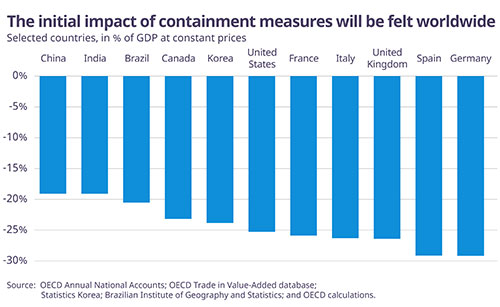
Grim forecasts of the economic consequences of COVID-19 have now become the norm. In its April World Economic Outlook, the IMF predicts a contraction of world GDP growth that is much larger than the global financial crisis of 2008-2009. Not surprisingly, this has been described as the worst global downturn since the Great Depression. This is the consequence of what the IMF calls the ‘Great Lockdown’, as economic and social activities are sharply curtailed across the world to contain and mitigate the coronavirus pandemic.

The Asian region, which includes some of the most dynamic economies in the world and accounts for more than 60% of the global population, is facing zero growth for the first time in 60 years. The region has endured the oil crisis and stock market crash in the early 1970s, the Asian financial crisis of 1997-98 as well as the global financial crisis of 2008-2009 without suffering a region-wide recession, although a number of countries experienced negative growth. But this time is very likely to be different. Regional growth is predicted to plummet to zero, although other forecasts, such as by the ADB, are less dire. Both the IMF and alternative forecasts concur that there will be a recovery in 2021. Nevertheless, in the short run, the poor and vulnerable in the Asian region are likely to bear the brunt of the sharp growth slow-down, while also bearing the brunt of a public health crisis.

Some of the affluent nations of the world have demonstrated that they are prepared to amass huge fiscal and financial resources, equivalent to more than 60% of US GDP, to ameliorate the rather adverse economic consequences of fighting the coronavirus pandemic. The poorer countries of the Asian region are unlikely to match such firepower. What Japan or even China can do, Cambodia cannot. Such countries will have to rely significantly on external assistance both through bilateral donors and multilateral agencies. Whether such assistance will be forthcoming on a timely and adequate basis remains to be seen.

Beyond COVID-19: ‘The America we need’

Where is the America we need?


It was not so long ago that the United States was enjoying its ‘unipolar moment’ as the world’s sole superpower. Communism collapsed and thus obliterated the Soviet Union. China was well on its way to embrace key elements of capitalism as part of its strategy to integrate with the global economy after decades of immiseration as an autarchy. The American political elite felt charitable and confident enough to accommodate the peaceful rise of China. Some declared an ideological victory by proclaiming the ‘end of history’. A US-led liberal democratic future was regarded as the only way forward after decades of fruitless ideological battles between communism and capitalism.

How the status quo has changed! It needed a pandemic like COVID-19 to bring the world’s sole hegemon ‘to its knees’. The world’s most influential nation now finds itself among the most ‘infected’, with over 20,000 fatalities. More such tragedies await an anxious nation led by a feckless leader whose administration bungled its response in dealing with a pandemic. While one is deeply saddened by current developments, what matters is what lies ahead. How the future of America evolves from here matters not just for Americans but will deeply affect the global community given the unique position of the United States in world affairs.

There are those who are doggedly optimistic that America is the ‘comeback nation’. In sharp contrast to this rosy narrative, some note with deep sorrow the death of the ‘myth’ that the US is the best country in the world.

As a leading scholar of international relations reminds us, COVID-19 and its lethal consequences on the American community have simply accelerated the fraying of the American model:

Long before COVID-19 ravaged the earth, there had already been a precipitous decline in the appeal of the American model. Thanks to persistent political gridlock, gun violence, the mismanagement that led to the 2008 global financial crisis, the opioid epidemic, and more, what America represented grew increasingly unattractive to many. The federal government’s slow, incoherent, and all too often ineffective response to the pandemic will reinforce the already widespread view that the United States has lost its way.

Others have speculated that…

As Washington falters, Beijing is moving quickly and adeptly to take advantage of the opening created by U.S. mistakes, filling the vacuum to position itself as the global leader in pandemic response.

The irony is that the pandemic originated in China whose initial missteps converted a local affliction into a pernicious global phenomenon. Yet, China’s assertive measures contained the crisis enabling it to declare victory against an epidemic and allowing it to act as a global citizen helping other nations in distress. The US administration has tried to pin the blame on China by depicting the pandemic as the ‘Chinese virus’, but this smear campaign has been unable to elicit any sympathetic and significant response from the global community.

The agenda of rebuilding the ‘America we need’ rather than the ‘America that we have’ is going to be long and arduous. Assuming that there is a change of Presidency in the November elections, deeply embedded inequities in the American socio-economic fabric would need to be tackled. Whether this crisis will lead to a ‘better America’ remains to be seen. After the pandemic is over, one might well witness a resumption of rapid growth, a resurgent stock market and (eventually) a buoyant labour market, but if it means replicating the deeply flawed structural features of the US economy, then the ‘comeback nation’ will not be the ‘America we need’.

What’s in a language? Social distancing vs safe distancing

People maintain social distance as they shop during the tenth day of the lockdown imposed by the government amid concerns about the spread of coronavirus disease (COVID-19), in Kathmandu, Nepal April 2, 2020. REUTERS/Navesh Chitrakar - RC26WF9AZUOZ

KEEP YOUR DISTANCE – BUT SHOULD IT BE CALLED ‘SOCIAL DISTANCING’?


Social distancing – along with such terms as self-isolation, quarantine, stay-at-home orders, lockdowns – have now become part of everyday conversation as governments across the world seek to cope with the COVID-19 pandemic.

The American Psychological Association  observes:

Social distancing means keeping a safe distance (approximately 6 feet or 1.5 metres) from others and avoiding gathering spaces such as schools, churches, concert halls, and public transportation.

Yet, dissenting voices have emerged about the validity of using this term. Used in other contexts, social distancing has deeply embedded prejudicial connotations. In South Africa during the apartheid era, ‘social distancing’ of the privileged whites from blacks and the coloured community persisted for a long time. In the de facto caste system of India, social distancing between upper and lower castes is still prevalent. In general, social distancing is a time-honored means of marginalizing the ‘other’. In any case, social distancing as a term implies the severing of human connections that is so essential to one’s emotional and physical well-being. So, why use it in the context of public policy to respond to a global public health crisis?

Not surprisingly, this usage is beginning to change, albeit slowly. One analyst notes:

On March 20, the World Health Organization said it was officially changing its language. “We’re changing to say ‘physical distance,’ and that’s on purpose because we want people to still remain connected,” said WHO epidemiologist Maria Van Kerkhove announced (pdf) at the organization’s daily press conference. Singapore calls it “safe distancing.” Stanford psychologist Jamil Zaki suggests physical distancing or “distant socializing.” “’ Social distancing’ was the wrong term to begin with,” he said in this  Q&A on Stanford’s website.


India goes into lock-down to fight COVID-19: Is the cure worse than the disease?

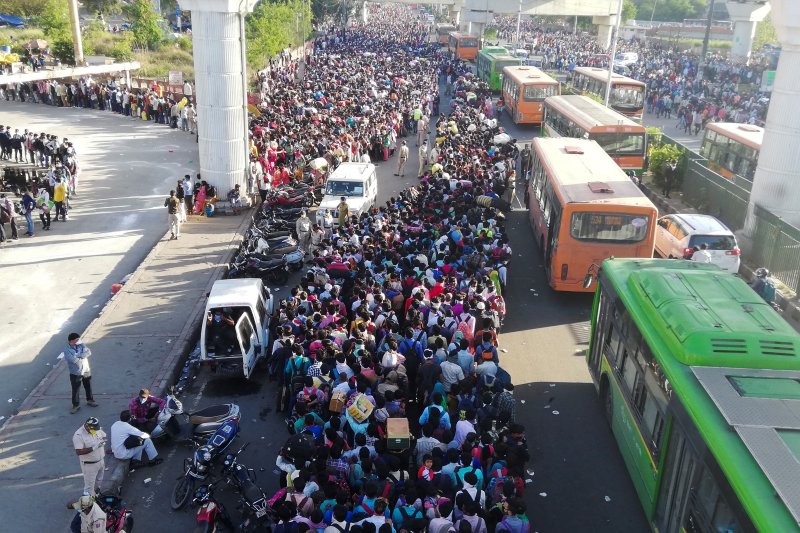
Migrant workers and their family members lineup outside the Anand Vihar bus terminal in New Delhi on March 18 to leave for their villages during a government-imposed nationwide lockdown.

What social distancing? Desperate migrant workers struggling to return home after India suddenly goes into lock-down to fight COVID-19

Prime Minister Modi announced a nation-wide lockdown on 25 March barely giving millions of Indians four hours to prepare for it. It turned out to be the strictest and world’s largest lock-down – which is not surprising given the size of India’s population (1.3 billion).

At least one Indian op-ed writer in a leading national newspaper was optimistic that the draconian measure might work. Writing a few days before the hastily announced lock-down, he observed:

With traditional, non-state safety nets still mostly functional, India is better placed than the West to face up to pandemics.

The esteemed op-ed writer must have rued the words he wrote after the lock-down triggered panic-buying among those who could afford it and, even worse, a mass exodus of migrant workers from India’s mega-cities. Given that all forms of transport were also shut down, the enforced migration back to the villages often occurred on foot as struggling workers and their families – after having suddenly lost their livelihoods – sought the safety and sanctuary of family and friends – watch this video which depicts heart-wrenching scenes of migrants desperately seeking to return home. More than 20 migrants paid the ultimate price by dying during their perilous journey. This number is pretty close to the deaths recorded in India as a result of the coronavirus pandemic. Paradoxically, the mass exodus simply heightened the risk of community-level transmission of COVID-19.

Modi offered an apology and tried to calm down a panicked nation, while authorities at all levels tried to cope with the awful, but unintended, consequences of India’s fight to vanquish COVID-19 by setting up soup kitchens and hastily erected quarantine facilities. A modest stimulus package geared towards the poor and vulnerable was also set up, but such efforts might be a case of too little, too late.

Could this potential human tragedy have been foreseen? Anyone familiar with the harsh structural realities of India’s socio-economic fabric could not have been sanguine about the consequences of a nation-wide lockdown.

India’s megacities rely heavily on migrant labour. They typically form a large part of India’s vast informal sector. They work as street vendors, cooks and cleaners. They toil away in small shops, factories and construction sites. For many of them, the ‘home’ in which they could engage in self-isolation might be a footpath, a floor in a work-place or a squalid, cramped room in an urban slum. Not surprisingly, a former Indian health secretary has observed:

Lockdown as a solution can be observed by the Indian middle class, which has regular salaries, a secure home space, and can afford the luxury of physical distancing.

As if to prove this point, one author from Delhi writes, with a huge dose of self-deprecation, how an upper-middle-class Indian twit would ‘quaff wine in comfort’ as he/she practices self-isolation and social distancing while the ‘poor are thrown to the wolves’. 

Does this mean that countries like India should simply forgo any attempt to engage in lock-downs and social distancing measures to cope with a public health crisis? Should one invoke the notion of ‘herd immunity’ to justify this laissez-faire approach even if it means the large-scale loss of life? Should one adopt Brazilian President Bolsonaro’s view that Indians like Brazilians have natural immunity or should one emulate the proclamation of the strongman of Belarus and seek to ‘die standing’ rather than engage in large-scale social and economic disruption to cope with a pandemic? Modi, of course, did none of this – but his government could have been much better prepared to reduce the adverse consequences of a national lock-down on the poor and vulnerable. The state of Kerala has led the way in this regard and other Indian states have much to learn from this experience.