“Distant Thunder” – What lies ahead for Bangladesh?

By Aunul Islam

Aunul Islam, read for his PhD at Imperial College, London. He graduated from The University of Manchester. He is a Quality Assurance Specialist in Higher Education and a Technology Consultant. He is an ex-civil servant of the UK government. A keen gardener, he finds solace through nature in this dysfunctional world order.

As I reflect on the July uprising that toppled the long reign of Sheikh Hasina in Bangladesh, I recall the film entitled “Ashani Sanket” (Distant Thunder). It is a 1973 Bengali film directed by the late and legendary director Satyajit Ray. A New York Times critic called it a fable. It is through the prism of this fable that I will revisit some recent historical episodes in Bangladesh and contemporary developments.

The film was based on the Bengal famine during World War II. The irony of this was that the famine was entirely a man-made one. Then-British Prime Minister Churchill’s war effort diverted most of the food crops away from the civilian population. Millions perished, with estimates ranging from 2.5 to more than 3 million.

Ironically 30 years later and a year after ‘Distant Thunder’ was released, famine returned to Bengal (March 1974-December 1974). Geopolitically, the world by then was a different place. It returned to erstwhile East Bengal which emerged as the newly formed nation of Bangladesh. This famine too was a man-made one leading, according to some estimates, to the death of 1.5 million people.

With the failure of American policy in the Indian sub-continent that failed to prevent the emergence of Bangladesh, the US government engaged in the cruel endeavour of making Bangladesh a ‘failed state.’ Hence, it withheld much-needed food aid to Bangladesh despite the prevalence of one of the worst famines in recent history.

Perhaps, now, Bangladesh’s young history (three years after independence) has changed the direction of the nation. The history of a nation was changed because Bangladesh was considered a homogeneous society and the nation speaking one language, Bengali, of course with the variation of dialects.  In terms of religion too, it was homogenous, as it was a Muslim population but with a secular disposition. Unlike Pakistan and India that have different ethnicities or groups like the Punjabis, Balochis, Pathans, Gujaratis, as well as many indigenous populations where homogeneity does not exist as such. With diverse ethnicities, socio-political management becomes challenging for some nations in South Asia to have stability.  Pakistan is suffering huge instability due to this, and India faces the strain of managing its fractious communities.

Bangladesh should have remained stable in terms of its homogeneity but, alas, USA created a new fault-line. It sought to divide the nation by seeking to create a failed founding leader and establishment of another group, the so- called “saviours” of the nation.

It reminds me something from history. When the British were strategically trying to enter India, one of the observations was the pride of the different languages the people of the subcontinent spoke! Destroy this, the nation will be divided, and the “will” to fight! Introduce English and this will create the fault-line to colonise them.

The 1974 famine was followed in 1975 by the brutal killing of Sheikh Mujibur Rahman (the country’s Prime Minister and founder of the nation) and most of his family members. The country was at that point in time the second poorest in the world (after Burkina Faso). The very fabric of the society was simple and therefore overcoming the shock of Mujib’s assassination was easier than it would have been presently.

In July-August 2024, a so-called “revolution” took place in ousting Sheikh Hasina as the Prime Minister after 16 years of rule, which is the culmination of the venting of pent-up frustration of the way that the country was run at the top. It reminds me also of a book entitled “Prisoners of Geography” and the many geopolitical pressure that impinge on a developing country but a country that was on the way to becoming a middle income economy and trying to free itself from being a prisoner of geography.

One could look at the film “Distant Thunder” either as a commentary on the past or the Thunder that is going to be in the future.  Here, I will attempt and to try to understand and narrate what could be a bad omen for the Bangladesh as a nation.

The so-called revolution represents a fault-line that may occur in running a nation where a foreign power takes advantage of it and could easily destabilize it, and this is what seems to have happened in the case of Bangladesh.

To add to the fault-line, it is unique only to Bangladesh that the student community leads political agitations. This happened in the case of the 1952 language movement where students played a crucial role. In 1971, the student community played a significant role along with the mass of the population. However, one of the negative aspects of any student-led revolution is that it could lead to chronic instability and reduce a nation’s prospects to become a prosperous middle-income economy.

At this point, I tried to re-visit the French Revolution and its long-lived impact on the psyche of the French nation. Even today, the most violent riots that takes place is in the French capital Paris. Thousands of cars have been burnt in few days in 2019 and 2021. This is unlike other neighbouring European countries. A prosperous country like France can afford its ‘revolutionary moments,’ but can Bangladesh?

Now let me revisit the situation in Bangladesh. The revolutionary moment was random (or was it “meticulously planned and executed” as maintained by Yunus, the Head of the Interim Government?) Many people lost their lives and thousands were injured at the hands of security forces, but the police also bore the wrath of the protestors when Sheikh Hasina’s regime fell. Many police stations were burnt to ashes and many ancestral homes of Hasina’s political members, and the civil servants were destroyed. Many became victims of mob violence and even as this is being written, the scenario is in a state of flux.

The strange position that the army took as a silent bystander is not helpful to the nation. They have been very selfish because their position as peacekeepers in the United Nations would be jeopardised and lost. They became silent partners and in doing so have really destroyed the very political and social stability of a country and it does not bode very well for the nation and ironically, they have lost the control of the population. On top of that, it has created a deep division with the police.

So, what transpired after three months of the takeover by the interim government is that it did not take a strong decision on the student-led revolution and make the student leaders go back to basics, that is, study first and be nation builders later. One cannot have a situation where self-appointed student leaders are running a nation and seeking to control key policy decisions. This has never been seen anywhere in the world! Ironically too, they want to rewrite history.

Bangladesh can least afford to be running a new experiment in student-led national governance. It is an Ashani Sanket (Distant Thunder) for the future of Bangladesh!

Counting the missing billions: taking care when reporting on money laundering

In reporting on financial and economic statistics, it is important to distinguish between stocks and flows as well relative and absolute numbers. Stocks (accumulated value of a variable over a given period) typically catches public attention in a way that annualised data usually do not. Similarly, relative figures usually turn out to be a lot more modest than absolute numbers.  I will illustrate these points by drawing on the Bangladesh experience.

In Bangladesh, media reports conflate typically stocks and flows. The currently popular citation is that US$ 150 billion has been siphoned off to various overseas havens by politically connected individuals over the last 15 years. Some media reports proceed to express stock estimates of money laundering as a proportion of flow data (annual GDP).  This can befuddle the lay reader.

The task of tracking money laundering falls on the Bangladesh Financial Intelligence Unit (BFIU).  I suspect, it is a small, under-resourced unit within the Bangladesh Bank (the best talent and resources probably go to units dealing with monetary policy). This does not make BFIU estimates less reliable than other estimates, but alternative estimates of annual rates of money laundering do exist and they ought to be acknowledged in public discourse. Transparency International Bangladesh (TIB) in the recent past has come up with an annualised figure of USD 3 billion, while the Washington-based Global Financial Integrity Institute (GFI) reported annualised figures of USD 8.7 billion. They note that most money laundering activities occur through trade mis-invoicing. One should not also overlook the use of the humble, but time-honoured, Hundi, as a source of money laundering. The bank heist by one of Bangladesh’s richest men is sensational but not a very common source of money laundering.

I personally prefer the use of annualised figure because they are easy to compare over time and across countries. Also, stock estimates can be made to assume astronomical magnitudes. For example, I understand that some Bangladeshi economists have come up with a stock estimate of money laundering for the 1972-2022 period. This understandably dwarfs the size of money laundering that are being reported now.

There is the issue of relative vs absolute numbers. Annualised data on money laundering can be expressed as a proportion of a country’s GDP. This is what the UN does. Another advantage is that this relative number offers an indication of the potential output loss from money laundering. In the case Bangladesh, a back-of-the envelope estimate (which is based on the annualised estimate of USD150 billion) suggests that it is 3.2% of GDP. The global norm ranges between 2-5% of GDP.

Has the incidence of money laundering has gotten worse over time? Here, the changes in country-specific ranking anchored in an ‘anti-money laundering index’ for 152 countries by a Swiss organisation, can be useful (1= worst, 152= best). BD ranked 82 in 2017, but then fell below 40 in later years before recovering to 46 in 2023. Why this has happened merits further investigation.

Finally, it is worth noting that, however measured, money laundering represents massive waste of resources enriching some at the expense of poorer nations. To be resolved, it needs global cooperation. Why is it that Singapore and London, for example, allow themselves to become havens for laundered funds? Indeed, London has been described as …’the main nerve centre of the darker global offshore system that hides and guards the world’s stolen wealth’. If the authorities there camp down on such havens (which they can), the incentive to park illicit funds abroad by crooks and criminals from developing countries will be significantly diminished.

.’

Hasina and beyond: Bangladesh at a critical juncture

Sheikh Hasina, the longest serving Prime Minister of Bangladesh, and the longest serving female Prime Minister in the world, could not defy the ‘iron law’ of history. Iron law? Yes, all political regimes have a finite time-span.

Hasina ruled Bangladesh with an iron fist. Her security forces – enabled by a pliant judiciary and media – engaged in brutal repression of opposition politicians (Bangladesh National Party and Jamaat in particular) and suppressed any significant attempt at dissent by civic activists, students, and others. Over a period of 15 years (2009-2024), the 76 years old veteran politician built a ‘deep state’ teeming with party loyalists (that is, those affiliated with the Awami League: AL). Her governance structure appeared to be a seemingly impregnable fortress that sustained Hasina’s hold on the body politic. A succession of brazenly rigged elections ensured that she would return to power again and again. Yet, a short-lived movement led by students toppled this fortress like a sandcastle on August 5, 2024. The armed forces on which Hasina relied for her ability to cling to power refused to offer their unconditional allegiance in the face of an unrelenting student movement. Hasina fled in disgrace to neighbouring India which offered her sanctuary, at least temporarily.

Initially, the protest movement targeted a contentious job reservation scheme in the public sector. This scheme disproportionately favoured the descendants of those who fought in the 1971 Bangladesh Liberation War. Such a scheme was in essence a pernicious means to induct loyalists into the bureaucracy.

Tragically, the youth-led uprising against the Hasina regime led to many hundreds of deaths of innocent students and civilians at the hands of security forces and government-supported vigilantes. Thousands were injured and many thousands were incarcerated. Students stood firm against such repression and successfully sought Hasina’s resignation once the army abandoned its support to the government.

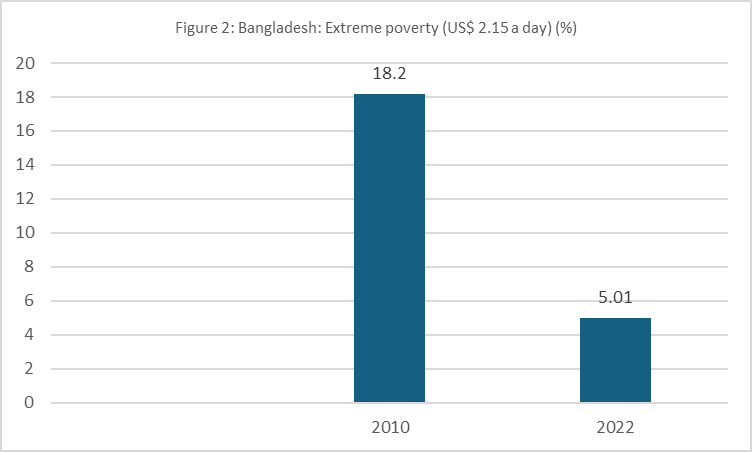
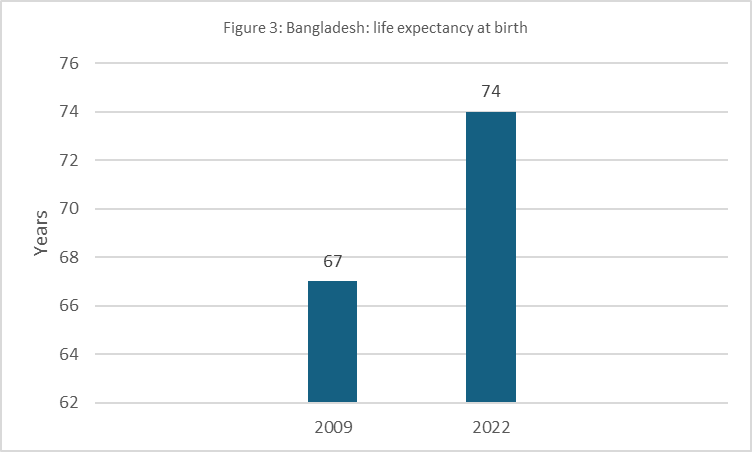
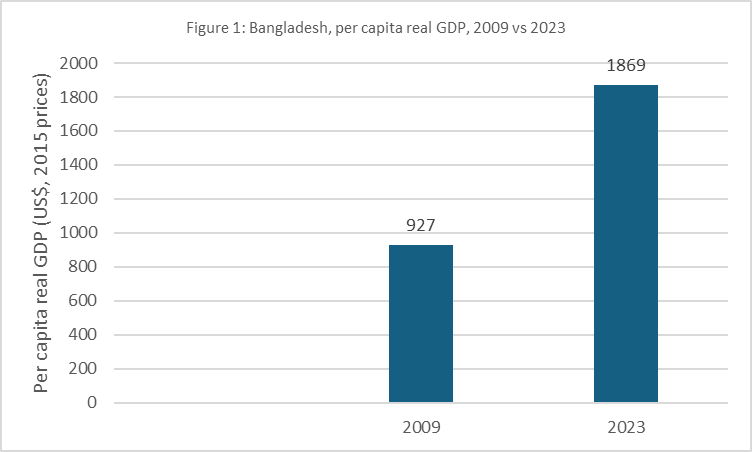
In retrospect, the Hasina regime represents a cruel paradox. Political repression was juxtaposed with substantial economic and social gains. Growth was sustained and rapid leading to a doubling of real per capita income between 2009 and 2023 – see Figure 1. Poverty fell significantly, and life expectancy increased substantially – see Figures 2 and 3. A UN assessment noted that ‘the country is internationally recognized for its good progress on several gender indicators’. The garments industry and remittances consolidated their position as leading export earners. New industries emerged, most notably pharmaceuticals and shipbuilding. Large-scale infrastructure projects were completed that enhanced communications and connectivity.

Source: https://data.worldbank.org/indicator/NY.GDP.PCAP.CD?locations=BD
 

Source: https://pip.worldbank.org/country-profiles/BGD

Source: https://data.worldbank.org/country/bangladesh

On the other hand, such achievements were nullified by massive corruption, egregious levels of inequality, and environmental degradation. The fundamental failure of the Hasina regime is that it dented the legitimacy of durable economic and social gains by denying Bangladeshis basic rights and liberties, including the right to vote in free and fair elections.

Hasina was also seen as being beholden to India. This caused public resentment at India’s influence on Bangladesh’s national affairs. Her attempt at a balancing act by wooing China was insufficient to dispel the widely held notion that she was slavishly pro-Indian.

Now that Hasina is gone, what next? An interim government, consisting of seventeen members and headed by Nobel Laureate Mohammad Yunus, has been established. It has taken the historically unprecedented step of appointing two student leaders as part of the government with full ministerial rank.

It seems that an implicit rift has developed between the Army brass, the student leaders and professional politicians represented by the Bangladesh Nationalist Party (BNP) and Jamaat. The Army Chief and his enablers wanted to form an interim government that that did not include Yunus. The student leaders did not approve of such a move and offered their alternative configuration of an interim government headed by Yunus and one that is politically neutral.  They envisage an interim government that will run for a substantial period to complete its tasks and then ensure the holding of free and fair elections. So far, neither the tenure of the interim government nor its terms reference have been made explicit.

For now, the student leaders have prevailed because they have enormous street power, but they – and the interim government that they helped create – face monumental challenges: restoring law and order, reforming the governance structure, restarting an economy that effectively became moribund during the massive disruptions caused by the student-led movement and holding free and fair elections. These challenges are occurring against a background of high expectations about a bright future.

The BNP-Jamaat alliance meanwhile is getting impatient. More importantly, they would like the interim government to hold elections within three months – a time-frame that is unlikely to be accepted by the student leaders. The silent rift among the key actors will then become explicit.

One can understand why the BNP-Jamaat is so impatient. They have an electoral opportunity that they did not believe would ever occur. Their arch nemesis AL is thoroughly vanquished, at least for now. The BNP-Jamaat forces can romp home electorally. What will the student leaders do then?

The two dominant parties (BNP and AL), backed by minor allies, have in the past accounted for more than 80 percent of votes cast in relatively free and fair elections (such as 2001). Sadly, they harbour a ‘legacy of blood’ that has tainted Bangladesh ever since its birth in 1971. The two parties treat each other as mortal enemies and display a deeply ingrained culture of revenge politics. This inhibits a robust and sustained commitment to peaceful transfer of power.  Professional politicians, regardless of their affiliations, come from a toxic gene pool representing a mix of ideologues, opportunists, crooks and criminals. Whether a genuinely third political force can emerge from the youth-led movement remains an open question.