Offers succinct commentary on topical issues that cut across both rich and poor countries. Entails critical insights on poverty, inequality, health, macro-policies and many more
The ultra-orthodox Jews (or Haredim) now account for 13.5 percent of the Israeli population, but in about 40 years, this is projected to increase to 31.3 percent if the exceptionally high fertility rates of Haredi females are maintained. Haredi Jews hardly mix with other Jews and have views and values that are incompatible with the secular and Zionist character of Israel. More importantly, Haredi men have rather low employment rates and the highest poverty rates. Most children of the Haredi community go to specially designated schools that shun the core curriculum of English, Maths and Science. Because of their growing size, Haredi parties exercise considerable political power which is likely to grow over time. This enables them to sustain the required budgetary support from the government that allows Haredi lifestyles to be sustained. Under a business-as-usual scenario, Israel could become a poorer, less productive economy, given that a large part of Israeli society will consist of Haredi men and women that will impose a major fiscal burden on the state. The political leadership might not be able to break out of the status quo if it remains addicted to ‘forever wars’ as a way of subverting the aspirations of Palestinian statehood and thus neglect the challenges posed by Israel’s demographic transformation.
In reporting on financial and economic statistics, it is important to distinguish between stocks and flows as well relative and absolute numbers. Stocks (accumulated value of a variable over a given period) typically catches public attention in a way that annualised data usually do not. Similarly, relative figures usually turn out to be a lot more modest than absolute numbers. I will illustrate these points by drawing on the Bangladesh experience.
In Bangladesh, media reports conflate typically stocks and flows. The currently popular citation is that US$ 150 billion has been siphoned off to various overseas havens by politically connected individuals over the last 15 years. Some media reports proceed to express stock estimates of money laundering as a proportion of flow data (annual GDP). This can befuddle the lay reader.
There is the issue of relative vs absolute numbers. Annualised data on money laundering can be expressed as a proportion of a country’s GDP. This is what the UN does. Another advantage is that this relative number offers an indication of the potential output loss from money laundering. In the case Bangladesh, a back-of-the envelope estimate (which is based on the annualised estimate of USD150 billion) suggests that it is 3.2% of GDP. The global norm ranges between 2-5% of GDP.
Has the incidence of money laundering has gotten worse over time? Here, the changes in country-specific ranking anchored in an ‘anti-money laundering index’ for 152 countries by a Swiss organisation, can be useful (1= worst, 152= best). BD ranked 82 in 2017, but then fell below 40 in later years before recovering to 46 in 2023. Why this has happened merits further investigation.
Finally, it is worth noting that, however measured, money laundering represents massive waste of resources enriching some at the expense of poorer nations. To be resolved, it needs global cooperation. Why is it that Singapore and London, for example, allow themselves to become havens for laundered funds? Indeed, London has been described as …’the main nerve centre of the darker global offshore system that hides and guards the world’s stolen wealth’. If the authorities there camp down on such havens (which they can), the incentive to park illicit funds abroad by crooks and criminals from developing countries will be significantly diminished.
Sheikh Hasina, the longest serving Prime Minister of Bangladesh, and the longest serving female Prime Minister in the world, could not defy the ‘iron law’ of history. Iron law? Yes, all political regimes have a finite time-span.
Hasina ruled Bangladesh with an iron fist. Her security forces – enabled by a pliant judiciary and media – engaged in brutal repression of opposition politicians (Bangladesh National Party and Jamaat in particular) and suppressed any significant attempt at dissent by civic activists, students, and others. Over a period of 15 years (2009-2024), the 76 years old veteran politician built a ‘deep state’ teeming with party loyalists (that is, those affiliated with the Awami League: AL). Her governance structure appeared to be a seemingly impregnable fortress that sustained Hasina’s hold on the body politic. A succession of brazenly rigged elections ensured that she would return to power again and again. Yet, a short-lived movement led by students toppled this fortress like a sandcastle on August 5, 2024. The armed forces on which Hasina relied for her ability to cling to power refused to offer their unconditional allegiance in the face of an unrelenting student movement. Hasina fled in disgrace to neighbouring India which offered her sanctuary, at least temporarily.
Initially, the protest movement targeted a contentious job reservation scheme in the public sector. This scheme disproportionately favoured the descendants of those who fought in the 1971 Bangladesh Liberation War. Such a scheme was in essence a pernicious means to induct loyalists into the bureaucracy.
Tragically, the youth-led uprising against the Hasina regime led to many hundreds of deaths of innocent students and civilians at the hands of security forces and government-supported vigilantes. Thousands were injured and many thousands were incarcerated. Students stood firm against such repression and successfully sought Hasina’s resignation once the army abandoned its support to the government.
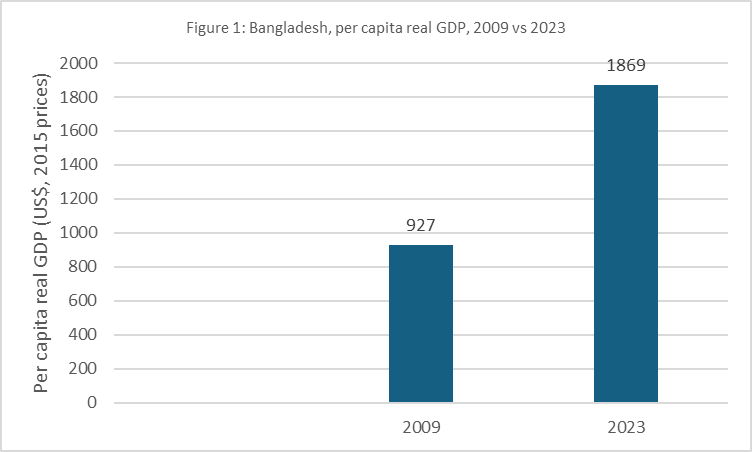
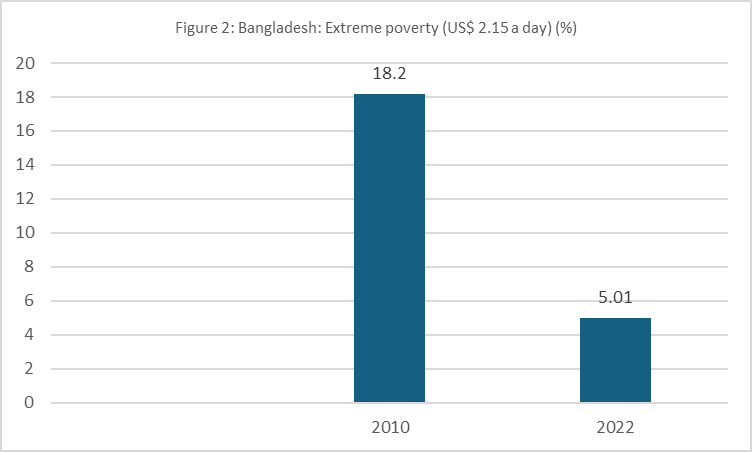
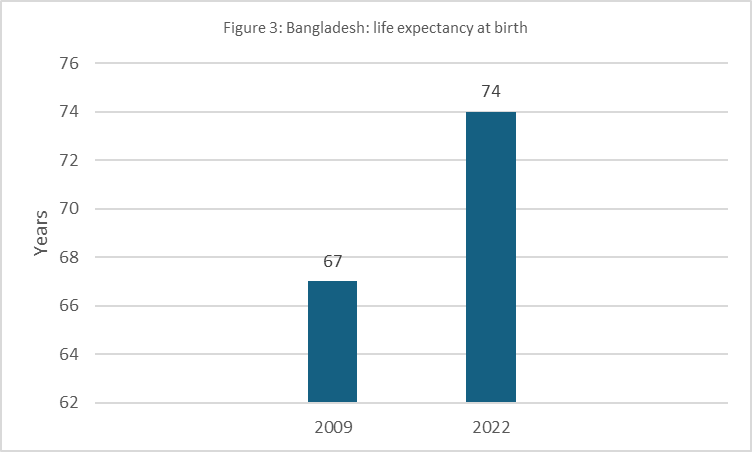
In retrospect, the Hasina regime represents a cruel paradox. Political repression was juxtaposed with substantial economic and social gains. Growth was sustained and rapid leading to a doubling of real per capita income between 2009 and 2023 – see Figure 1. Poverty fell significantly, and life expectancy increased substantially – see Figures 2 and 3. A UN assessment noted that ‘the country is internationally recognized for its good progress on several gender indicators’. The garments industry and remittances consolidated their position as leading export earners. New industries emerged, most notably pharmaceuticals and shipbuilding. Large-scale infrastructure projects were completed that enhanced communications and connectivity.
On the other hand, such achievements were nullified by massive corruption, egregious levels of inequality, and environmental degradation. The fundamental failure of the Hasina regime is that it dented the legitimacy of durable economic and social gains by denying Bangladeshis basic rights and liberties, including the right to vote in free and fair elections.
Hasina was also seen as being beholden to India. This caused public resentment at India’s influence on Bangladesh’s national affairs. Her attempt at a balancing act by wooing China was insufficient to dispel the widely held notion that she was slavishly pro-Indian.
Now that Hasina is gone, what next? An interim government, consisting of seventeen members and headed by Nobel Laureate Mohammad Yunus, has been established. It has taken the historically unprecedented step of appointing two student leaders as part of the government with full ministerial rank.
It seems that an implicit rift has developed between the Army brass, the student leaders and professional politicians represented by the Bangladesh Nationalist Party (BNP) and Jamaat. The Army Chief and his enablers wanted to form an interim government that that did not include Yunus. The student leaders did not approve of such a move and offered their alternative configuration of an interim government headed by Yunus and one that is politically neutral. They envisage an interim government that will run for a substantial period to complete its tasks and then ensure the holding of free and fair elections. So far, neither the tenure of the interim government nor its terms reference have been made explicit.
For now, the student leaders have prevailed because they have enormous street power, but they – and the interim government that they helped create – face monumental challenges: restoring law and order, reforming the governance structure, restarting an economy that effectively became moribund during the massive disruptions caused by the student-led movement and holding free and fair elections. These challenges are occurring against a background of high expectations about a bright future.
The BNP-Jamaat alliance meanwhile is getting impatient. More importantly, they would like the interim government to hold elections within three months – a time-frame that is unlikely to be accepted by the student leaders. The silent rift among the key actors will then become explicit.
One can understand why the BNP-Jamaat is so impatient. They have an electoral opportunity that they did not believe would ever occur. Their arch nemesis AL is thoroughly vanquished, at least for now. The BNP-Jamaat forces can romp home electorally. What will the student leaders do then?
There is growing realization that the real battle for the future of a new, inclusive Bangladesh has just started. The progressive forces unleashed by the youth-led uprising need to evolve into a new party that can prevail electorally over the old guard represented by professional politicians.
The two dominant parties (BNP and AL), backed by minor allies, have in the past accounted for more than 80 percent of votes cast in relatively free and fair elections (such as 2001). Sadly, they harbour a ‘legacy of blood’ that has tainted Bangladesh ever since its birth in 1971. The two parties treat each other as mortal enemies and display a deeply ingrained culture of revenge politics. This inhibits a robust and sustained commitment to peaceful transfer of power. Professional politicians, regardless of their affiliations, come from a toxic gene pool representing a mix of ideologues, opportunists, crooks and criminals. Whether a genuinely third political force can emerge from the youth-led movement remains an open question.
Narendra Modi, poised to become Prime Minister of India after the conclusion of the 2024 Lok Sabha elections, is probably the most successful politician of contemporary India. He strode like a colossus, first as Chief Minister of Gujarat (13 years), and subsequently as Prime Minister of India (10 years). This is a record that is unlikely to be broken. He would love to surpass the late Jawaharlal Nehru’s distinction as India’s longest-serving Prime Minister, but will he?
There is an eternal truth in politics. Successful politicians typically get consumed by hubris which paves the way for their inevitable downfall. In Modi’s case, hubris has been compounded by notorious communal proclivities as well as a strong authoritarian streak. The party that he leads, the Bharatiya Janata Party (BJP), is conspicuous for its Hindutvya ideology that has marginalized and victimized Muslims and other minorities. What Modi has done is add to the Hindutvya ideology a potent mix of expanding welfare payments to the poor and aggressive investment in infrastructure. This has enabled Modi to take the BJP to dizzying heights of electoral victories that gave the party sizeable majorities in 2014 and 2019.
Modi took advantage of these circumstances and held the governing institutions as of India as well as his own party under his arrogant grip. India soon found itself being classified as an ‘electoral autocracy’ ruled by someone who regarded himself as a divine avatar destined to shape the destiny of India.
The 2024 elections disrupted the status quo and humbled Modi. The BJP fell well short of its majority, its worst result since 2009. How will Modi cope now? Is he going to govern the way he did in the past or will he simply fade away and become another ordinary politician who came to power after a ‘Pyrrhic’ victory?
There are several reasons why one might witness the decline of Modi. First, he must contend with the preferences and machinations of capricious allies to run a coalition government. This is the kind of politics that Modi is simply not used to. He might react by asserting his authoritarian persona, but this might make his fragile hold on power even more fragile. Second, he must contend with a rejuvenated Opposition led by Rahul Gandhi and his allies. Third, there is the long-term issue of whether there are diminishing returns to exploiting the poisonous majoritarianism of Hindutvya as an electoral strategy. The fact that the BJP in the 2024 elections has shed seats heavily in the Hindu heartland of Uttar Pradesh is an indication of that trend. It is ironic that the incumbent BJP candidate lost his seat even in Ayodhya where the grand Ram Mandir that was built on the ruins of a mosque stands.
Reinforcing the limits of Hindutvya is the fact that India faces multiple challenges that the BJP has been unable to resolve: crony capitalism, conspicuously high inequality, lack of equitable access to health care and education, lack of good jobs, especially for young people, and the perils of climate change. As Modi cannot hide from confronting these challenges by posing as a divine entity, ambitious power-seekers within the BJP itself might rise to the fore and force him to move away from his role as a party leader. After all he will soon be 75 years old, and he might be asked to retire in the same way that Advani and other party elders did.
Israel started its life as an independent nation by engaging in ethnic cleansing or ‘nakba’ as the Palestinians call it. It was forcefully done, but in the Israeli imagination, it became a choice-driven process. As John Mearsheimer, the redoubtable politician of Jewish heritage noted recently, ‘voluntary’ ethnic cleansing is the only ‘final solution’ – a land for Jews and Jews only, where there is no trace of indigenous Palestinians as they will have all moved to other neighbouring Arab countries. Hence, there is no need to engage in dangerous conversations on a ‘binational ‘ state of Israel-Palestine or two states of Israel and Palestine embodying peaceful co-existence.
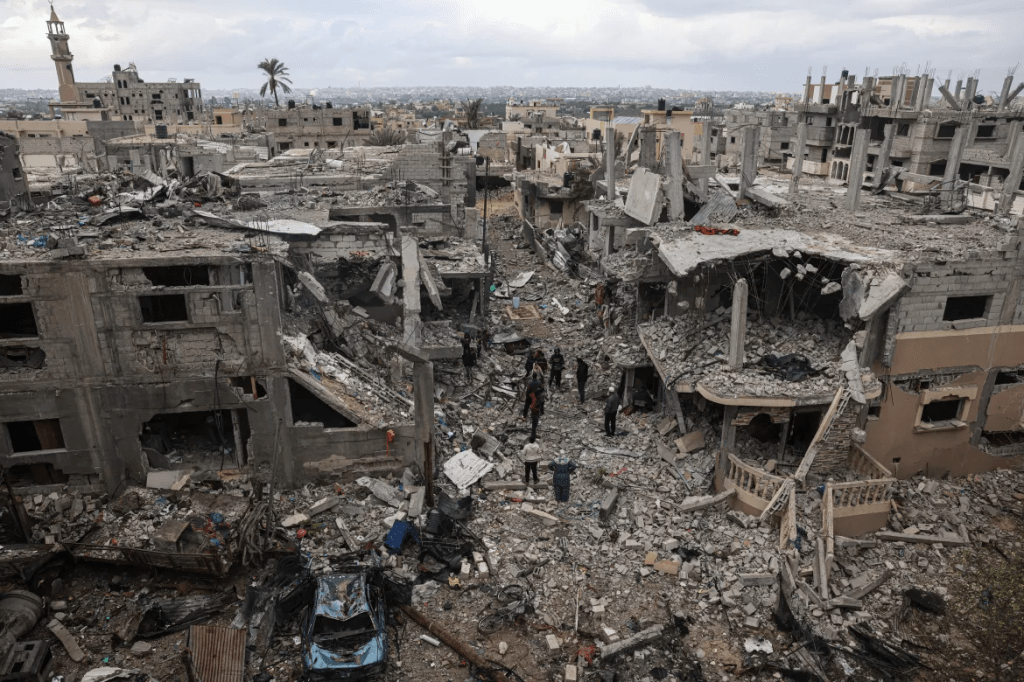
The prized goal of voluntary ethnic cleansing has not happened. What has emerged is a dystopian world in which a highly militarized, ethno-nationalist, settler-colonial state brutally subjugates Palestinians while pining for the pipe dream of peaceful ethnic cleansing. The latest genocidal war on Gazans by Israel – admittedly in retaliation against the October 7 attacks by Hamas – is the latest example of this dystopian world that captures the bitter reality of a nation that has forsaken its future for ‘forever wars’ against a weak and largely defenceless enemy that it finds difficult to vanquish. It is Hamas today, but it could morph into another entity tomorrow.
As the Washington Post’s Ishaan Tharoor has emphasized, Israel is facing growing global isolation and is boxed into a corner. The United States continues to be Israel’s cheerleader (what ‘genocide’? there are no ‘red lines’), but several Western allies that meekly followed ‘follow-the-leader’ in the past are quietly eschewing this shameful strategy. Many EU nations, and dependable allies like Australia, have voted in favour of UN resolutions seeking a long-term ceasefire to stop the wanton bloodshed in Gaza. Many of these very countries have voted in favour of a UN resolution to grant Palestine full UN membership. Ireland, Norway and Spain have fully recognized the Palestinian state a few days ago.
“Toddlers go up in flames, and our Israeli public celebrates…that’s what our hell looks like…Israel has such a strong desire for revenge that it is slowly sinking into a dark abyss, hand in hand with the ruins of Gaza”.


 Reflections on development and governance