Offers succinct commentary on topical issues that cut across both rich and poor countries. Entails critical insights on poverty, inequality, health, macro-policies and many more
A modern central bank usually relies on ‘monetary policy committees’ or MPCs (albeit with different names, such as boards and councils) that play a pivotal role in the conduct of monetary policy. The collective deliberations of the MPCs are held regularly throughout the year and are geared towards recommendations (either by vote or consensus) on the setting of the policy rate.
The core principle is that the practice of monetary policy – and hence the role of the MPCs – should be free of political pressure. Central banks should be accountable but have operational independence in pursuit of their primary goal of maintaining price stability.
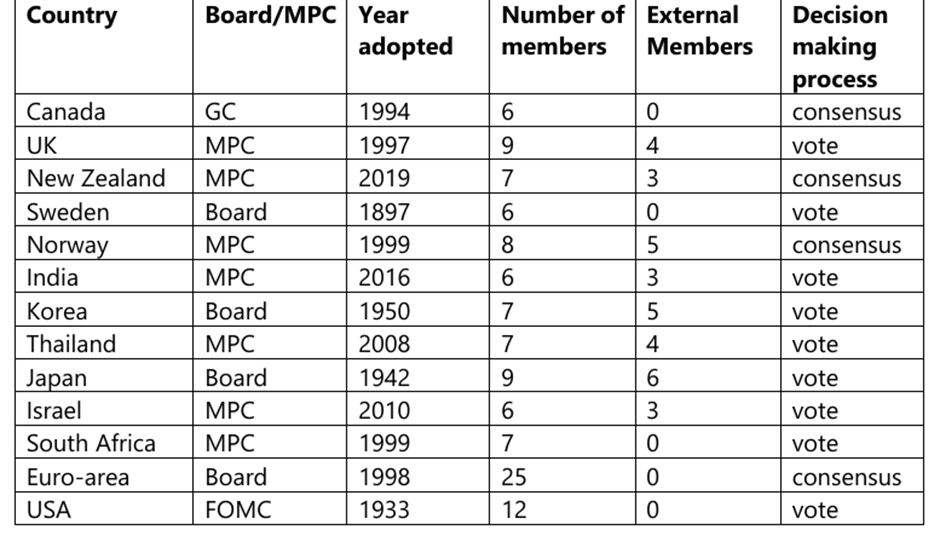
The size of the MPCs and the decision-making structure varies across countries and regions as shown below (Table 1). The MPCs are dominated by internal bank staff and economists, and, in some cases, with representatives from the corporate world. There are also cases in which there are no external members. There is no scope for representatives of workers and employers and representatives from civil society to be part of the membership of MPCs.
Table 1: Composition of MPCs, selected central banks
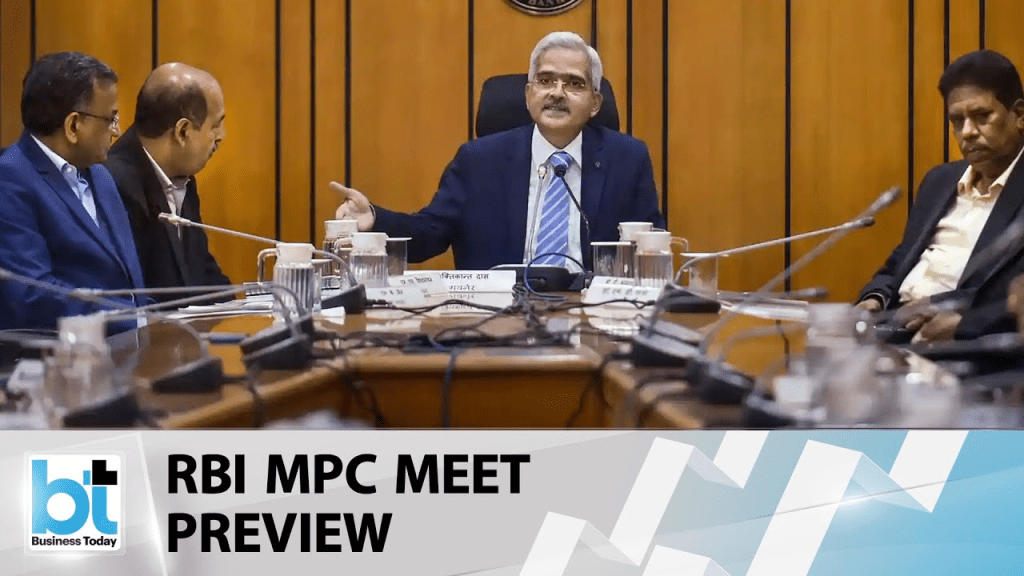
The degree of gender parity is low in a typical MPC. India is a conspicuous example – see Exhibit 1. Would improving gender parity improve the quality of monetary policy as measured in terms of maintaining price stability? Research findings on this are ambivalent, but the aim is to use an august institution to promote gender equality which is a core element of the global development agenda.
Exhibit 1: Where have all the women gone? The Governor of the Reserve Bank of India meets with members of the MPC
Despite the restrictions placed on central banks that restrain them from broad-based community-level engagement, these entities have tried to overcome such restraints by a transparent communications strategy in which deliberations of MPCs are made public. Furthermore, in recent years central banks have moved away from a preoccupation with price and financial stability. One important example of this trend is a new form of engagement via international cooperation among central banks, most notably supporting climate action as a key aspect of monetary policy. This is best illustrated by the ‘Network for Greening the Financial System’ (NGFS) which now has 134 members.
Financial inclusion is another way in which central banks are changing their engagement with workers and employers and the broader community. As is well known, the aim of financial inclusion is to incorporate the unbanked segment of the population – which can be quite large in developing countries – into the formal financial system. A 2024 meta-analytical assessment shows that ‘…financial inclusion outcomes reflect small, positive and statistically significant average effects on consumption, income, asset and other poverty-related indicators. Given this finding, it is noteworthy to point out that the ‘Alliance for Financial Inclusion’ reports that there are now 84 central banks across the world that have formally integrated financial inclusion in their mandates.
Financial inclusion creates synergies between monetary policy and poverty reduction strategies as well as the agenda of transition to formality. Central banks have discovered that financial inclusion, by encouraging formalization, improves the monetary transmission mechanism and thus strengthens the effectiveness of monetary policy. This in turn creates the space for workers and employers as well as civil society at the domestic level to engage with monetary authorities in areas that go beyond price stability.
Aunul Islam, read for his PhD at Imperial College, London. He graduated from The University of Manchester. He is a Quality Assurance Specialist in Higher Education and a Technology Consultant. He is an ex-civil servant of the UK government. A keen gardener, he finds solace through nature in this dysfunctional world order.
The “Sick Role” theory was developed in 1951 by Talcott Parsons. This is a concept in medical sociology. The theory states that anyone suffering from severe illness has a distinct set of rights and roles than someone who is well.
Let us review this in relation to human capital. Loss of human capital can be due to diverse reasons, such as sickness, injury, mental decline, unemployment, or the inability to keep up with innovation. We can easily see how sick role and loss of human capital may be viewed as closely interrelated.
Let us try to understand the underlying dilema of a society from an individual’s perspective which could be capitalist or socialist in orientation. Imagine you are now fit and well and are serving as an engineer, academic etc. Your role would have been what your profession dictates. The moment you are unwell for distinct reasons, your new role is a “sick role.” Employers would view this as acceptable, as long it is not for a long term, and it is not affecting their “capital.” If the sickness is a long-term condition, then the relationship between employer and employee, and between an individual and society becomes problematic.
The scenario that is painted here is not hypothetical. Think of the recent global pandemic (Covid-19). A vast number of people are suffering from “long COVID.” If one reviews how differently various governments and enterprises have viewed long COVID and have tried to tackle it, the notion of “sick role” in a contemporary context becomes interesting, intriguing, and worrisome. The human capital dimension of sick role becomes predominant and sick people then transforms into mere commodities that are no longer worthy of use. The worst scenario is when even family members are no longer supportive of your long-term sick role. In this world of modernity and capitalism, your new role as a long-term sick person is not tenable.
Aunul Islam, read for his PhD at Imperial College, London. He graduated from The University of Manchester. He is a Quality Assurance Specialist in Higher Education and a Technology Consultant. He is an ex-civil servant of the UK government. A keen gardener, he finds solace through nature in this dysfunctional world order.
As I reflect on the July uprising that toppled the long reign of Sheikh Hasina in Bangladesh, I recall the film entitled “Ashani Sanket” (Distant Thunder). It is a 1973 Bengali film directed by the late and legendary director Satyajit Ray. A New York Times critic called it a fable. It is through the prism of this fable that I will revisit some recent historical episodes in Bangladesh and contemporary developments.
The film was based on the Bengal famine during World War II. The irony of this was that the famine was entirely a man-made one. Then-British Prime Minister Churchill’s war effort diverted most of the food crops away from the civilian population. Millions perished, with estimates ranging from 2.5 to more than 3 million.
Ironically 30 years later and a year after ‘Distant Thunder’ was released, famine returned to Bengal (March 1974-December 1974). Geopolitically, the world by then was a different place. It returned to erstwhile East Bengal which emerged as the newly formed nation of Bangladesh. This famine too was a man-made one leading, according to some estimates, to the death of 1.5 million people.
With the failure of American policy in the Indian sub-continent that failed to prevent the emergence of Bangladesh, the US government engaged in the cruel endeavour of making Bangladesh a ‘failed state.’ Hence, it withheld much-needed food aid to Bangladesh despite the prevalence of one of the worst famines in recent history.
Perhaps, now, Bangladesh’s young history (three years after independence) has changed the direction of the nation. The history of a nation was changed because Bangladesh was considered a homogeneous society and the nation speaking one language, Bengali, of course with the variation of dialects. In terms of religion too, it was homogenous, as it was a Muslim population but with a secular disposition. Unlike Pakistan and India that have different ethnicities or groups like the Punjabis, Balochis, Pathans, Gujaratis, as well as many indigenous populations where homogeneity does not exist as such. With diverse ethnicities, socio-political management becomes challenging for some nations in South Asia to have stability. Pakistan is suffering huge instability due to this, and India faces the strain of managing its fractious communities.
Bangladesh should have remained stable in terms of its homogeneity but, alas, USA created a new fault-line. It sought to divide the nation by seeking to create a failed founding leader and establishment of another group, the so- called “saviours” of the nation.
It reminds me something from history. When the British were strategically trying to enter India, one of the observations was the pride of the different languages the people of the subcontinent spoke! Destroy this, the nation will be divided, and the “will” to fight! Introduce English and this will create the fault-line to colonise them.
The 1974 famine was followed in 1975 by the brutal killing of Sheikh Mujibur Rahman (the country’s Prime Minister and founder of the nation) and most of his family members. The country was at that point in time the second poorest in the world (after Burkina Faso). The very fabric of the society was simple and therefore overcoming the shock of Mujib’s assassination was easier than it would have been presently.
In July-August 2024, a so-called “revolution” took place in ousting Sheikh Hasina as the Prime Minister after 16 years of rule, which is the culmination of the venting of pent-up frustration of the way that the country was run at the top. It reminds me also of a book entitled “Prisoners of Geography” and the many geopolitical pressure that impinge on a developing country but a country that was on the way to becoming a middle income economy and trying to free itself from being a prisoner of geography.
One could look at the film “Distant Thunder” either as a commentary on the past or the Thunder that is going to be in the future. Here, I will attempt and to try to understand and narrate what could be a bad omen for the Bangladesh as a nation.
To add to the fault-line, it is unique only to Bangladesh that the student community leads political agitations. This happened in the case of the 1952 language movement where students played a crucial role. In 1971, the student community played a significant role along with the mass of the population. However, one of the negative aspects of any student-led revolution is that it could lead to chronic instability and reduce a nation’s prospects to become a prosperous middle-income economy.
At this point, I tried to re-visit the French Revolution and its long-lived impact on the psyche of the French nation. Even today, the most violent riots that takes place is in the French capital Paris. Thousands of cars have been burnt in few days in 2019 and 2021. This is unlike other neighbouring European countries. A prosperous country like France can afford its ‘revolutionary moments,’ but can Bangladesh?
Now let me revisit the situation in Bangladesh. The revolutionary moment was random (or was it “meticulously planned and executed” as maintained by Yunus, the Head of the Interim Government?) Many people lost their lives and thousands were injured at the hands of security forces, but the police also bore the wrath of the protestors when Sheikh Hasina’s regime fell. Many police stations were burnt to ashes and many ancestral homes of Hasina’s political members, and the civil servants were destroyed. Many became victims of mob violence and even as this is being written, the scenario is in a state of flux.
The strange position that the army took as a silent bystander is not helpful to the nation. They have been very selfish because their position as peacekeepers in the United Nations would be jeopardised and lost. They became silent partners and in doing so have really destroyed the very political and social stability of a country and it does not bode very well for the nation and ironically, they have lost the control of the population. On top of that, it has created a deep division with the police.
So, what transpired after three months of the takeover by the interim government is that it did not take a strong decision on the student-led revolution and make the student leaders go back to basics, that is, study first and be nation builders later. One cannot have a situation where self-appointed student leaders are running a nation and seeking to control key policy decisions. This has never been seen anywhere in the world! Ironically too, they want to rewrite history.
Bangladesh can least afford to be running a new experiment in student-led national governance. It is an Ashani Sanket (Distant Thunder) for the future of Bangladesh!
Americans are pessimistic about the future and foresee a nation in decline as as a Pew Research survey highlighted in 2023 (Figure 1). The American Psychological Association, in its 2024 survey, released only a few ago, reports that 77% of responds suffer from stress because of their bleak assessment of the nation’s future (Figure 2)
Figure 1: Majority of Americans foresee a bleak future….
Are these grim perceptions rooted in reality? Boosters of American capitalism, such as the ‘sponsored’ media, will beg to differ. They will claim that America remains – and will continue to remain – among the most powerful and richest nations in the world. Are the boosters of American capitalism correct or has the average American got it right? Let us briefly examine long-term trends in per capita income, poverty and inequality in USA as a way of offering a data-driven perspective on this contentious topic.
Per capita real disposable income has grown steadily since 1990 (Figure 3), but within this positive and broad trend there are some troubling signs. While per capita real disposable income recovered from the trough of the COVID-19 recession, living standards today (2024) are lower than a few years ago.
One feature of Figure 1 is worth highlighting. The US economy has suffered nine recessions since 1950 (note the shaded areas in the figure representing US recessions.) Every time a recession takes place, average living standards take a hit as job opportunities shrink and unemployment rises.
Figure 3: Rising per capita income, but is lower today (2024) than a few years ago
What about trends in poverty? These are shown in Figure 4. There have been periods of sharp rises in poverty followed by impressive declines. The 2020 COVID-19 recession saw a surge poverty followed by a decline. Yet, the poverty rate in 2022 is still higher than it was in 2000.
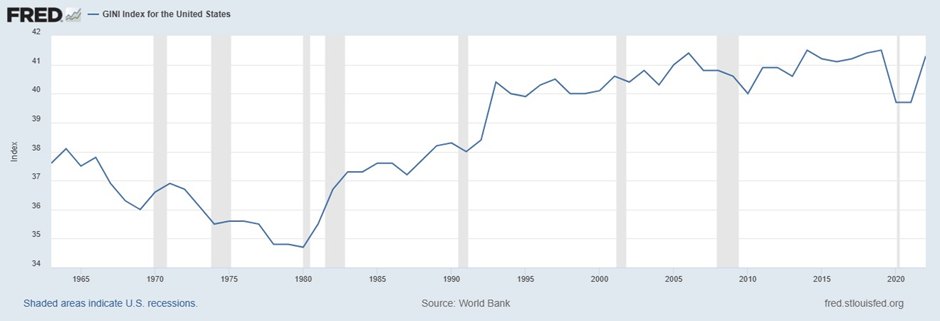
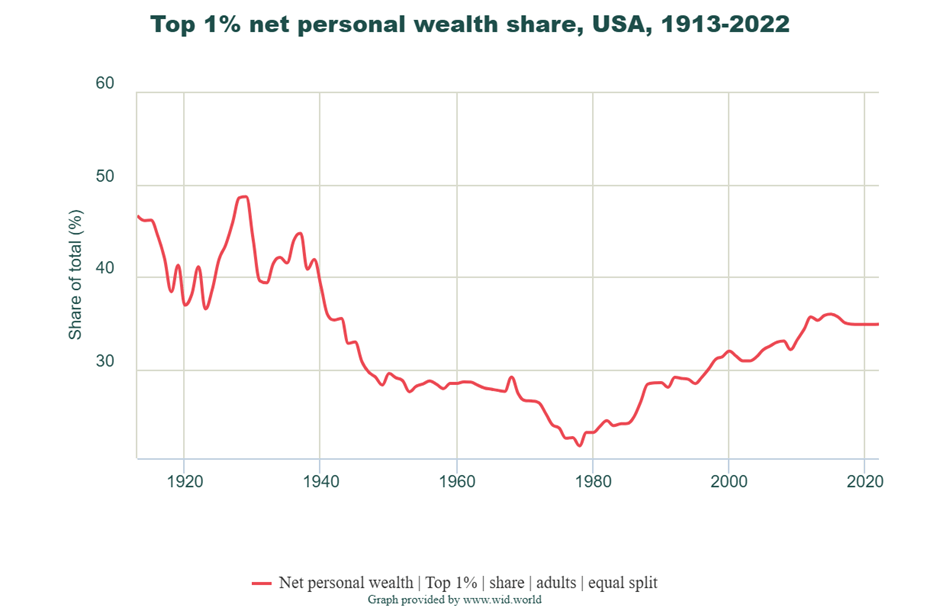
As is well known, the Achilles heel of US society is its high and rising levels of inequality, both in terms of income and wealth. These are shown in Figure 5 and 6. Perhaps these trends help to explain why 80% of Americans feel that the gap between the rich and the poor will widen.
Figure 5: Growing income inequality (as measured by the Gini index)
It seems that the average American knows deep down what ails American society. It appears that it is the Trump vs Harris campaign surrounding the imminent US Presidential election (November 5, 2024) that is disconnected from reality. There has been no meaningful national conversations led by the Presidential candidates on how to respond to the challenges of deep-rooted poverty and inequality in the United States of America.
The ultra-orthodox Jews (or Haredim) now account for 13.5 percent of the Israeli population, but in about 40 years, this is projected to increase to 31.3 percent if the exceptionally high fertility rates of Haredi females are maintained. Haredi Jews hardly mix with other Jews and have views and values that are incompatible with the secular and Zionist character of Israel. More importantly, Haredi men have rather low employment rates and the highest poverty rates. Most children of the Haredi community go to specially designated schools that shun the core curriculum of English, Maths and Science. Because of their growing size, Haredi parties exercise considerable political power which is likely to grow over time. This enables them to sustain the required budgetary support from the government that allows Haredi lifestyles to be sustained. Under a business-as-usual scenario, Israel could become a poorer, less productive economy, given that a large part of Israeli society will consist of Haredi men and women that will impose a major fiscal burden on the state. The political leadership might not be able to break out of the status quo if it remains addicted to ‘forever wars’ as a way of subverting the aspirations of Palestinian statehood and thus neglect the challenges posed by Israel’s demographic transformation.



 Reflections on development and governance