On January 3, 2026, US President Trump announced via his social media account that a special operation ‘captured’ ( a euphemism for abducted) President Maduro of Venezuela and his wife and flew them over to the United States to face criminal charges for engaging in ‘narco-terrorism conspiracy, cocaine importation conspiracy, possession of machine guns and destructive devices and conspiracy to possess machine guns and destructive devices against the US’. The opening hearing took place on 5th January at a US Federal Court, with both Maduro and his wife defiantly claiming that they were kidnapped and not guilty, and that he remains the President of Venezuela. One can foresee a protracted legal battle ahead.
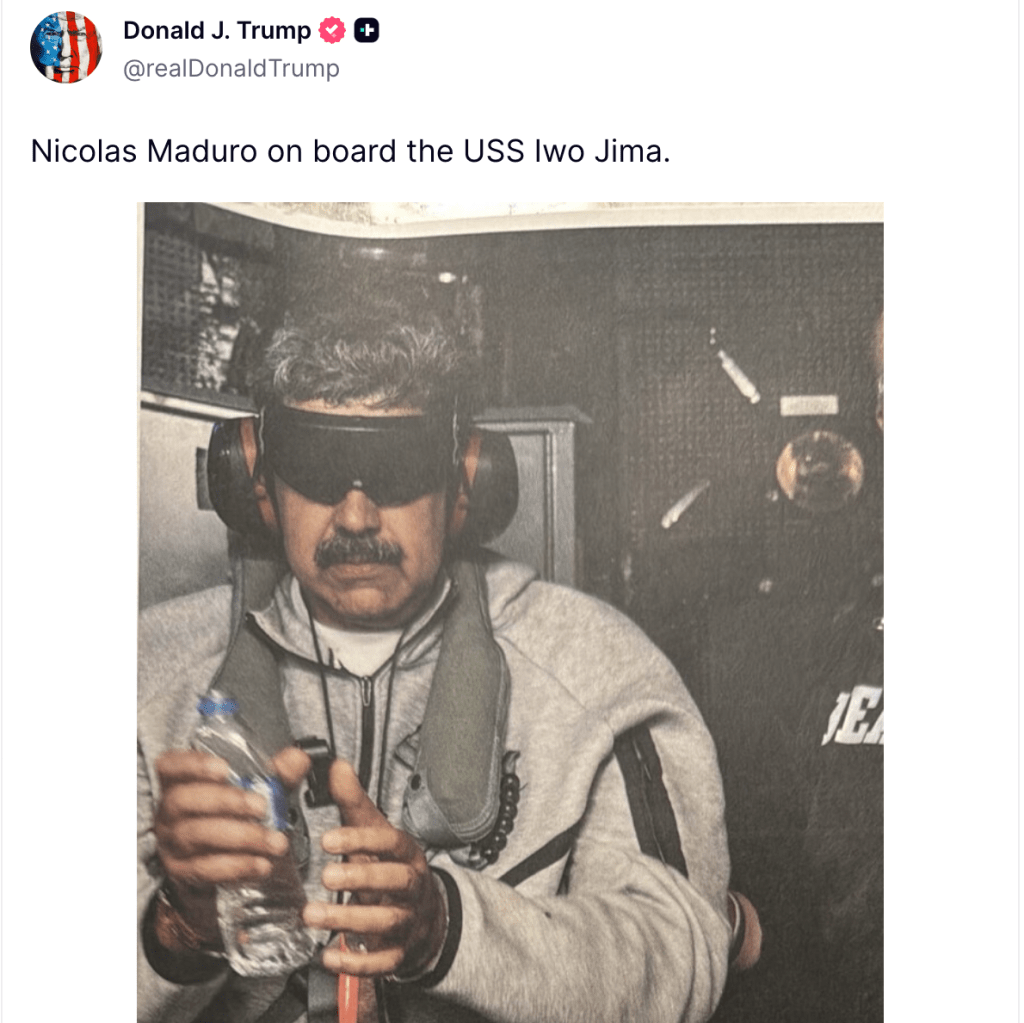
Source: https://www.nytimes.com/2026/01/03/world/americas/maduro-photo-trump.html
Trump was candid about his real intentions. The US administration would ‘run’ Venezuela until a viable and peaceful transfer of power to local authorities took place. Venezuela, which possesses the world’s largest oil reserves, would become, proclaimed Trump, the beneficiary of US technical and engineering prowess as leading energy companies embark on fixing the country’s dilapidated oil infrastructure. Wishful thinking? Probably.
Note that Trump left the Maduro regime intact, with the Vice President now constitutionally mandated to become acting President in the absence of Maduro. Trump also dismissed the possibility of the Nobel Prize-winning Machado leading the transition process, while failing to mention González, the Presidential candidate. This begs the question. What transition?
How has the global community reacted to these stunning developments? One does not need to be a legal expert to realize that the US military aggression in Venezuela that led to the abduction of Maduro and his wife is a brazen violation of international law and the UN charter. It also left at least 40 Venezuelans dead, including significant damage to private property and infrastructure. Yet, European leaders – supposedly the champions of international law and a rules-based global order have, once again, generally failed to acknowledge that in an unambiguous fashion. They are petrified to upset Trump and sought refuge in mealy-mouthed statements and carefully crafted obfuscation. Here are some notable examples, starting with the UK, which claims to enjoy a ‘special relationship’ with the USA.
Prime Minister Keir Starmer said the UK will discuss the “evolving situation” in Venezuela with U.S. counterparts while noting Britain will “shed no tears” about the demise of Maduro’s “regime”. This interview with Starmer from the British TV channel ITV is riveting to watch.
The EU expressed concern at the developments and urged respect for international law, even as it noted that Maduro “lacks legitimacy.”
French President Emmanuel Macron called for 2004 presidential candidate Edmundo Gonzalez Urrutia to lead a political transition. On the other hand, France said the U.S. operation undermined international law, and no solution to Venezuela’s crisis can be imposed externally.
German Chancellor Friedrich Merz said that Maduro had “led his country to ruin,” but called the U.S. action legally “complex.”
Italian Prime Minister Giorgia Meloni was the only major European leader to side with the U.S., arguing its military action in Venezuela was “legitimate” and “defensive.”
What about Canada? Well…
Prime Minister Mark Carney said on X that, “Canada has not recognized Maduro’s illegitimate regime since the 2018 electoral fraud. The Canadian government welcomes the opportunity now available to the Venezuelan people to access freedom, democracy, peace, and prosperity.”
He added, “True to its longstanding commitment to the rule of law, sovereignty, and human rights, Canada calls on all parties to respect international law. We support the sovereign right of the Venezuelan people to decide and build their own future in a peaceful and democratic society.”
And Australia?
Prime Minister Anthony Albanese has responded to the capture of Venezuelan President Nicolas Maduro by US forces. “The Australian government is monitoring the situation and will provide assistance to any Australians in Venezuela,” Mr Albanese said. “We urge all parties to support dialogue and diplomacy to secure regional stability and prevent escalation. “We continue to support international law.”
These mild and conditional utterances by Western leaders on what is clearly a breach of international law contrast sharply with what China and Russia had to say.
China delivered a strongly worded message to the United States on Monday (5th January) at an “emergency” meeting of the UN Security Council, calling on Washington to abide by international law, end its illusion that it is the world’s police force and court, and immediately release Nicolas Maduro and his wife.
Russia’s United Nations ambassador Vasily Nebenzya denounced US actions in Venezuela and urged the immediate release of detained Venezuelan President Nicolás Maduro during a United Nations Security Council session in New York on Monday, January 5.
India, on the other hand, appeared to adopt the Western strategy of obfuscation. Thus:
India broke its silence on the US capture of Venezuelan President Nicolás Maduro with a carefully worded statement that expressed “deep concern” but conspicuously avoided naming Washington or condemning the military strikes that seized the Latin American leader.
What about Venezuela’s regional neighbours? As expected, regional divisions emerged and reflected the ideological proclivities of different countries.
Argentine President Javier Milei, Trump’s ideological soulmate, characterized (the USA) as supporting “democracy, the defense of life, freedom, and property.”
“On the other side,” …are those accomplices of a narco-terrorist and bloody dictatorship that has been a cancer for our region.”
Other right-wing leaders in South America similarly seized on Maduro’s ouster to declare their ideological affinity with Trump.
In Ecuador, conservative President Daniel Noboa issued a stern warning for all followers of Hugo Chávez, Maduro’s mentor and the founder of the Bolivarian revolution: “Your structure will completely collapse across the entire continent.”
In Chile, where a presidential election last month marked by fears over Venezuelan immigration brought down the leftist government, far-right President-elect José Antonio Kast hailed the U.S. raid as “great news for the region.”
Left-wing presidents in Latin America — including Brazil’s Luiz Inácio Lula da Silva, Mexico’s Claudia Sheinbaum, Chile’s Gabriel Boric, and Colombia’s Gustavo Petro — expressed grave concerns over what they saw as U.S. bullying.
Lula said the raid set “an extremely dangerous precedent.” Sheinbaum warned it “jeopardizes regional stability.” Boric said it “violated an essential pillar of international law.” Petro called it “aggression against the sovereignty of Venezuela and of Latin America.”
In sum, global reaction to Maduro’s abduction by the US has been quite diverse, but one is struck by the muted response of Europe and other leaders from the West. They will face a stern test if Trump follows through on his threat to invade Greenland and forcibly take it away from Denmark. Certainly, the Danish intelligence service, traditionally a close American ally within the framework of NATO, is so worried that it has officially designated the United States as a ‘security risk’.

 Reflections on development and governance