Counting the missing billions: taking care when reporting on money laundering

In reporting on financial and economic statistics, it is important to distinguish between stocks and flows as well relative and absolute numbers. Stocks (accumulated value of a variable over a given period) typically catches public attention in a way that annualised data usually do not. Similarly, relative figures usually turn out to be a lot more modest than absolute numbers.  I will illustrate these points by drawing on the Bangladesh experience.

In Bangladesh, media reports conflate typically stocks and flows. The currently popular citation is that US$ 150 billion has been siphoned off to various overseas havens by politically connected individuals over the last 15 years. Some media reports proceed to express stock estimates of money laundering as a proportion of flow data (annual GDP).  This can befuddle the lay reader.

The task of tracking money laundering falls on the Bangladesh Financial Intelligence Unit (BFIU).  I suspect, it is a small, under-resourced unit within the Bangladesh Bank (the best talent and resources probably go to units dealing with monetary policy). This does not make BFIU estimates less reliable than other estimates, but alternative estimates of annual rates of money laundering do exist and they ought to be acknowledged in public discourse. Transparency International Bangladesh (TIB) in the recent past has come up with an annualised figure of USD 3 billion, while the Washington-based Global Financial Integrity Institute (GFI) reported annualised figures of USD 8.7 billion. They note that most money laundering activities occur through trade mis-invoicing. One should not also overlook the use of the humble, but time-honoured, Hundi, as a source of money laundering. The bank heist by one of Bangladesh’s richest men is sensational but not a very common source of money laundering.

I personally prefer the use of annualised figure because they are easy to compare over time and across countries. Also, stock estimates can be made to assume astronomical magnitudes. For example, I understand that some Bangladeshi economists have come up with a stock estimate of money laundering for the 1972-2022 period. This understandably dwarfs the size of money laundering that are being reported now.

There is the issue of relative vs absolute numbers. Annualised data on money laundering can be expressed as a proportion of a country’s GDP. This is what the UN does. Another advantage is that this relative number offers an indication of the potential output loss from money laundering. In the case Bangladesh, a back-of-the envelope estimate (which is based on the annualised estimate of USD150 billion) suggests that it is 3.2% of GDP. The global norm ranges between 2-5% of GDP.

Has the incidence of money laundering has gotten worse over time? Here, the changes in country-specific ranking anchored in an ‘anti-money laundering index’ for 152 countries by a Swiss organisation, can be useful (1= worst, 152= best). BD ranked 82 in 2017, but then fell below 40 in later years before recovering to 46 in 2023. Why this has happened merits further investigation.

Finally, it is worth noting that, however measured, money laundering represents massive waste of resources enriching some at the expense of poorer nations. To be resolved, it needs global cooperation. Why is it that Singapore and London, for example, allow themselves to become havens for laundered funds? Indeed, London has been described as …’the main nerve centre of the darker global offshore system that hides and guards the world’s stolen wealth’. If the authorities there camp down on such havens (which they can), the incentive to park illicit funds abroad by crooks and criminals from developing countries will be significantly diminished.
.’

The gilded age of the robber barons and wealth inequality in Bangladesh: rhetoric vs reality

The ‘gilded age’ refers to a certain period of American history (most notably the 1870s) which was characterized by ‘a period of gross materialism and blatant political corruption’.  The key actors of the gilded age were a cohort of robber barons. They have been described as

‘…the powerful 19th-century American industrialists and financiers who made fortunes by monopolizing huge industries through the formation of trusts, engaging in unethical business practices, exploiting workers, and paying little heed to their customers or competition…The robber barons …amassed their fortunes by monopolizing essential industries. In turn, these monopolies were built upon the liberal use of …intimidation, violence, corruption, conspiracies, and fraud.’

Sounds familiar? One could readily argue that this is an apt description of a handful of ultra-wealthy individuals, often called oligarchs, in 21st century Bangladesh. They also lived in the gilded age during the now-defunct Ancien Regime of Hasina. A leading Bangladeshi economist (Dr. Debapriya Bhattacharya) has observed:

‘Oligarchs are the wealthy people and politically powerful. And we did not see such groups in Bangladesh in the past the way we are witnessing now…’

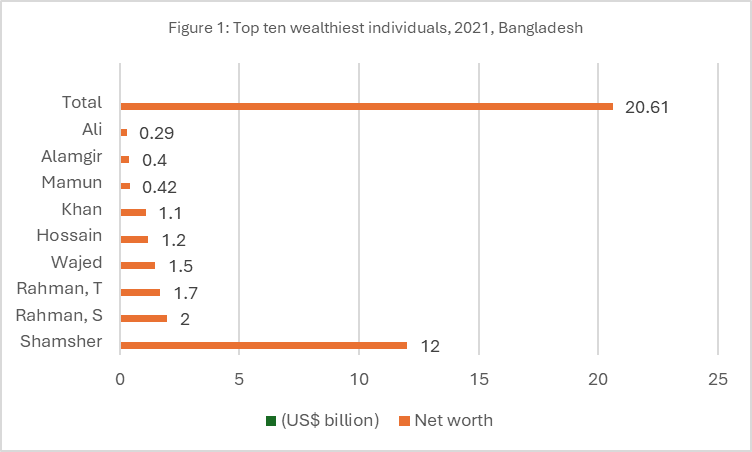
He declined to name them, but one can easily find such names through media reports. Figure 1 reveals pertinent details on the ten wealthiest individuals. Some have fallen on tough times after the downfall of the Hasina regime because they were so closely associated with it. Others live abroad and are safe from the long arm of Bangladeshi law enforcement agencies for their alleged crimes and misdemeanours.

Source:  Derived from Top 10 Billionaires in Bangladesh 2024 | Meet the Richest Titans from Bangladesh | Business Haunt

On top of the ten richest individuals identified above, one of the latest editions of the Credit Suisse Global Wealth Report estimates that, in 2021, there were 28,931 USD dollar millionaires in Bangladesh with an average net worth of US$ 3 million. If this group is added to the ten richest individuals identified above, one arrives at an aggregate net worth of US$ 107.4 billion. While this reads like a lot, standard measures of wealth inequality express the collective net worth of the wealthiest individuals in a country as a share of the aggregate wealth of a country. This turns out to be 12.9 %. Is this high or low relative to the past and relative to other countries?

This is where the world inequality database becomes extremely useful. It has been developed by a world class team of scholars working in the field of inequality. This team measures inequality in terms of the wealth share of the top 1% of the richest in a country. Using this method, one arrives at the evolution of wealth inequality in Bangladesh between 1995 and 2022. This is shown in Figure 2. Contrary to widespread belief, wealth inequality in Bangladesh has been falling moderately since 2005, after rising between 2000 and 2005. In particular, the idea that the thoroughly discredited Hasina regime was associated with rising wealth inequality does not seem to be compatible with the available evidence.

Figure 2

How does Bangladesh compare vis-à-vis other countries? Here too, there are some surprises. Compared with a selected group of middle-income countries (Brazil, India, Indonesia, South Africa), wealth inequality in Bangladesh (as recorded in 2022) seems noticeably low.

Source: Derived from world inequality database

Some caveats are in order. It is entirely possible that the degree of understatement of net worth in Bangladesh is higher than in other comparable countries due to tax evasion and money laundering. It is equally possible that the impact of such factors has increased over time leading to a spurious reduction in wealth disparities. Clearly, a lot more research needs to be done to explore and examine these critical issues so that one can sift rhetoric from reality. What one can at least say is that several individuals and business groups drew on their close political connections to acquire a great deal of wealth under the Hasina regime and thus behaved like the robber barons of 19th century America.