Economic damage from COVID-19 worse than expected

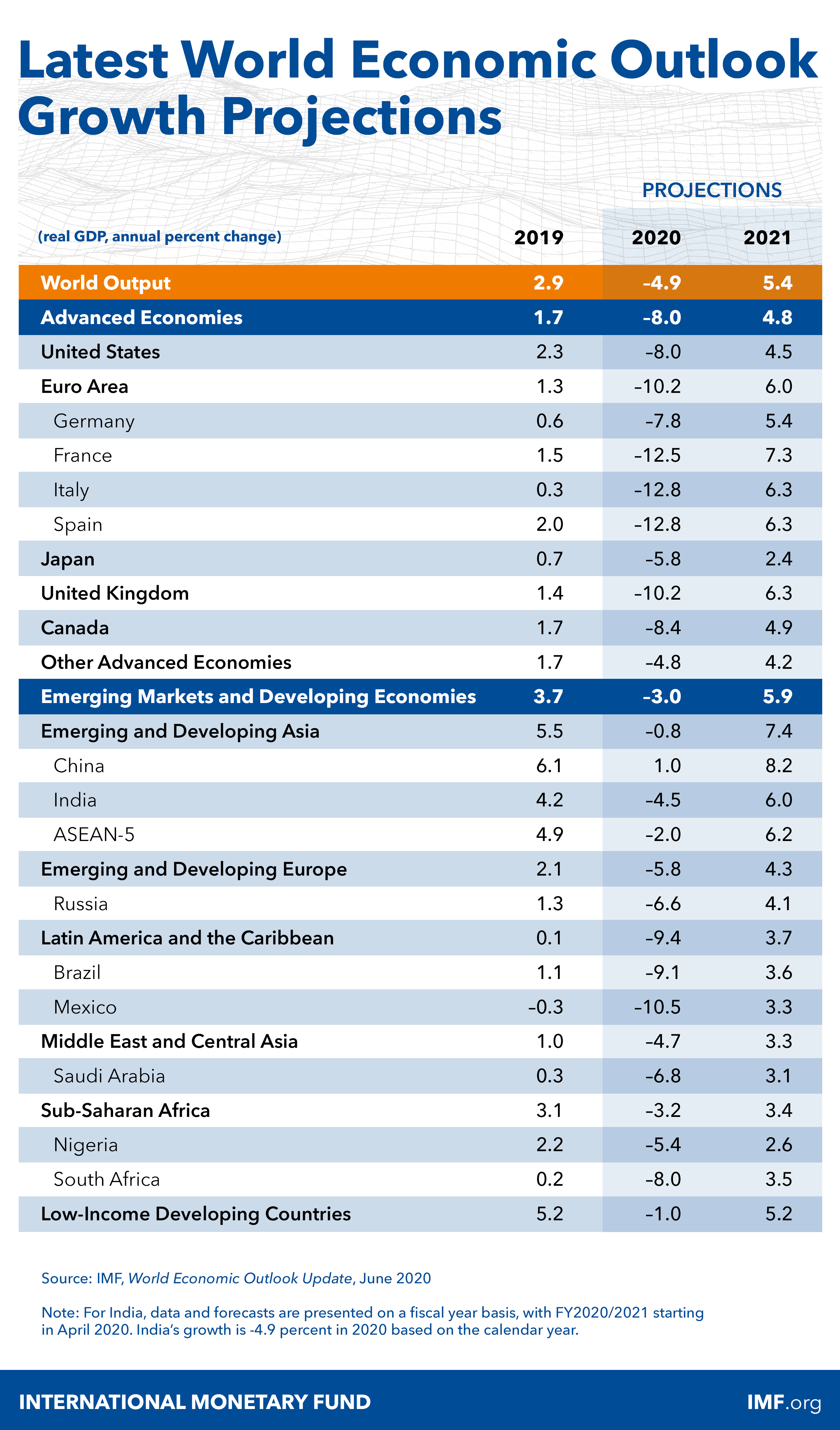
Recent projections suggest that the economic damage unleashed by COVID-19 on countries across the world is worse than expected. In it’s June 2020 update, the IMF now projects that global growth will contract by 4.9% in 2020 vis-a-vis 3% in it’s April 2020 World Economic Outlook . As the IMF notes:

The COVID-19 pandemic has had a more negative impact on activity in the first half of 2020 than anticipated, and the recovery is projected to be more gradual than previously forecast. In 2021 global growth is projected at 5.4 percent. Overall, this would leave 2021 GDP some 6½ percentage points lower than in the pre-COVID-19 projections of January 2020.

World Economic Outlook, June 2020, Growth Projections table

The OECD, in its June 2020 outlook, offers equally grim predictions and highlights the magnitude of the economic recession across the world based on two scenarios – (1) the current pandemic has a time-bound single wave (‘single hit’) (2) the current pandemic is followed by a second wave towards the end of 2020 (‘double hit’)

Wold gross domestic product

Policy-makers across the world thus face a monumental challenge – how to cope with the pandemic while dealing with one of the most severe recessions in living memory. Whether governments can muster the imagination, political will and resources to deal with a pandemic-induced economic crisis remains to be seen.

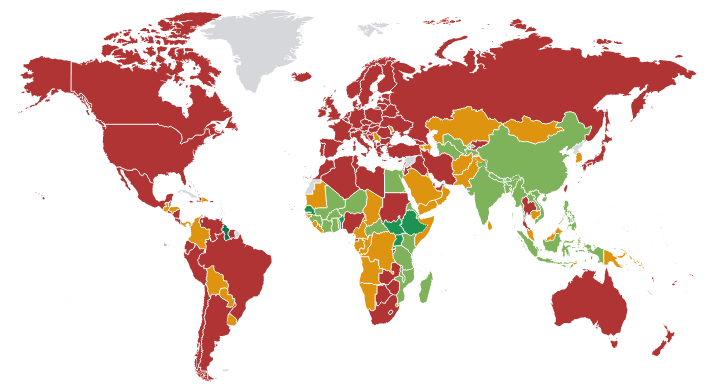
The geographical spread of recessions during the current pandemic: A map of the world in 2020

The IMF – and other international organizations – have predicted a severe global recession following the major disruptions to economic and social activities in the wake of COVID-19.

Here is a map of the world  reflecting the imprint of the coronavirus pandemic.

The number of countries with either severe or moderate negative GDP growth  – depicted in red and yellow – dominate this map. This was not even considered a remote possibility a few months ago. While the IMF’s April 2020 World Outlook expects a robust recovery in 2021, there is now growing recognition that global recovery might not happen until 2023.

download

Source: IMF data mapper

The perilous consequences of COVID-19: Hunger in a rich nation

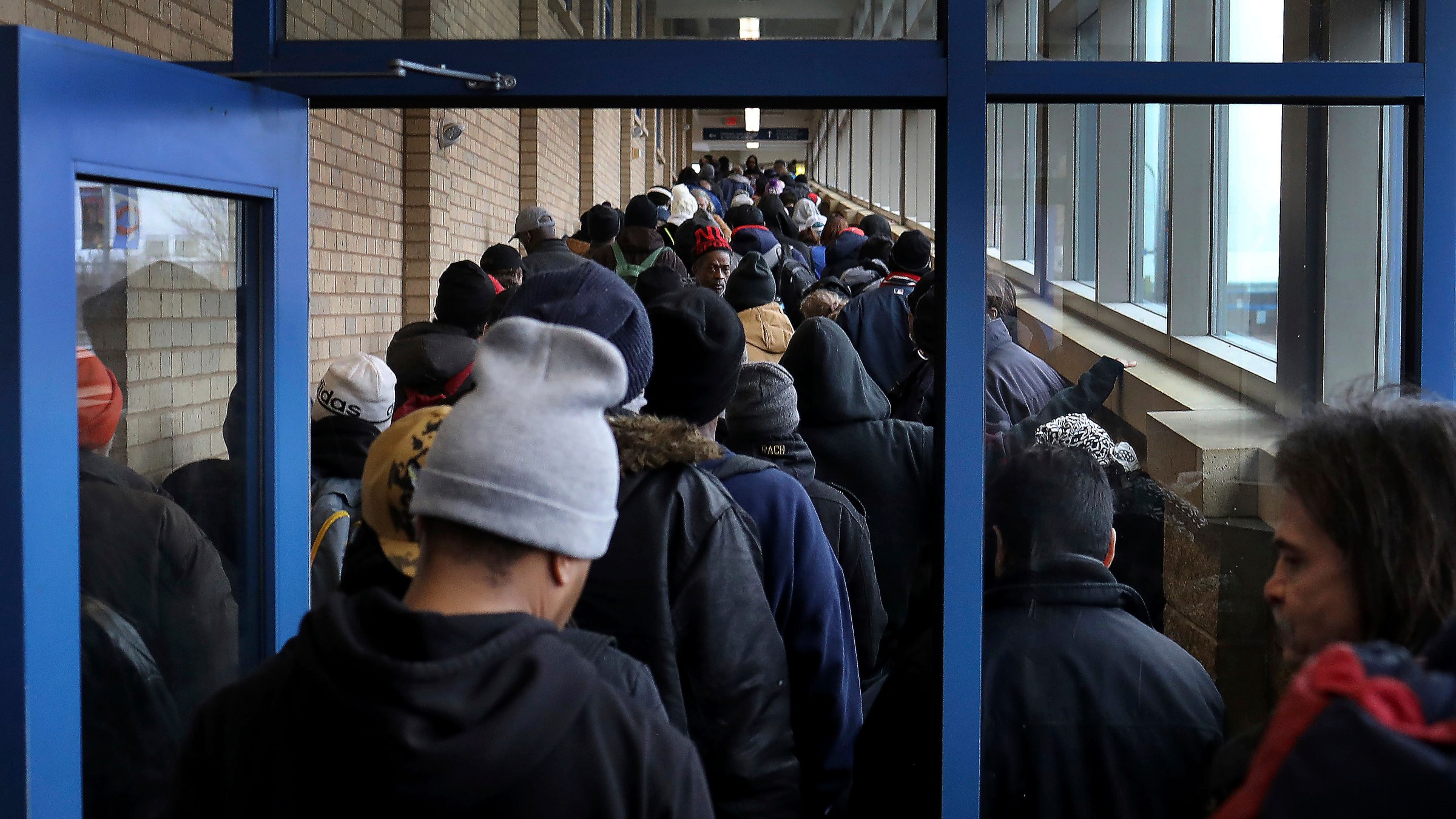
People line up at a food bank

Source: Mother Jones

A recent New York Times report (NYT, May 6, 2020) laments: ‘New research shows a rise in food insecurity without modern precedent’. No, the newspaper of record was not referring to a poor country. It was ruefully acknowledging the sorry state of affairs in the world’s most powerful and affluent nation, namely, the United States.

Food insecurity is defined by the US government (Economic Research Service of the US Department of Agriculture) as a condition in which ‘…households were uncertain of having, or unable to acquire, enough food to meet the needs of all their members because they had insufficient money or other resources for food.’

Food insecurity leads to hunger. In 2018, 11.1% or 14.3 million households were deemed to be food insecure and hence at risk of suffering from hunger.  The incidence of hunger has always been sizeable in the USA – reflecting the persistence of poverty and low and stagnant real wages for a large number of workers, especially in the service sector. There was a noticeable reduction in food insecurity in recent years after this measure experienced a spike during the 2007-2008 global financial crisis.

Now, it appears that the sharp recession caused by COVID-19 has created the spectre of large-scale hunger. There has been a surge in demand for ‘food banks’.

Feeding America, an organization that acts as an anchor for community-based feeding programmes that serve over 40 million Americans, offers some grim projections based on the following scenarios.

  • If unemployment increases by 1.1 percentage points and poverty increases by 1.5 percentage points, 3.3 million more people will experience food insecurity (Scenario A).
  • If unemployment increases by 4.5 percentage points and poverty increases by 2.6 percentage points, 9.9 million more people will experience food insecurity (Scenario B).
  • Finally, if unemployment increases by 7.6 percentage points and poverty increases by 4.8 percentage points, 17.1 million more people will experience food insecurity (Scenario C).

Figure 1 shows the likely impact of COVID-19 on the incidence of hunger in the USA based on the above scenarios and compares it with historical benchmarks. The projected rise in food insecurity is indeed historically unprecedented. Surveys undertaken by Brookings validate the above findings. The Brookings survey results on food insecurity in the USA following the COVID-19 pandemic are shown in Figures 2 and 3.

Figure 1

Figure 2

FIgure 1

Figure 3

Figure 2

Analysts who specialize in the study of food insecurity in USA and organizations such as Feeding America are urging the US government to undertake appropriate policy interventions to mitigate this sharp rise in hunger in the USA. A notable proposal is to increase the real value of food stamps that operate under SNAP (supplemental nutritional assistance programme). Whether this will happen remains to be seen as SNAP seems to have become ensnared in political bickering between the Democrats (who favour an increase in the real value of food stamps) and Republicans (who do not).

The harsh reality is that unless appropriate measures are expeditiously undertaken, the increased incidence of hunger in the USA will take a long time to abate. As the experience of 2007-2008 global financial crisis has shown, the rise in food insecurity took about 10 years to revert to its pre-crisis level (see figures 1 and 3).


COVID-19 and developing countries: grim predictions of a significant increase in global poverty threaten the attainment of the SDGs

Migrant workers stuck in Mumbai because of a lockdown lining up for food this week.
Source: New York Times, April 30, 2020
The fight against COVID-19 has entailed a sharp, but one hopes transitional,  decrease in economic and social activities across the world through a combination of containment and mitigation measures. The result is a predicted steep recession in both developed and developing countries.
There are fears that the scale and scope of this global recession will be the worst since the Great Depression. Such a development was not, of course, anticipated by any of the major international institutions that track developments in the global economy. Thus, the IMF’s World Economic Outlook of January 2020 observes that:

‘Global growth is projected to rise from an estimated 2.9 percent in 2019 to 3.3 percent in 2020 and 3.4 percent for 2021…’ It noted a series of ‘downside risks’ that could drag down global growth, such as ‘…rising geopolitical tensions, notably between the United States and Iran, intensifying social unrest, further worsening of relations between the United States and its trading partners, and deepening economic frictions between other countries.’

Any reference to the possibility of the coronavirus pandemic stemming from a specific country was conspicuously absent in the January 2020 global assessment, although publicly available reports were already alerting readers to a potential public health crisis in China and beyond. The World Economic Outlook of April has completely overturned its January forecasts and now predicts a 3 percent contraction in global output in 2020, although it expects a strong recovery in 2021.
The World Bank’s January 2020 Global Economic Prospects (GEP) was a bit subdued (2.5% global growth in 2020 rising gradually over the forecast horizon), but the assessment of downside risks was oblivious about a public health crisis brewing in China. GEP noted ‘… the possibility of a re-escalation of global trade tensions, sharp downturns in major economies, and financial disruptions in emerging market and developing economies.’
Thus, the major international institutions have been caught by surprise by the emergence of COVID-19 and its dire economic consequences. There is now understandably a rush to assess the extent of the economic damage, primarily in terms of forecasts of a global recession. Given that sustained economic growth is a necessary, but not a sufficient, condition for a sustained reduction in poverty, a severe global recession will invariably have an adverse impact on global poverty. As a recent New York Times report puts it: ‘Millions Had Risen Out of Poverty. Coronavirus Is Pulling Them Back’.
What is the likely magnitude of this reversal in progress in reducing global poverty? A UNU-WIDER paper is one of the few early, but much-needed, attempt to provide some estimates – and they appear rather grim. This is shown in Table 1.
Contraction in per capita  consumption/income (%)
Additional increase (%) in global poverty above the status quo (bottom row) (%)
International poverty line (USD1.90 per day)
Additional increase (%) in global poverty above the status quo (bottom row) (%)
International poverty line (USD 3.20 per day)
Additional increase (%)in global poverty above the status quo (bottom row) (%)
International poverty line (USD 5.50 per day)
5%
1.1
1.8
1.6
10%
2.4
3.7
3.3
20%
5.6
7.7
7.0
Status quo (global poverty incidence, %, latest year)
10.1
25.2
43.5
Depending upon the magnitude of the contraction in per capita consumption/income that is assumed, and depending upon the specific international poverty line used, the estimated increase in global poverty above the status quo ranges from 1.1% to nearly 8%. In absolute terms, they range from approximately 85 million to 581 million. If these numbers are borne out in reality, they represent a major reversal in the global progress in poverty reduction and threaten the attainment of a core goal of the SDGs pertaining to the elimination of extreme poverty and hunger.
These numbers led the leading author of the paper to express
…’ (surprise) at the sheer scale of the potential poverty tsunami that could follow COVID-19 in developing countries. Our findings point towards the importance of a dramatic expansion of social safety nets in developing countries as soon as possible and – more broadly – much greater attention to the impact of COVID in developing countries and what the international community can do to help‘.
The Director of UN-WIDER concurs noting that:

This study shows that the achievement of the 2030 Agenda, and in particular, the SDGs on no poverty and zero hunger, is under considerable threat. The need of the hour is to bring together development agencies, national governments, civil society and the private sector in a global effort to protect the livelihoods and lives of the poorest of the poor in the Global South.’

The economic consequences of COVID-19: For the first time in 60 years, growth is expected to be zero in the Asian region


Figure 1

Figure 2

Grim forecasts of the economic consequences of COVID-19 have now become the norm. In its April World Economic Outlook, the IMF predicts a contraction of world GDP growth that is much larger than the global financial crisis of 2008-2009. Not surprisingly, this has been described as the worst global downturn since the Great Depression. This is the consequence of what the IMF calls the ‘Great Lockdown’, as economic and social activities are sharply curtailed across the world to contain and mitigate the coronavirus pandemic.

The Asian region, which includes some of the most dynamic economies in the world and accounts for more than 60% of the global population, is facing zero growth for the first time in 60 years. The region has endured the oil crisis and stock market crash in the early 1970s, the Asian financial crisis of 1997-98 as well as the global financial crisis of 2008-2009 without suffering a region-wide recession, although a number of countries experienced negative growth. But this time is very likely to be different. Regional growth is predicted to plummet to zero, although other forecasts, such as by the ADB, are less dire. Both the IMF and alternative forecasts concur that there will be a recovery in 2021. Nevertheless, in the short run, the poor and vulnerable in the Asian region are likely to bear the brunt of the sharp growth slow-down, while also bearing the brunt of a public health crisis.

Some of the affluent nations of the world have demonstrated that they are prepared to amass huge fiscal and financial resources, equivalent to more than 60% of US GDP, to ameliorate the rather adverse economic consequences of fighting the coronavirus pandemic. The poorer countries of the Asian region are unlikely to match such firepower. What Japan or even China can do, Cambodia cannot. Such countries will have to rely significantly on external assistance both through bilateral donors and multilateral agencies. Whether such assistance will be forthcoming on a timely and adequate basis remains to be seen.