Americans are pessimistic about the future and foresee a nation in decline as as a Pew Research survey highlighted in 2023 (Figure 1). The American Psychological Association, in its 2024 survey, released only a few ago, reports that 77% of responds suffer from stress because of their bleak assessment of the nation’s future (Figure 2)


Source: https://www.apa.org/news/press/releases/2024/10/top-us-stressors
Are these grim perceptions rooted in reality? Boosters of American capitalism, such as the ‘sponsored’ media, will beg to differ. They will claim that America remains – and will continue to remain – among the most powerful and richest nations in the world. Are the boosters of American capitalism correct or has the average American got it right? Let us briefly examine long-term trends in per capita income, poverty and inequality in USA as a way of offering a data-driven perspective on this contentious topic.
Per capita real disposable income has grown steadily since 1990 (Figure 3), but within this positive and broad trend there are some troubling signs. While per capita real disposable income recovered from the trough of the COVID-19 recession, living standards today (2024) are lower than a few years ago.
One feature of Figure 1 is worth highlighting. The US economy has suffered nine recessions since 1950 (note the shaded areas in the figure representing US recessions.) Every time a recession takes place, average living standards take a hit as job opportunities shrink and unemployment rises.

Source: https://fred.stlouisfed.org/
What about trends in poverty? These are shown in Figure 4. There have been periods of sharp rises in poverty followed by impressive declines. The 2020 COVID-19 recession saw a surge poverty followed by a decline. Yet, the poverty rate in 2022 is still higher than it was in 2000.

Source: https://fred.stlouisfed.org/
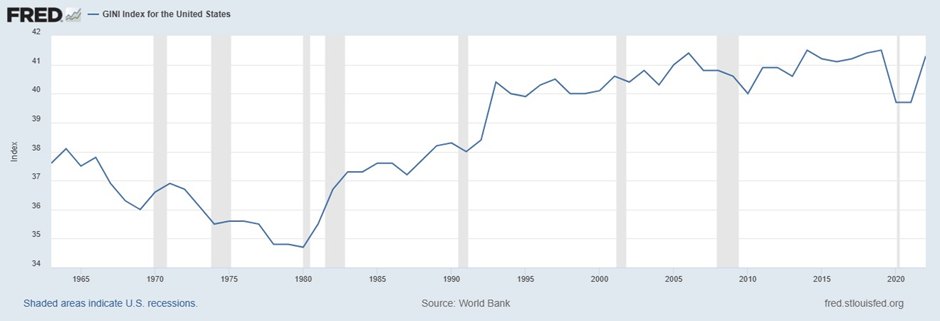
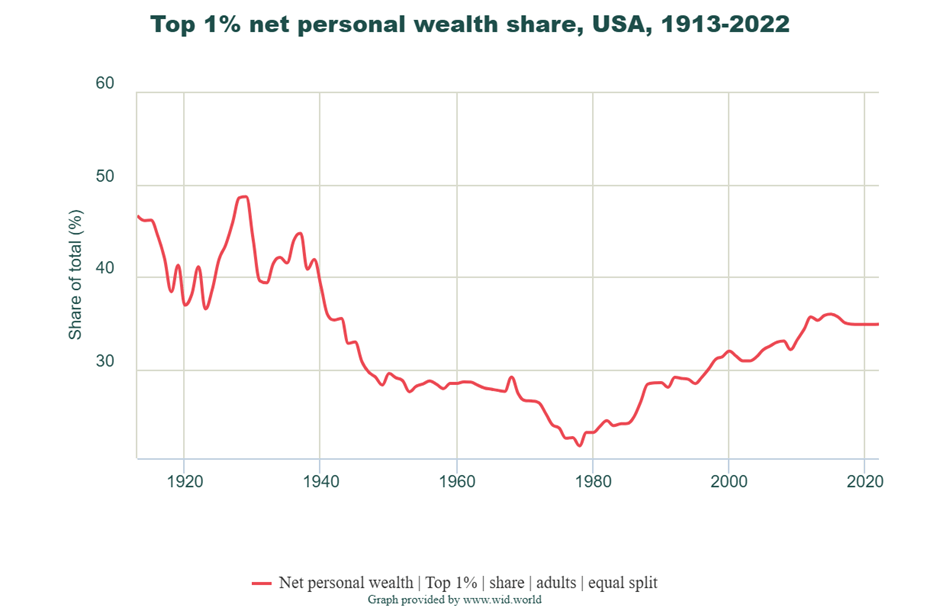
As is well known, the Achilles heel of US society is its high and rising levels of inequality, both in terms of income and wealth. These are shown in Figure 5 and 6. Perhaps these trends help to explain why 80% of Americans feel that the gap between the rich and the poor will widen.
Source: https://fred.stlouisfed.org/
Source: https://wid.world/country/usa/
It seems that the average American knows deep down what ails American society. It appears that it is the Trump vs Harris campaign surrounding the imminent US Presidential election (November 5, 2024) that is disconnected from reality. There has been no meaningful national conversations led by the Presidential candidates on how to respond to the challenges of deep-rooted poverty and inequality in the United States of America.
 Reflections on development and governance