India’s ‘inequality problem’

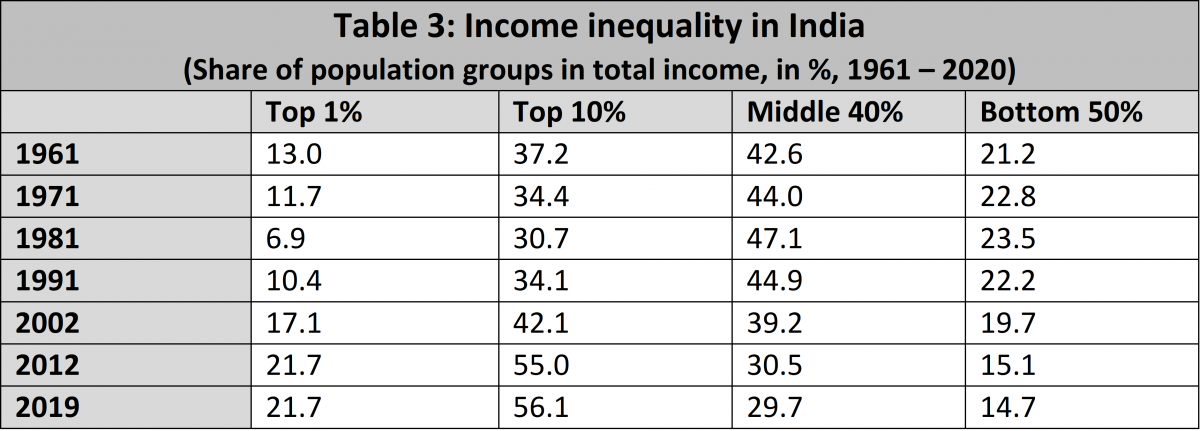
In a recent piece, Maitreesh Ghatak, Professor of economics at London School of Economics, reflects on India’s ‘inequality problem’. The graph above shows trends in Indian inequality (based on the income share of the top 1%) relative to its Asian peers, while the table reported below highlights the inexorable rise in income inequality based on different cohorts in India since the 1980s.
Ghatak, is, of course, not the only one worried about the rise in inequality in India. The widely noted World Inequality Report offers a dismal account of inequality in India. Cited below is its account of India.

Extreme income inequalities in India

…The top 10% and top 1% hold respectively 57% and 22% of total national income, the bottom 50% share has gone down to 13%. India stands out as a poor and very unequal country, with an affluent elite.

Income inequality in the long run: a historical high

Indian income inequality was very high under British colonial rule (1858-1947), with a top 10% income share around 50%. After independence, socialist-inspired five-year plans contributed to reducing this share to 35-40%. Since the mid- 1980s, deregulation and liberalization policies have led to one of the most extreme increases in income and wealth inequality observed in the world. While the top 1% has largely benefited from economic reforms, growth among low and middle-income groups has been relatively slow and poverty persists.

Wealth inequality

The bottom 50% own almost nothing…The middle class is also relatively poor …as compared with the top 10% and 1% who own respectively 65% of the total …and 33%

Gender inequality

Gender inequalities in India are very high. The female labor income share is equal to 18%. This is significantly lower than the average in Asia (21%, excluding China). This value is one of the lowest in the world, slightly higher than the average share in the Middle East (15%).

Oxfam has also released a report (‘Inequality Kills’) and notes that there are now more than140 billionaires in India, up from just over 100 in recent years. This group more than doubled its wealth during the pandemic …while 84% of Indian households experienced a decline in their income. There are now more than 46 million ‘new poor’  that emerged during the pandemic.

Labour market distress amidst rising inequality

These disturbing trends are occurring at a time when India is experiencing acute labour market distress – rising unemployment, declining labour force participation rate, falling real wages. According to media reports, in recent days one has probably witnessed India’s ‘first large-scale unemployment riots’.

Protests against lack of jobs….
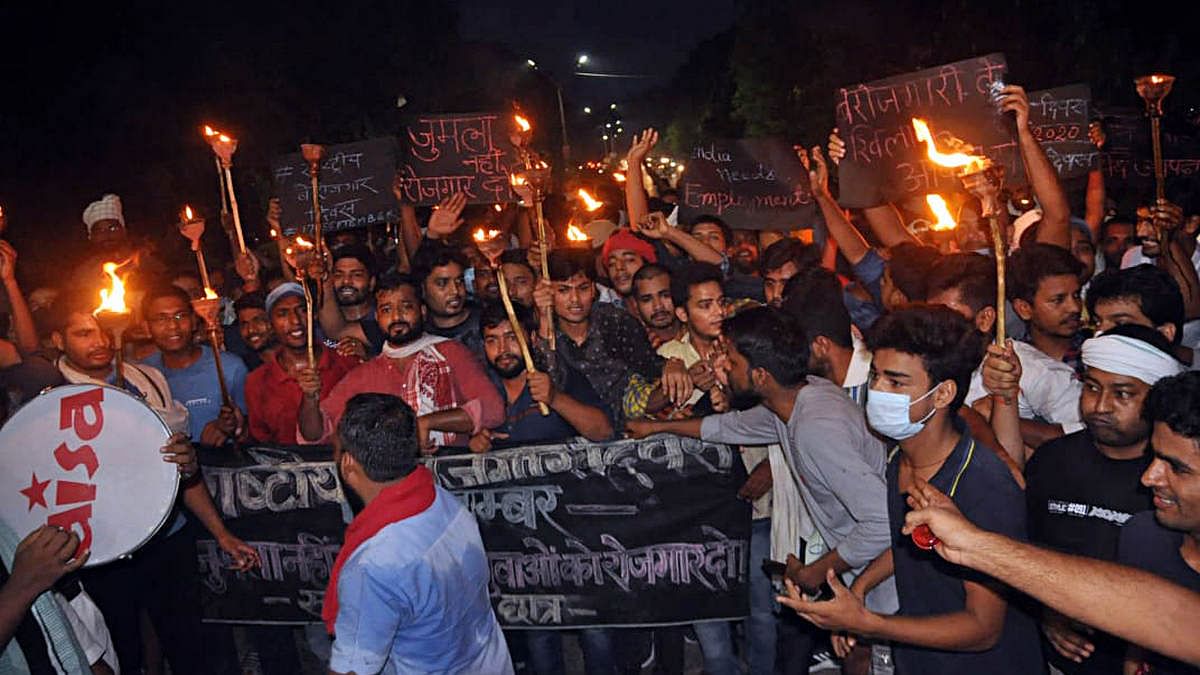
Students protest against unemployment at the Banaras Hindu University in Varanasi Thursday | Photo: ANI

Government response

How is the government reacting to these challenges? The latest budget has indicated very little by way of tackling both rising inequality and emerging labour market distress.The concern is that the government is much more concerned about enacting its majoritarian agenda rather than dealing with deep-seated economic problems. Whether this mindset will change depends upon how the current government fares in the 2024 elections.
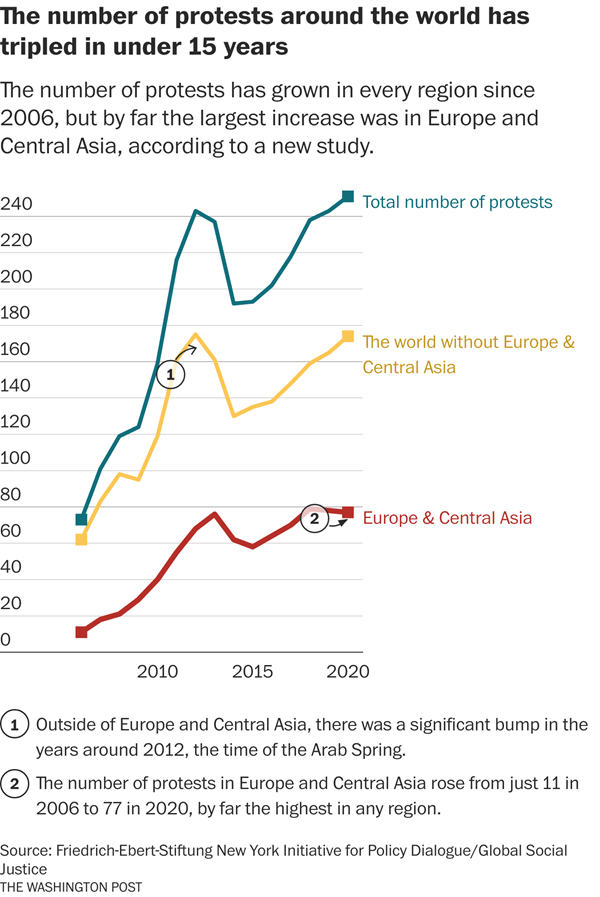
The rise of global protests

Adam Taylor from the Washington Post (4 November 2021) offers a thoughtful review of a new study (“World Protests: A Study of Key Protest Issues in the 21st Century,” from a team of researchers with German think tank Friedrich-Ebert-Stiftung (FES) and the Initiative for Policy Dialogue, Columbia University ) which demonstrates that the scale and scope of global protests have tripled since 2006 – see Figure and map below. More than half the protests worldwide were due to perceived failures of democratic governance and demands for enhanced political representation. Others pertain to corruption, inequality, lack of decent jobs and working conditions, poor living standards, and lack of action on climate change. So far, politicians across the world have not responded satisfactorily to these concerns. This implies that such protests are likely to continue to the detriment of social cohesion.

The World Bank’s Doing Business Report dies an ignoble death: why India and Indonesia should be embarrassed

Source: Jakarta Post

There was a time when the creators of the World Bank’s Ease of Doing Business Index (EDB) encapsulated in its Doing Business report (DBR) exuded a great deal of enthusiasm. They proposed that an inter-country ranking system along multiple dimensions of the domestic business environment held a lot of promise:

The main advantage of showing a single rank: it is easily understood by politicians, journalists, and development experts and therefore created pressure to reform. As in sports, once you start keeping score everyone wants to win (as cited in Doshi et al)

Scholarly investigations marvelled at how influential the DBR was. Thus, Doshi et al conclude:

The World Bank, … marshaled the Ease of Doing Business (EDB) index to amass surprising influence over global regulatory policies …The  EDB ranking system affects policy through bureaucratic, transnational, and domestic-political channels. We use observational and experimental data to show that states respond to being publicly ranked and make reforms strategically to improve their ranking. A survey experiment of professional investors demonstrates that the EDB ranking shapes investor perceptions of investment opportunities.

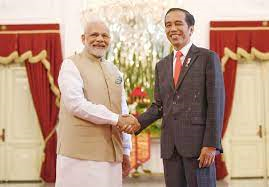
Indeed, large emerging economies, such as India and Indonesia, represent, in retrospect, embarrassing examples of how the highest political leadership became so enamoured of the EDB that they made it a cornerstone of their policy. In February 2020, one report points out that

President Joko “Jokowi” Widodo has ordered his Cabinet to improve the country’s Ease of Doing Business … ranking and to make it into Top 40.

In India, even as recently as May, 2021, India’s Prime Minister Modi’s office proudly proclaimed

India has successively scaled greater heights in the World Bank’s Ease of Doing Business ranking jumping from 142 in the year 2014 to 63 in the year 2019. As per the latest report, we are one of the top 10 improvers in the world. Under the leadership of PM Modi, the journey of India is moving closer to the global best practices.

Jokowi, Modi and their minders were apparently blissfully unaware that the World Bank itself was preparing to abandon its flagship publication. By mid-September, 2021, the fatal blow to the much-cherished DBR was delivered. In the pithy words of the World Bank:

Afterdata irregularities on Doing Business 2018 and 2020 were reportedinternally in June 2020, World Bank managementpausedthe next Doing Business report andinitiateda series ofreviewsandauditsof the report and its methodology. In addition, because the internal reports raised ethical matters, including the conduct of former Board officials as well as current and/or former Bank staff, management reported the allegations to the Bank’s appropriate internal accountability mechanisms.

After reviewing all the information available to date on Doing Business, including the findings ofpast reviews, audits, and the report the Bank released today on behalf of the Board of Executive Directors, World Bank Groupmanagementhas taken the decision todiscontinue theDoing Business report. The World Bank Group remains firmly committed to advancing the role of the private sector in development and providing support to governments to design the regulatory environment that supports this. Going forward, we will be working on a new approach to assessing the business and investment climate. We are deeply grateful to the efforts of the many staff members who have worked diligently to advance the business climate agenda, and we look forward to harnessing their energies and abilities in new ways.”

This scandal-ridden report almost claimed the position of IMF Chief (Kristalina Georgieva) because of allegations that, during her tenure as World Bank Chief, internal staff were put under pressure to improve the rankings of China. She narrowly escaped being fired by the IMF Board. In another case of inappropriate pressure being applied to the EDB exercise, Saudi Arabia was implicated.

What went wrong? What are the lessons that one can learn from this debacle? Professor Sonaldi Desai offers a thoughtful critique. She notes:

The (EDB) experience has highlighted both the power of data and the political influence such rankings can yield. Should we try to reform the index or give up on it? The decision rests on the answer to two questions. First, are there universally acceptable standards of sound economic practices that are applicable and measurable across diverse economies? Second, if the indices are so powerful, should their construction be left to institutions like the World Bank that bring not just knowledge but also wield the heft of global economic power? For the moment, the answer to both seems to be a no.

Vaccine inequality, SDGs and the new allocation of Special Drawing Rights (SDRs) by the IMF: promises and pitfalls

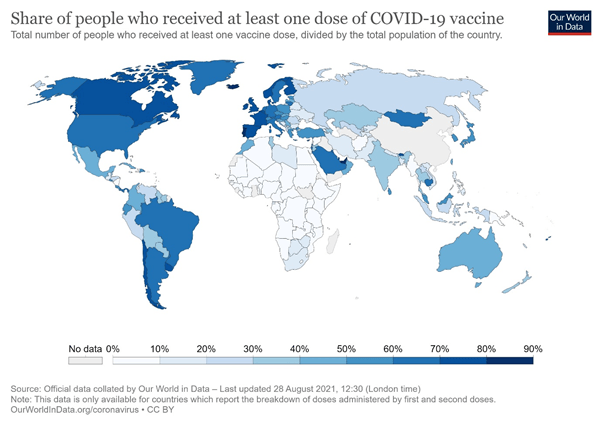
Map of vaccine inequality

It widely known that the challenge of vaccine inequality (see Map above) impedes the ability of emerging and developing economies (EDEs) to cope with the pandemic and thus resume normal economic activity. As of today (September 15, 2021), 60.8% of the population in high income countries had at least one dose of available vaccines, while only a little over 3% of the population in low-income countries had one dose. It would take a massive – and unaffordable  – increase of 57% of health-care spending for low-income countries to inoculate 70% of the population against COVID-19. In contrast, advanced economies will only need to increase 0.8% of health-care spending to reach the same target.[1]

Given this grim challenge, the IMF  – in conjunction with other international agencies – has recently (June, 2021) proposed the provision of a USD 50 billion plan to vaccinate at least 60% of the world’s population and complement the global vaccination program with relevant COVID-safe health measures. No concrete actions have been taken so far.

The announcement by the IMF of the largest allocation of special drawing rights (SDRs) amounting to USD 650 billion in August, 2021 might be one way to support the USD 50 billion-dollar plan. Yet, critics are concerned that the new SDRs might raise a lot of expectations without fulfilling them. This is because SDRs – in line with line with long-standing practice – will be distributed to countries in line with a country’s quota share with the IMF. Given that EDEs are ‘minority’ shareholders, it is not surprising that EDEs as a whole are expected to get 42% of SDRs, while low-income countries are likely to get 3.2% of the new SDRs.[2] In some cases, even this modest amount might be a lot as a share of the GDP of low-income countries, but this might still fall short of their spending needs. On the other hand, advanced economies that do not really seem to have financial constraints in dealing with the pandemic, will have significant shares of SDRs which they might not be prepared to recycle to the poorer parts of the world. Hence, a proposal has been made that a COVID-19 trust be set up to recycle the SDRs as well as transfer them to the regional development banks (Eichengreen, 2021). Whether this will happen remains to be seen.

There is the long-term development challenge of attaining and financing the SDGs. Even in the pre-COVID-era, there was a USD 2.5 trillion financing gap which, as a result of COVID-19, has increased to USD 4.2 trillion (OECD, 2021). This has occurred against a background of modest trends in national tax revenues of EDEs as well as aggregate trends in external finance – see Figure 1 below. Hence, as the international community approaches 2030, the key fiscal policy will revolve around finding sustainable means of resource mobilization to reduce the SDG financing gap.

Figure 1


[1] These statistics are available at https://data.undp.org/vaccine-equity/

[2] These figures are based on data provided by the IMF  (https://blogs.imf.org/2021/08/26/a-shot-in-the-arm-how-special-drawing-rights-can-help-struggling-countries.)

India’s GDP: don’t be fooled by the numbers

The Indian economy apparently grew by an astonishing 20 percent in the most recent quarter for which data is available (Q1, 2021-22). In a tweet, the Ministry of Finance proclaimed:

Q1:2021-22 data reaffirms Government’s prediction of an imminent V-shaped recovery made last year at this time. Increase of 20.1% in GDP – despite the intense second wave (of COVID-19) in the months of April-May – highlights the continued economic recovery.

[Extract of a tweet the  from Ministry of Finance, ]

This was accompanied by the following figure.

Figure 1


Really? Despite the savage impact of the second COVID-19 wave that killed hundreds of thousands within the space of a short period and decimated small business? This should provoke one to invoke  the old adage ‘lies, damn lies, and statistics’. It is always possible to use numbers to bolster a weak argument.

Consider the following admittedly contrived example. Take three periods (each representing a quarter). Set period 1 as 100. Now assume there is a massive economic contraction so that the level of GDP in the second period is 75. Assume that a ‘V-shaped’ recovery takes place so that the GDP level in period 3 is 90. One could argue that this is not yet a ‘real’ recovery because the level of GDP in period 3 is still below period 1.

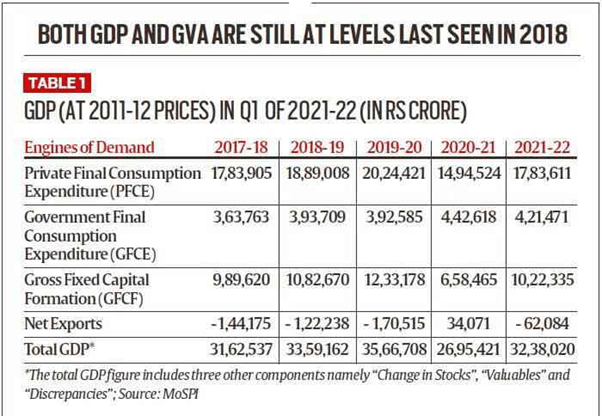
This contrived example offers a good representation of what happened to the Indian economy. Today, (2021-22) Indian GDP is lower than it was in 2018-19 – see Table 1 below.  Hence, celebrating a 20 percent quarterly growth rate conceals more than it reveals.

Mahesh Vyas, who heads the highly cited Centre for Monitoring the Indian Economy (CMIE), aptly observes:

India can … choose to celebrate the rapid recovery from the excruciating pain of lockdowns or bemoan the steady erosion of well-being and growth potential…it is now becoming increasingly clear that the recovery … will not get India’s real GDP to where it was before the shock even by the end of March 2022. 

Table 1

Source: scroll.in which in turn is extracted from other media reports (Hindustan Times, Indian Express)